The Scout's Prologue: ©
Organizational Legacy Of The
1st Cavalry Division
and its
Subordinate Commands

 Origin Of The 1st Cavalry Division
 After an all night of reconnaissance on the search engines, you have finally
arrived at the Outpost of the 1st Cavalry Division. You must be tired, take a
break, draw up a stool and join in the Cavalry Scout's Breakfast Report for an
update on the historical background, heritage and lineage of the 1st Cavalry
Division and Subordinate Commands; the 1st, 2nd, 3rd, 4th and Aviation Combat
Brigades, 1st Cavalry Division Special Troops Battalions and Companies along
with the 5th, 7th, 8th, 9th, 12th and 227th Aviation Regiments and the
subordinate maneuvering elements of the Direct Support Units and 82nd Field
Artillery.
After an all night of reconnaissance on the search engines, you have finally
arrived at the Outpost of the 1st Cavalry Division. You must be tired, take a
break, draw up a stool and join in the Cavalry Scout's Breakfast Report for an
update on the historical background, heritage and lineage of the 1st Cavalry
Division and Subordinate Commands; the 1st, 2nd, 3rd, 4th and Aviation Combat
Brigades, 1st Cavalry Division Special Troops Battalions and Companies along
with the 5th, 7th, 8th, 9th, 12th and 227th Aviation Regiments and the
subordinate maneuvering elements of the Direct Support Units and 82nd Field
Artillery.
|
|
|---|
| The History Of The Cavalry |
|---|
|
|
|---|
However, before you read their report that references the early history of the
active, attached and legacy units of the 1st cavalry Division, it may be
worthwhile to review the a 26 minute video clip, "History of the Cavalry",
that was researched, and produced by the Pictorial Center, Signal Corps, US
Army. It covers the first use of the Cavalry as an aggressive, offensive
ground force in the Revolutionary War and its continuing evolutionary changes
in the offensive methodology that capitalized on the available technology,
making today's "Cavalry" the most effective armed force in securing and
protecting our freedoms.
The continuing WebSite materials, the Cavalry Scout Report, starts with the
early days of the horse soldier and their initial mission to protect the
western movement of people and commerce along the Northwest Oregon and
Southwest Santa Fe Trails. These trails and railroad lines, which soon
followed, a result of the perceived Manifest Destiny, extended the
domination of the United States into the far reaches of a largely unsettled
territory which was slowly developing.
The Army, having large areas of land masses and a growing number of people to
protect, established a number of military posts at strategic locations
throughout the Northwest, West and Southwest. These "outposts" were staffed
with a fast, mobile and high spirited strike force of cavalry troops to
provide protection along these arteries of emigration and commerce. These
early missions, and the later reorganization and consolidation of many the
early Cavalry Regimental Elements into the 1st Cavalry Division and its
specialized support functions, along with new tactical equipment training and
developments enabled the Division to evolve into the modern, highly trained,
mission ready, assault and support force of today.
Throughout the history of the 1st Cavalry Division, it has had the ability to
transition through the seamless integration of the methods of war fighting and
improvements in armament technology. This attribute is founded upon the
evolution of Division Commanders and subordinate units with experienced
Commissioned and Noncommissioned personnel who continuously upgrade their
management of warring skills.
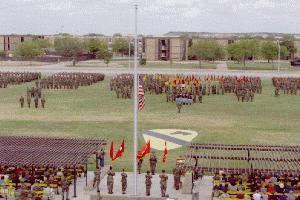 |
|---|
| Change Of Command Ceremony |
|---|
|
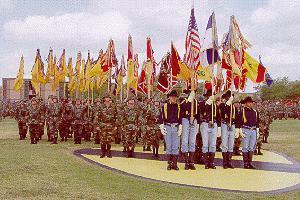 |
|---|
| Presentation Of Division Colors |
|---|
|
|---|
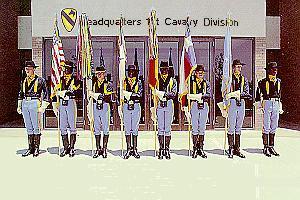
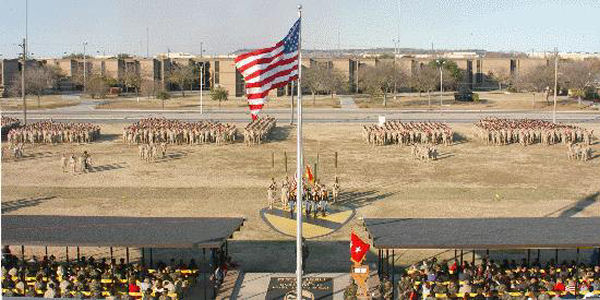
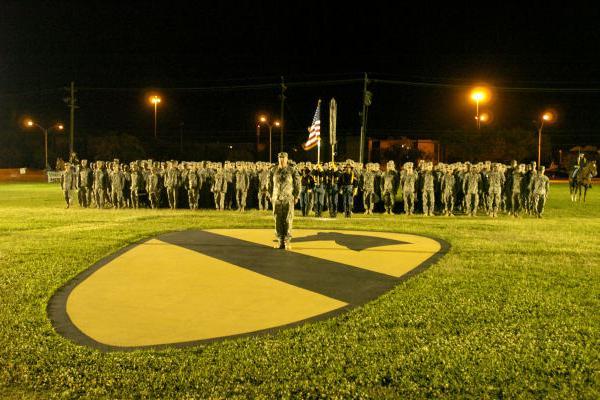
Upper Left: The Commissioned, Noncommissioned Officers and Soldiers of the 1st
Cavalry Division participates in a colorful Change of Command Ceremony at
Cooper Field, Ft. Hood, TX, The flag was flown at "half staff" in memory of
all the victims of the 911 attack.
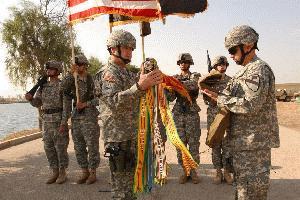
Upper Right: The Color Guard presents the Colors of the Subordinate Units and
the Division to the Outgoing and Incoming Commanders of the 1st Cavalry
Division.
In combat, individual exploits and personal valor are important, but team
effort wins the battles. The Department of the Army pays close attention to
team performance as well to the organizations in which its soldiers serve and
fight, and to the flags and colors that symbolize those organizations. In the
same way that patriots fight for their country's flag, soldiers fight for
their unit colors. It is one of the missions of the US Army Center of Military
History to retain those organizations with the greatest heritage on the rolls
of the Army.
The older an organization, the more soldiers, both active and retired, have
had the opportunity of serving in and identifying with it along with the more
opportunities the organization has had to win battle honors. As the Army
continues to be downsized, it is essential that the oldest and most honored
organizations remain. As Base Realignment and Closings Laws are enacted and
units are inactivated, flags and colors move around to ensure their retention.
The term "reflagging" was coined in the 1980s to describe this phenomenon
formerly called a "transfer less personnel and equipment." While such
actions have occurred occasionally throughout the Army's history, they
increased after World War II as the Army placed more emphasis on retaining
units with the most history and honors.
The Army currently uses the following factors to determine the historical
priority of Divisions and Brigades and the point value assigned to each:
- Age - one point for each year since initial organization. (No points are
subtracted for periods of inactive status.)
- Campaign Participation Credit - two points for each campaign.
- US Unit Decorations - two points for each award.
As you will read in detail, in later chapters of its history, the 1st Cavalry
Division has retained its long heritage throughout its organizational life by
the following transformations:
- 1957, October 15 - The 24th Infantry Division was reflagged as the 1st
Cavalry Division in Tonggu, South Korea.
- 1965, July 01 - The 11th Air Assault Division was reflagged as the 1st
Cavalry Division, the Army's first Airmobile Division, at Fort Benning,
Georgia.
- 1971. May 05 - The 1st Armored Division was reflagged as the 1st Cavalry
Division at Fort Hood, Texas.
- Since 1971, several unit redesignations, reassignments and equipment
upgrading have been made to improve the "war fighting" capability of the
Division. Although not "reflagged", the most recent Line Organization of
the 1st Cavalry Division, as structured under the "reconstitutational"
changes instituted in the period of 15 February to 07 March, 2008 in
preparation for deployment to Operation IRAQI FREEDOM - VI are shown
below:
| 1st Cavalry Division - Table Of Organization |
|---|
|
|
|---|
|
|---|
|


|
Division Command
Sergeant Major |
|---|
|
|---|
| Personal Staff |
|
|
|---|
|
|
|
|---|
|
|
|
|---|
|
|
|
|---|
|
|
|
|---|
|
|
|---|
|
|---|
| Coordinating Staff |
 |
 |
 |
Special Staff |
|---|
|
 |
|
 |
|
|---|
|
|
|
|
|
|---|
|
|
|
|
|
|---|
|
 |
|
|
|
|---|
| |
 |
|
|---|
| MAJOR SUBORDINATE COMMANDS |
|---|
|
|---|
 |
|---|
"HQ", 1st Bde Combat Tm
2nd Bn, 5th Cavalry Reg't
"HHC", 2nd Bn, 5th
Scout Pltn
Mortar Pltn
"A" & "B" Cos (Mech)
"C" & "D" Cos (Armor)
"F" Co, 115th Bde Spt Bn
1st Sqdn, 7th Cavalry Reg't
"HHT", 1st Sqdn, 7th
Mortar Pltn
"A", "B" & "C" Trps
"D" Co, 115th Bde Spt Bn
2nd Bn, 8th Cavalry Reg't
"HHC", 2nd Bn, 8th
Scout Pltn
Mortar Pltn
"A" & "B" Cos (Mech)
"C" & "D" Cos (Armor)
"E" Co, 115th Bde Spt Bn
1st Bn, 82nd Fld Arty
"HHB", 1st Bn, 82nd FA
"A", "B" & "D" Btry
"G" Co, 115th Bde Spt Bn
115th Bde Spt Bn (BSB)
"HHC, 115th Bde Spt Bn
"A", "B" & "C" Cos
1st Bde Spl Trps Bn (BSTB)
"HHC", 1st Bde Spl Trps
MP Platoon
Support Platoon
CBRN Recon Platoon
"A" Co, Military Intel
UAV Platoon
"B" Co, Signal
"C" Co, Engineer |
"HQ", 2nd Bde Combat Tm
1st Bn, 5th Cavalry Reg't
"HHC", 1st Bn, 5th
Scout Pltn
Mortar Pltn
"A" & "B" Cos (Mech)
"C" & "D" Cos (Armor)
"F" Co, 15th Bde Spt Bn
1st Bn, 8th Cavalry Reg't
"HHC", 1st Bn, 8th
Scout Pltn
Mortar Pltn
"A", & "B" Cos (Mech)
"C" & "D" Cos (Armor)
"E" Co, 15th Bde Spt Bn
4th Sqdn, 9th Cavalry Reg't
"HHT", 4th Sqdn, 9th
Mortar Pltn
"A", "B" & "C" Trps
"D" Co, 15th Bde Spt Bn
3rd Bn, 82nd Fld Arty
"HHB", 3rd Bn, 82nd FA
"A" & "B" Btry
"G" Co, 15th Bde Spt Bn
15th Bde Spt Bn (BSB)
"HHC, 15th Bde Spt Bn
"A", "B" & "C" Cos
2nd Bde Spl Trps Bn (BSTB)
"HHC", 2nd Bde Spl Trps
MP Platoon
Support Platoon
CBRN Recon Platoon
"A" Co, Military Intel
UAV Platoon
"B" Co, Signal
"C" Co, Engineer |
 |
"HQ", 3rd Bde Combat Tm
3rd Bn, 8th Cavalry Reg't
"HHC", 3rd Bn, 8th
Scout Pltn
Mortar Pltn
"A", & "B" Cos (Mech)
"C" & "D" Cos (Armor)
"F" Co, 215th Bde Spt Bn
6th Sqdn, 9th Cavalry Reg't
"HHT", 6th Sqdn, 9th
Mortar Pltn
"A". "B" & "C" Trps
"D" Co, 215th Bde Spt Bn
1st Bn, 12th Cavalry Reg't
"HHC", 1st Bn, 12th
Scout Pltn
Mortar Pltn
"A" & "B" Cos (Mech)
"C" & "D" Cos (Armor)
"E" Co, 215th Bde Spt Bn
2nd Bn, 82nd Fld Arty
"HHB", 2nd Bn, 82nd FA
"A" & "B" Btry
"G" Co, 215th Bde Spt Bn
215th Bde Spt Bn (BSB)
"HHC, 215th Bde Spt Bn
"A", "B" & "C" Cos
3rd Bde Spl Trps Bn (BSTB)
"HHC", 3rd Bde Spl Trps
MP Platoon
Support Platoon
CBRN Recon Platoon
"A" Co, Military Intel
UAV Platoon
"B" Co, Signal
"C" Co, Engineer |
"HQ", 4th Bde Combat Tm
2nd Bn, 7th Cavalry Reg't
"HHC", 2nd Bn, 7th
Scout Pltn
Mortar Pltn
"A" & "B" Cos (Mech)
"C" & "D" Cos (Armor)
"F" Co, 27th Bde Spt Bn
1st Sqdn, 9th Cavalry Reg't
"HHT", 1st Sqdn, 9th
Mortar Pltn
"A", "B" & "C" Trps
"D" Co, 27th Bde Spt Bn
2nd Bn, 12th Cavalry Reg't
"HHC", 2nd Bn, 12th
Scout Pltn
Mortar Pltn
"A" & "B" Cos (Mech)
"C" & "D" Cos (Armor)
"E" Co, 27th Bde Spt Bn
5th Bn, 82nd Fld Arty
"HHB", 5th Bn, 82nd FA
"A" & "B" Btry
"G" Co, 27th Bde Spt Bn
27th Bde Spt Bn (BSB)
"HHC, 27th Bde Spt Bn
"A", "B" & "C" Cos
4th Bde Spl Trps Bn (BSTB)
"HHC", 4th Bde Spl Trps
MP Platoon
Support Platoon
CBRN Recon Platoon
"A" Co, Military Intel
UAV Platoon
"B" Co, Signal
"C" Co, Engineer |
|---|
| |
|---|
"HHC", Air Cav Combat Tm
1st Bn, 227th Avn (ATK)
"HHC", 1st Bn, 227th Avn
"A", "B", "C" & "D" Cos
"E" Flt Spt Company
2nd Bn, 227th Avn (GS)
"HHC", 2nd Bn, 227th Avn
"A", "B", "C" & "D" Cos
"E" Flt Spt Company
"F" Company (ATGC)
3rd Bn, 227th Avn (ASLT)
"HHC", 3rd Bn, 227th Avn
"A", "B", "C" & "D" Cos
"E" Flt Spt Company
"F" Company (Blues Pltns)
4th Bn, 227th Avn (ATK)
"HHC", 4th Bn, 227th Avn
"A", "B", "C" & "D" Cos
"E" Flt Spt Company
615th Avn Spt Bn (ASB)
"HHC", 615th Spt Bn
"A", "B" & "C" Cos
"D", & "E" (TUAV) Cos
"F" Co, 1st Bn, 58th AR |
1st Cav Div HQ & HQ Bn
"HSC", 1st CD HQ & Srvs Co
Division Cmd Grp (DCG)
Battalion Cmd Grp (BCG)
Inspector General (IG)
Staff Judge Advocate (SJA)
Chaplin
Division Engineers
Fire Support Element
Public Affairs (PA)
Safety
"A" Company - Operations
Operation & Plans (G-3)
Civil Affairs (G-5)
Information, O & P (G-7)
Civil Affairs (G-9)
Chemical (CBRNE)
Provost Marshal (PMO)
"B" Company - I & S
Personnel (G-1)
Intelligence (G-2)
Logistics & Supply (G-4)
Comptroller (G-8)
Diviasion Surgeon
"C" Company - Signal (SIG)
Communications (G-6)
1st Cav Div Band
1st Cav Div Horse Cav Det
9th Air Spt Ops Sqdn
|
|
"HHB",41st Fires Brigade
2nd Bn, 20th Fld Arty
"HHB", 2nd Bn, 20th FA
"A", "B" & "C" Batteries
67th Forward Supt Co
1st Bn, 21th Fld Arty
"HHB", 1st Bn, 21th FA
"A", "B" & "C" Batteries
575th Forward Supt Co
"A" Btry, 26th Fld Arty
324th Network Supt Co
589th Brigade Suport Bn
"HHC", 589th Bde Spt Bn
"A" & "B" Company
|
1st CD Museum |
|---|
|
|---|
| Date Of Revision - 16 November, 2012 |
|---|
In addition to the reviewing the histories of the subordinate units currently
attached 0r attached to the 1st Cavalry Division, you may wish to review the
rich histories of the Legacy Units; that formally served, contributed
significantly to the combat effectiveness, played key roles in the battlefield
accomplishments and evolutionary organizational restructuring of the 1st
Cavalry Division.
| 1st Cavalry Division - Linage Legacy Units |
|---|
|
|---|
"HQ&HQ" Btry. Arty Cmd
1st Bn, 21st Fld Arty
68th Chemical Company |
"HQ&HQ" Detachment
8th Engineer Bn
20th Engineer Bn
91st Engineer Bn |
|
"HQ&HQ" Company
515th Bde Spt Bn (FWD) |
Organizational History
4th Bn, 5th Air Defense
13th Signal Bn
312th M.I. Bn
545th M.P. Company |
|---|
|
|---|
15th Finance Bn
15th Personnel Servs Bn |
1st Cavalry Regiment |
|
4th Cavalry Regiment
1st Sqdn, 4th Cavalry Reg't
3rd Sqdn, 4th Cavalry Reg't
4th Sqdn, 4th Cavalry Reg't
5th Sqdn, 4th Cavalry Reg't
6th Sqdn, 4th Cavalry Reg't
|
"D" Trp, 9th Cavalry Reg't
"F" Trp, 9th Cavalry Reg't |
|---|
|
|---|
"HHT", 10th Cavalry Reg't
"C" Trp, 10th Cavalry Reg't |
"HQ&HQ" Company
2nd Bn, 7th Cavalry
1st Bn, 153rd Infantry
2nd Bn, 153rd Infantry
3rd Bn, 153rd Infantry
2nd Bn, 162nd Infantry
1st Bn, 206th FA
39th Support Bn (FWD)
"A" Co, 28th Signal Bn
"C" Co, 1/102nd Infantry
"A" Btry, 103rd FA
"B" Co, 1/108th Infantry
"E" Trp, 151st Cavalry
"F" Btry, 1/202nd ADA
"HHSC", 223rd MI Bn
239th Engineer Co
239th MI Company
629th MI Battalion
642nd Maintenance Co
1115th Transport Co
|
|
1st Cav Div Spl Trps Bn
"HSC", 1st CD (BSTB)
"A" Co, 1st CD BSTB
"B" Co, 1st CD BSTB
"D" Co, 1st CD BSTD |
"HHC", 15th Sustainment Bde
15th Bde Special Trp Bn (BSTB)
"HHC", 15th Special Trps Bn
"A" Co, Maint & Med
"B" Co, 15th Special Trps Bn
Spt Opns (SPO)
15th Personnel Servs Bn |
|---|
|
|
|---|
|
|---|
| Date Of Revision - 17 November, 2012 |
|---|
Beginning with its organization and activation in 1921 to the present day,
units of the 1st Cavalry Division have had major roles from defending our
country, achieving victory in war to providing humanitarian support anywhere
in the world. The
Order of Battle data identifies and summarizes the command and subordinate
units that have been either attached or attached to the 1st Cavalry Division
since its inception in 1921 at Ft. Hood, TX to its deployment to Iraq in
support of Operation IRAQI FREEDOM - VI. In order to present a pictorial time
line representation of continuity of commands of the individual units, along
with their designations (and redesignations), the data has been displayed in
an indentured, structured format similar to the present day Line
Organization Charts.
MISSION
 "As one of the Army's two on-call heavy contingency
force divisions, the First Team has an on-order mission to
deploy to a designated contingency area of operations by sea,
air or land, conduct reception, staging, onward movement
and integration; and on order, conduct combat operations
and redeployment."
"As one of the Army's two on-call heavy contingency
force divisions, the First Team has an on-order mission to
deploy to a designated contingency area of operations by sea,
air or land, conduct reception, staging, onward movement
and integration; and on order, conduct combat operations
and redeployment."

 | |
|---|
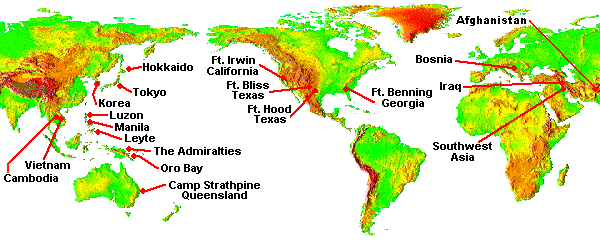
| Key Strategic And Tactical Assembly Areas (TAA) Of The 1st Cavalry Division |
|---|
|
Introduction
The 1st Cavalry Division, a major subordinate command of the US Third Mobile
Armored Corps, is a 19,000 soldier, heavy armored division stationed at Ft.
Hood, TX. As one of the two "on-call" heavy contingency force divisions of the
Army, the First Team has an on-order mission to deploy by sea, air or land to
any part of the world on a short notice. The following narratives, divided in
timeline sequences of major operational missions, describes the environment,
tactical conditions, evolution of equipment technology and the strategic
methodology employed by the 1st Cavalry Division to enable a successful
mission and enhance a warring organization.
The early history of Fort Bliss, TX, the Army Base where the 1st Cavalry
Division was activated, was closely tied to the movement of people and trade
along the Oregon and Santa Fe Trails. These routes, a result of perceived
"manifest destiny", extended the domain of the United States into the far
reaches of a largely unsettled territory. As more and more wagon trains loaded
with settlers rolled west, they were attacked by Indians. The Army, having
large areas of territory to protect, established a number of military posts
at strategic locations throughout the West. These outposts were staffed with
a fast, mobile and high spirited strike force of cavalry troops to provide
protection along these arteries of emigration and commerce.
In order to provide a series of "snapshots" of the heritage of the 1st Cavalry
Division that has evolved, some of it naturally and some of it by deliberate
planning, its history is described by a series of "tableaux" which are
presented for each of the significant events or challenges confronted by the
Division.
 |
|---|
| Daily Saber Exercises |
|---|
| |
|---|
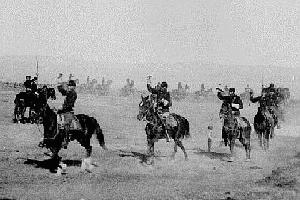
On 22 January 1921, the 1st Cavalry Division was constituted in the US Regular
Army. Subsequently, on 20 August 1921 the 1st Cavalry Regiment, was
preassigned to the 1st Cavalry Division nearly a month before the formal
activation of the Division. On 13 September 1921, with the initiation of the
National Defense Act, the 1st Cavalry Division was formally activated at Ft.
Bliss, TX and Major General Robert Lee Howze, a Texas native from Rusk County
and seasoned veteran of the Frontier Indian Wars, Spanish American War,
Philippines Insurrection, Mexican Expedition, World War I and recipient of the
Medal of Honor, was selected as its first Division Commander.
Upon formal activation, the 7th, 8th and 10th Cavalry Regiments were assigned
to the new Division. With almost a century of service behind the oldest of its
regiments and sixty five years of service for its youngest, the units that had
already ridden and fought its way into the pages of history were organized
into the newly formed divisional structure. The four regiments were now to
fight side by side. Other units initially assigned to the 1st Cavalry Division
in 1921 included the 1st and 2nd Machine Gun Squadrons, Weapons Troops, 10th
Light Tank Company, 13th Signal Troop, 15th Veterinary Company, 27th Ordnance
Company, 43rd Ambulance Company, 82nd Field Artillery Battalion (Horse) and
the 1st Cavalry Quartermaster Trains which later was redesignated as the 15th
Replacement Company.
Later, the 5th Cavalry Regiment was assigned on 18 December 1922, relieving
the 10th Cavalry Regiment. On 03 January 1933, the 1st Cavalry Regiment was
relieved from the Division and transferred to Ft. Knox, KY where it was
reorganized and redesignated as a mechanized unit. Concurrent with the relief
of the 1st Cavalry Regiment, the 12th Cavalry Regiment was assigned
the 1st Cavalry Division. It would not be until 01 November 1957, when
elements of the 4th Cavalry Regiment, 4th Battle Group and the first element
of the 9th Cavalry Regiment, the 1st Squadron, would be assigned to the 1st
Cavalry Division in Korea.
The following operational periods summaries the new threats and constant
challenges presented to the Division that provided the opportunity to hone
their experience levels and modernize equipment to what it is today.
 |
|---|
| Flying Column Close On Manila |
|---|
| |
|---|
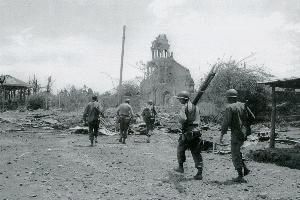
In February 1943, the entire 1st Cavalry Division was alerted for an overseas
assignment. They closed on their port of embarkment, Camp Stoneman. CA and
departed during the period of 23 May to 21 June. Following six months of
intensive training in northern Australia, adjusting to jungle environments,
the Division got its first taste of combat in 1944 when they sailed for the
Admiralty Islands and stormed ashore in an amphibious landing at Los Negros
Island. After a fierce campaign on Los Negros and clearing the chain of
surrounding islands, the Division could look with pride on its first combat
test of World War II.
In the next action undertaken was Operation KING II on the Philippine Island
of Leyte, On October 20, the invasion force must have appeared awesome to the
waiting Japanese as it swept toward the eastern shores of Leyte near Tacloban.
After the breakout of Tacloban, the Division fought tirelessly against the
Japanese fortifications. With the last of the strong-holds eliminated, the
Division moved on to Luzon, the main island of the Philippines. During the
fighting on Luzon, the Division formed a "Flying Column" to slice through 100
miles of Japanese territory. In a period, measured in hours, the 1st Cavalry
Division was in Manila and the prisoners at Santo Tomas were freed along with
the recapture of the Malacanan Palace and the legislative buildings.
In 1945, following their long engagement with the enemy, the Division staged
for the invasion (Operation OLYMPIC and CORONET) of Japan at Lucena, Luzon,
PI. The war came to a sudden end when President Harry Truman authorized the
use of the
atomic bomb on Heroshima (06 August) and Nagasaki (09 August) and with the
subsequent radio announcement, on 15 August, of the surrender of Japan made
all the preparation superfluous. MacArthur's "First Team" was given the honor
of leading the Allied Occupational Army into Tokyo.
 |
|---|
| Troopship Cecil - Yokohama |
|---|
| |
|---|
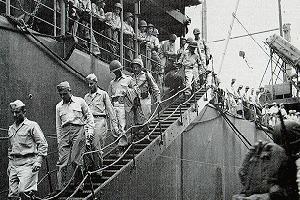
At 1030 hours of 04 September 1945 the leading ships were in place in the
inner harbor of Yokohama. The First Team was given the honor of leading the
Allied Occupational Army into Tokyo. The advanced party 1st Cavalry Division
transferred to their landing crafts and landed unopposed at the Yokohama
docks. As soon as the advanced party established initial assembly areas,
movement of troops got underway. Transport ships moved to dockside and began
their operation of unloading equipment and debarking the 1st Cavalry Division
soldiers.
The Division's first mission in Tokyo was to assume control of the central
portion of the city. Daily patrols began the long task of locating,
investigating and reporting all Japanese installations which had contributed
to the nation's war effort. All arsenals, factories, barracks and storage
grounds had to be examined and reports made of their contents. In addition,
the Division was concerned with the status of demobilization of the Japanese
armed forces. Although the Imperial Army and Navy were being disbanded under
supervision of Japanese officials, the 1st Cavalry Division maintained liaison
with them and checked on the progress of their work.
 |
|---|
| 70th Tank Battalion Moves Out |
|---|
| |
|---|
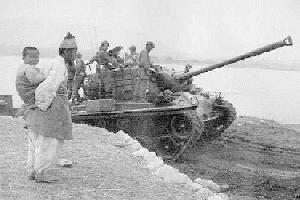
On 15 July 1950, the 1st Cavalry Division, thrust into action to counter the
invasion of the North Koreans into South Korea sailed out of Tokyo Bay. On 18
July they plunged ashore at Pohangdong, South Korea, to successfully carry out
the first amphibious landing of the Korean conflict. Moving inland, in a
blocking maneuver, they halted the North Korean war machine at the Pusan
Perimeter. The Division broke out of the perimeter in mid-September and
started moving north. Crossing the 38th Parallel quickly, they closed on
Pyongyang, capturing the North Korean capital city.
The sudden intervention of Communist Chinese Forces dashed hopes of a quick
end to the war. First Team troopers fought courageously in the north-south,
see-saw campaigns that followed and successfully defended the city of Seoul.
After 18 months of continuous fighting, the Division rotated back to Hokkaido,
Japan in 1952 for rest and rehabilitation. Following the armistice, the
Division relocated to Korea in 1957, with the mission of patrolling the
Demilitarized Zone for 8 years.
 |
|---|
| Closing On Hokkaido |
|---|
| |
|---|
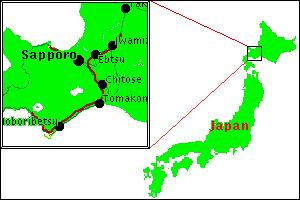
Soon after the 1st Cavalry Division had been pulled off Line "Jamestown" and
placed in reserve, word came down that they were to assume a new mission of
establishing a strong defensive military presence in the mountainous, northern
island of Hokkaido, Japan. Hokkaido is the second largest of the four main
islands of Japan. The reasons for uprooting and transferring the 1st Cavalry
Division to the northern island of Hokkaido, Japan were founded upon a long
standing strategy to deter the interests of the Union of Soviet Socialist
Republics (USSR) from expanding their control and influence further
eastward.
In negotiations among the World War II allies, Joseph Stalin declared his
interest in occupying the nearby islands of Sakhalin, Hokkaido, and Kurile in
exchange for entry of the USSR into the war against Japan. President Roosevelt
disagreed, but by the end of the war, Soviet troops had taken Sakhalin and the
Kuriles and were preparing to invade Hokkaido.
The first of the regiments to leave Korea, the 5th Cavalry Regiment was
relieved in reserve by the 180th Infantry Regiment. On 07 December, the 5th
Cavalry Regiment left Inchon. Four days later, its convoy entered the harbor
of Muroran, on the southeastern coast of Hokkaido, and movement to Camp
Chitose, Area I was completed by train. On 18 December, the 7th Cavalry
Regiment departed Korea. On 30 December, the 8th Cavalry Regiment, the first
of the regiments to engage the enemy in Korea, turned over its equipment to
the 279th Infantry Regiment and moved out in skirmish lines in a march over
the hills and to the beach where they were loaded into LSTs. The last unit to
embark was the 77th Field Artillery, which had moved off the line as the year
of 1951 was ending. On 12 January 1952, the 77th left Korea and arrived at the
port of Muroran on 16 January closing out the move of the 1st Cavalry Division
from Korea to Hokkaido just 18 months after the July 1950 landing at
Pohangdong.
The concept of Pentomic divisions was developed in 1956 to meet the needs of
nuclear battlefields. The goal was to field highly mobile divisions with great
fire power and supported by state-of-the-art communication systems and
logistics. A division was composed of a maximum of 13,500 personnel assigned
to five battle groups. Each battle group was a self-contained force trained to
conduct independent operations when necessary. Specialized firepower support
was provided by artillery and missile units armed with conventional ordnance
and nuclear warheads.
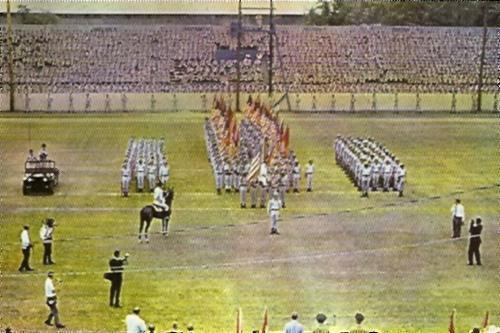
One of the first implementations of the Pentomic Division concept was carried
out on 15 October 1957, in ceremonies held in Tonggu, Korea, when the colors
of the 24th Infantry Division were retired and the colors of the 1st Cavalry
Division were passed to the Commanding General of the former 24th Infantry
Division. "The First Team" had returned, standing to defend Korea against
Communist aggression.
Concurrent with the reorganization and reflagging of the 1st Cavalry Division
to the pentomic concept, the 545th MP Company, the 61st, 77th, 82nd, and 99th
Field Artillery Battalions, the 26th and 29th AAA Battalions and the 70th Tank
Battalion, which had served so nobly in Korea and Japan, were inactivated and
relieved from assignment to the 1st Cavalry Division.
 |
|---|
| Ft, Benning Stadium, GA |
|---|
| |
|---|
It was not one man's dream; the notion of using aircraft or helicopters as the
fast, new steed of modern cavalry. The efforts of many went into the formation
of the first air assault division. More than a decade of flying experiments,
equipment evaluations and development of new hardware and tactics proceeded
the conversion of the 1st Cavalry Division to the Air Assault configuration.
Tests were conducted with troop carrying helicopters and those equipped with
a variety of machine guns and rockets.
The Air Assault Operations formed, equipped and trained six airmobile
companies to send into combat. Then, troubling events in Vietnam accelerated
the decision to convert the 11th Air Assault (Test) to a combat division. The
decision was initially made in March 1965. It was also decided that the new
division would be formed around the colors of the 1st Cavalry Division. On 16
June, Secretary of Defense Robert S. McNamara made a public announcement that
the Department of the Army had been given the green light to organize an air
assault division. McNamara also stunned many observers, when he declared that
the new division would be combat ready eight weeks after its organization.
 |
|---|
| Operation LeJeune, 04 April '67 |
|---|
| |
|---|
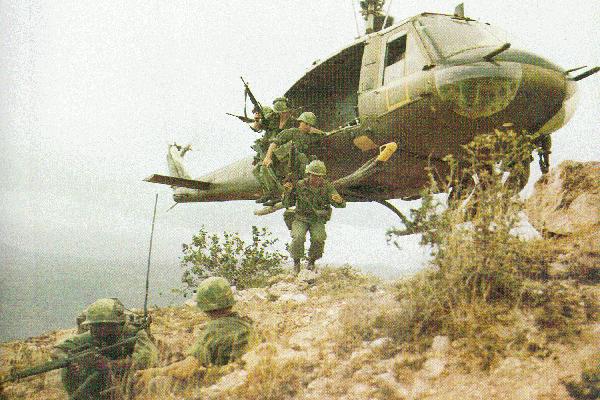
The 1st Cavalry Division went home in 1965, to Ft. Benning, GA, but only long
enough to be reorganized for a new mission, becoming the Army's first air
mobile division. The First Team was back in combat as the first fully
committed division of the Vietnam War. Their first real combat test came
during the Pleiku campaign that lasted for 35 days of continuous air mobile
operations. The troopers destroyed two of the three regiments of a North
Vietnamese Division.
The first actions of 1968 began by terminating the longest Vietnam actions of
the Division, Operation PERSHING. Later, for nearly a year the Division
scoured the Bong Son plain, An Lo valley and the hills of coastal II Corps,
seeking out enemy units and their sanctuaries. When the operation ended, the
enemy had lost 5,401 soldiers and 2,400 enemy soldiers had been detained.
Moving to I Corps, Vietnam's northern most tactical zone, the Division set up
Camp Evans for their new base camp. Early in the next year, the enemy launched
the Tet Offensive, a major effort to overrun South Vietnam. Some 7,000 enemy,
primarily well equipped, crack NVA regulars blasted their way into the
imperial city of Hue and Quang Tri, the capital of Vietnam's northern most
province.
Taking actions in the conflict, Quang Tri and Hue were sequentially liberated.
Shattering the enemy's dreams of a Tet victory, the 1st Cavalry Division
"Sky-troopers" moved to relieve the besieged Marine Base at Khe Sann. The
First Team was "First into Cambodia," hitting what was previously a Communist
sanctuary. Troopers deprived the enemy of much needed supplies and ammunition,
scattering the enemy forces. The Vietnam service for the Division ended in
1972 when its last brigade began withdrawing. The 1st Cavalry Division had
been the first division to go, and the last to leave.
 |
|---|
| Return Of Forces To Germany |
|---|
| |
|---|
On 05 May 1971, advanced elements of the 1st Cavalry Division returned to the
United States and based their operations in Ft. Hood, TX. where they were
reorganized as the "First Triple Capability (TRICAP) Division." This TRICAP
designation stemmed from its organization, consisting three fronts of attack;
- an armored brigade, a mechanized infantry brigade, an airmobile brigade,
along with support troops tailored to assist the combat elements of the
Division.
The 1st Cavalry Division was reorganized,in 1975, to add a computerized system
to increase the effectiveness of artillery (TACFIRE), becoming the newest
armored division in the Army. In parallel, they tested the Division
Restructure (DRS) concept to evaluate the most effective use of manpower and
weapons systems for the battles to be fought in the future.
The first National Training Center (NTC) rotation for the Division took place
in 1982 to initiate a long on-going series of tough, realistic desert battles.
The Division now conducts three NTC rotations a year. All the training,
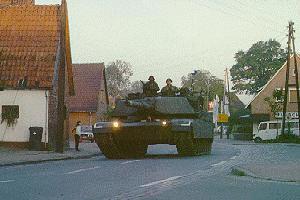
modernization, planning, and operations culminated in REFORGER '83, when the
First Team deployed nearly 9,000 soldiers to Holland, drew pre-positioned
equipment, moved to a staging area and conducted exercise "Certain Strike" on
the plains of Northern Germany. The success of the exercise proved that the
Division was fully capable of performing its wartime mission.
In 1987 the First Team became the first division to field and train with
Mobile Subscriber Equipment (MSE), the militarized version of a commercial
cellular telephone system which became fully operational in 1988. In 1989 the
Division added new weapons to its inventory with combined use of the AH-64
Apache, M2 Bradley, and MSE. In addition, the AH-64 Apaches had the capability
to launch "Hellfire" anti-armor missiles. A variation in one of the missiles
design provided the capability to be guided to it's target by the new OH-58D
Observation Helicopter.
 |
|---|
| Destroy The Republican Guard |
|---|
| |
|---|
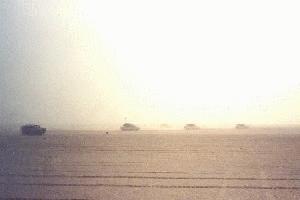
In August 1990, the 1st Cavalry Division was alerted for deployment to
Southwest Asia as part of the joint and combined forces participating in
Operation DESERT SHIELD. The focus at that time was the defense of Saudi
Arabia against potential Iraqi attack. With minimum delay, chartered aircraft
flew the First Team soldiers from Robert Gray Army Airfield, Ft. Hood, TX, to
Dhahran International Airport via Paris, France and Cairo, Egypt. As soon as
each unit drew their prepositioned equipment, they moved to an Assembly Area
in the desert 160 miles west of the port. In this engagement First Team
infantrymen were issued the newest version of the Bradley Fighting Vehicle,
the up-armored M2A2 tank.
Before hostilities took place, the First Team gained valuable experience in
combined operations through coordination with French, Egyptian and Syrian
forces. In 1991, the Division, attached to VII (US) Corps, and the focus of
the First Team began to shift toward offensive action. The Division moved
nearly 500 kilometers to another assembly area near King Khalid Military City
(KKMC) in northern Saudi Arabia, a key strategic location covering the
historic Wadi al Batin approach into Saudi Arabia
In Operation DESERT STORM, their "First" major mounted ground engagement, the
Division attacked 10 miles into Iraq, confirming and destroying enemy
positions. Regrouping, the Division charged west pausing only to refuel before
passing through breeches in the enemy obstacle belt and within 24 hours they
had gone 300 kilometers, slicing deep into the enemy's rear. The cease fire,
which came after 100 hours of action, halted the continuing attack as the
Division were "closing on" and preparing to destroy an entire Division of the
Republican Guard.
 |
|---|
| 1st Cavalry Division |
|---|
| |
|---|
Knowing that the future is always unpredictable and that the basic ingredient
of success of a military organization is a structure that allows the greatest
speed and flexibility in adapting technologies in the ever changing combat
organizations. Upon return to the United States, The 1st Cavalry Division
initiated the first of a series of reorganizations in the period May 1991 to
August 1993. The Division rebuilt, as a new contingency force, was ready to
deploy anywhere in the world on a moments notice.
On 21 May 1991, the 1st Cavalry Division became the largest division in the
Army, with the reactivation of its 3rd (Greywolf) Brigade. Organic units
included in this reactivation were formally assigned to the 1st (Tiger)
Brigade, 2nd Armored Division that, at times, had been attached to the 1st
Cavalry Division during the Gulf War. Units filling out the 3rd Brigade were
3rd Battalion, 41st Infantry Regiment, 1st and 3rd Battalions, 67th Armor
Regiment, 1st Battalion, 3rd Field Artillery Regiment and the 502nd
(later redesignated as the 215th) Forward Support Battalion.
In October of 1992 the new Engineer Brigade, 1st Cavalry Division was
activated and organized. Though the "Engineering Restructuring Initiative" of
the Army, the nucleus of the Brigade was formed around the division's historic
8th Engineer (Combat) Battalion. Additional organic units were assigned to the
Brigade. The 20th Engineer Battalion was transferred from Ft. Campbell,
Kentucky and the 91st Engineer Battalion was activated to complete the
alignment of the Brigade.
In August of 1993, the reflagging actions were completed and following its
reorganization, the Division became the Army's largest division and only
armored contingency force.
 |
|---|
| Desert Landscape At Night |
|---|
| |
|---|
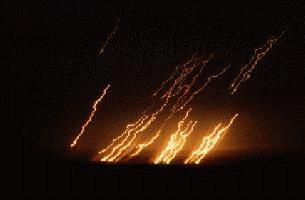
The US Army Forces Central Command (ARCENT) - Kuwait, a major subordinate
command of the US ARCENT of Ft. McPherson, GA. and U.S. Central Command
(CENTCOM) of Tampa, FL, is the operational unit of the US Army in Kuwait. The
mission of the US CENTCOM is to a) support US and free-world interests by
assuring access to Mideast oil resources, b) help friendly regional states
maintain their own security and collective defense, c) maintain an effective
and visible US military presence in the region, d) deter threats by hostile
regional states and e) project a military force into the region if
necessary.
Following the Gulf War, members of US Central Command's Army component and
the armed forces of Kuwait agreed to participate in a series of Combined
Exercises held within the framework of the Mutual Defense Cooperation
Agreement between Kuwait and the United States. In these exercises, Army
battalions rotate into Camp Doha for training with the Kuwaiti while brigade
command elements rotate into various locations in the country to gain
familiarity with the terrain to develop and practice a mutual set of defensive
postures. These exercises represented an opportunity for US Army forces to
work with Kuwaiti armed forces in country while at the same time demonstrating
US capability and commitment to the region.
Since Desert Storm, the 1st Cavalry Division has responded several times to
contingency requirements to participate in joint desert training, and deploy
in maneuvering exercises which support the mission objectives of the US
Central Command. Each operation has underscored the need for vigilance and
quick response and reinforced the value of pre-positioned equipment and
limited forward presence in offsetting the strategic time/distance challenges
inherent in winning the "race for Kuwait."
 |
|---|
| 1st Cavalry Presence Patrol |
|---|
| |
|---|
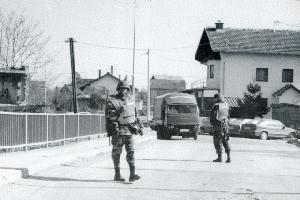
On 17 April 1998, a Pentagon spokesman announced that the 1st Cavalry
Division troops from Ft. Hood, Texas, would deploy in late summer to replace
the US peace keeping force in Bosnia, the 1st Armored Division. It was an
historic move. It was the first time a Continental United States (CONUS) based
contingency unit would assume the Bosnian peacekeeping mission.
On 07 October 1998, the First Cavalry Division, in the mission of "Task Force
Eagle," conducting peace support operations in Bosnia-Herzegovina, assumed
authority of the Multinational Division (North) area of operations in
Bosnia-Herzegovina from the 1st Armored Division.
The mission of the 1st Cavalry Division was to conduct operations to enforce
the military provisions set forth by the Dayton Accords. Their day-to-day
presence and commitment to the citizens of this ravaged nation helped prove
that a lasting and self-sustaining peace is possible. In order to conduct
successful peace missions while in theater, soldiers were extensively trained
on mine awareness, country and cultural customs and checkpoint and convoy
operations.
During the six months, squads and platoons conducted over 9,000 combat patrols
and escorted over 1000 convoy movements over some of the most rugged terrain
and austere conditions. The soldiers conducted hundreds of weapons storage
site inspections, established vehicle checkpoints designed to monitor and
control movement and often conducted searches for and seizures of illegal
contraband and weapons.
 |
|---|
| Moving UAV To Launch Area |
|---|
| |
|---|
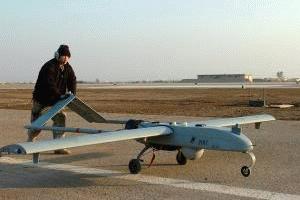
"Force XXI" was the comprehensive process of the Army for modernizing and
preparing for the challenges of the 21st Century. Force XXI projects soldiers
into the 21st century and provides them with the necessary doctrine and
organizations, the most realistic training, and the best equipment and weapon
systems that our nation can provide. In Fiscal Year 2001, the 1st Cavalry
Division began its transition to the Force XXI design.
Providing the Division with Force XXI equipment that is fully digitized
creates a "collaborative virtual environment" that, among other advantages,
gives commanders, separated by great distances, the ability to communicate
through various digital systems providing situational awareness across the
battlefield.
In its end configuration, Force XXI equipment will best ideally suited for
joint operations and is designed to be fully compatible with the operational
systems of the other services. Seamless information connectivity with the
other elements of the joint force are its primary characteristic and is
essential for the success of joint operations. The mission of the Army is to
equip the Division with a capability based upon the achievement of a
full-spectrum dominance against any potential enemy across the entire field of
military operations by 2015 - 2020.
 |
|---|
| New York Twin Towers |
|---|
|
 |
|---|
| Jennerstown Crash Site |
|---|
|
 |
|---|
| The Pentagon Building |
|---|
|
|---|
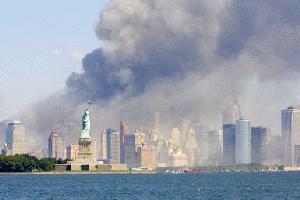
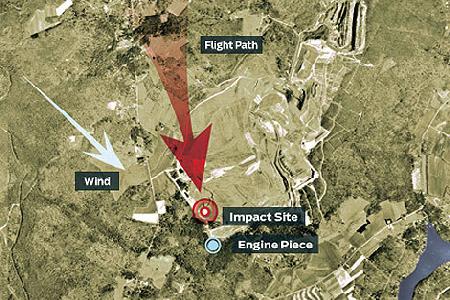
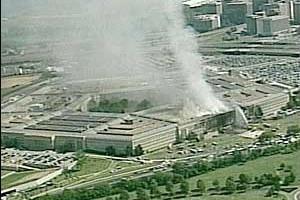
The changeover in FORCE-XXI structure was well underway when on 11 September
2001, terrorists, master minded by Osama bin Laden, attacked the United States
in four separate instances.
- The first, hijacked American Airlines Flight 11 hit the North Tower of
the World Trade Center, New York, NY at 0845 hours.
- The second, hijacked United Airlines Flight 175, hit the South Tower of
the World Trade Center, New York, NY at 0903 hours.
- The third, hijacked American Airlines Flight 77, hit the West side of the
Pentagon, Washington DC at 0943 hours.
- The fourth, United Airlines Flight 93 that lost control when the
passengers attempted to overwhelm their hijackers, crashed into a field
8 miles east of Jennerstown, PA at 1006 hours.
On 18 September, as a result of these incidents, President George W. Bush
declared war on those countries who harbored terrorists and defined the
military retaliations as Operation INFINITE JUSTICE. The origins of the name
can be traced back to the 1998 Operation INFINITE REACH airstrikes against
Osama bin Laden's facilities in Afghanistan and Sudan in response to the
bombings of US embassies in Kenya and Tanzania.
 |
|---|
| Operation CLEAR SKIES |
|---|
| |
|---|
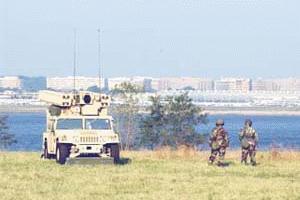
In early September, Fire Support Elements of 4th Battalion, 5th Air Defense
Artillery (ADA) along with staff officers of the 32nd Army Air Missile Defense
Command (AAMDC) deployed to the National Capitol Region to support the
multi-layered air defense military exercise, This exercise integrated fighter
and support aircraft, radar and ground-based air defense systems and
communication links, including those of the Sentinel radar, Avenger
Antiaircraft Missile Weapon System, and Stinger Man Portable missile systems
of the 4th Battalion, 5th ADA.
On 09 September, the operation was upgraded as Operation CLEAR SKIES II and
was scheduled to end on 14 September. However, on 10 September, in response to
elevated security threats, the Secretary of Defense, Rumsfeld approved the
transition of the exercise into a live operation NOBLE EAGLE - loading the
launchers with live missiles to provide an extra layer of defense for the
anniversary of the 11 September attack on the United States, which included a
large outdoor ceremony at the Pentagon attended by President George W.
Bush.
Just one month after the terrorist attacks of 11 September, President Bush
initiated Operation ENDURING FREEDOM. The following month, US Forces entered
Afghanistan to begin offensives directed at those organizations and
governments who were directly and indirectly responsible for the attacks. The
545th Military Police Company deployed and were responsible for interrogating
and processing nearly 2500 detainees.
 |
|---|
| Security Alert |
|---|
| |
|---|
Despite heavy commercial and military air traffic in the immediate region, the
soldiers of 4th Battalion, 5th ADA continued to be at a high state of alert
and motivation. Relying on previous training for confidence in the success of
this mission, they remain composed and continue to calmly man their
strategically located positions around the capital, ready to respond should
the situation warrant.
In early 2003, select divisional units were designated to deploy in support of
Operation IRAQI FREEDOM. These specialized units included the 1-227 Aviation
Battalion who provided aviation assets to the operations. maintenance support
for the battalion was provided by the 615th Aviation support battalion and
airfield security was provided by the 1-21 Field Artillery. The 68th Chemical
Company was attached to 3rd Infantry Division serving as a Hazardous material
response team.
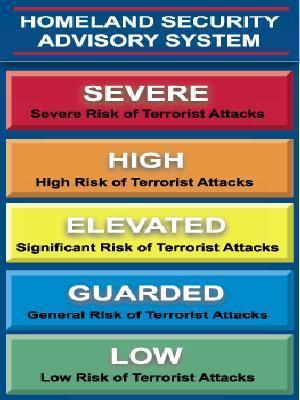
In response to the increase of the threat level change to "Orange", Fire
Support Elements of the 4th Battalion, 5th ADA redeployed to the national
capital and by 12 February all of their equipment was in position and
integrated into the defense system communications network. Since that
movement, they have remained there on station, carrying out their assigned
precautionary and prudent defense mission.
 |
|---|
| Karzai And Zafarullah Jamali |
|---|
| |
|---|
In Early May, 2003, US Forces began a major operation to clean up Tikrit, the
stronghold of Saddam's al-Tikriti clan that had been a center of pro-regime
sentiment even as the former government collapsed. US officers say members of
Saddam's Baath Party are trying to reorganize to stage attacks on American
troops, and one of the men detained Friday was described as a party
official.
During the raids, troops found several weapons and about $3,000 hidden in
various houses, and one Iraqi was killed when he tried to wrest a rifle from
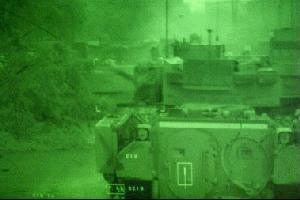
an American soldier. The raid, the second in Tikrit in as many days, began
shortly after midnight when six Bradley Fighting Vehicles sealed off a
residential district. Soldiers broke down gates and doors, forced their way
inside and emerged with about 20 men, blindfolded and hands tied behind their
backs.
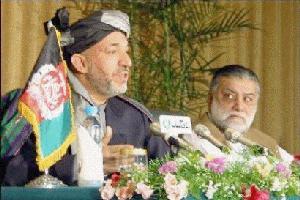
Afghan President Hamid Karzai has begun submitting lists of wanted "war
criminals and terrorists" to Pakistan Prime Minister Zafarullah Jamali in an
effort to stamp out Taliban and al-Qaeda extremists lurking along the
neighbors' mountainous border. The list included Akhtar Mohammad Usmani, a
deputy of Taliban leader Mullah Omar, Mullah Dadullah, the Taliban's
intelligence chief, Mullah Biradar, the militia's internal security chief and
Hafiz Mujeeb, a lower-ranking commander.
Many Afghan officials, suspicious of Pakistan for its previous nurturing and
support of the Taliban regime, have accused it of allowing sanctuary for
fugitive extremists in its remote tribal border regions. Afghan and United
States forces hunting the extremists have come under repeated attack along
Afghanistan's border with Pakistan, leading to suspicions that anti-US and
anti-Kabul groups have been regrouping on the Pakistani side.
 |
|---|
| Advance, Destroy Everything !! |
|---|
| |
|---|
In the fall of 2003, the Division as a whole was ordered to prepare for
deployment to support Operation IRAQI FREEDOM - II. In January 2004, Division
elements began deploying to the theater of operations and in April the
Division assumed command and control of Task Force - Baghdad.
Deployed under the designation of Task Force BAGHDAD, the Division established
and operated from 40 Forward Operating Bases (FOB) throughout the Iraqi
capital city. Carrying out their mission, they came in direct contact with the
terrorists, battling enemy forces more than 935 times, which included
subversive attacks by small-arms fire, mortar, Rocket-Propelled Grenades and
Improvised Explosive Devices.
During the deployment 2,508 combat badges and 175 medals for valor, including
two Silver Stars along with 1,900 Purple Hearts, were award to 1st Cavalry
soldiers. The ceremony also served as a grim reminder of the cost of defending
the freedoms of the country in Operation IRAQI FREEDOM-II as the cannons were
fired to honor the loss of its 169 members who gave their lives in their
service.
The Division engaged in multiple lines of operations simultaneously to defeat
the enemy and win the support of the Iraqi people. Two major events in the
march toward true democracy occurred during the year in the Iraqi capital:
(1), the coalition returned sovereignty to the people of Iraq in June 2004;
(2), the national elections of January 2005 demonstrated the resolve of the
Iraqi people to gain control of their own country.
 |
|---|
| Back And Ready For Change |
|---|
| |
|---|
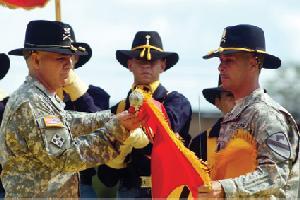
On 25 May 2005, the 1st Cavalry Division marked the official return from Iraq
by uncasing its colors in a ceremony held on Cooper Field Parade Grounds. More
than 2,500 soldiers, representing all of the units of the Division, were in
attendance. During the ceremony the many accomplishments and sacrifices of the
Division while in Iraq were highlighted.
Following six months of extensive planning, officers of the 1st Cavalry
Division began executing the monumental task of reorganizing and realigning
its manpower and equipment resources into the Army Matrix of Modular Forces.
A whirlwind sequence of 31 Unit Changes of Commands, including ten new Unit
Activations, nineteen Unit Inactivations along with transfers of two Units,
were executed in the traditional Cavalry ceremony. As each newly activated
Brigade changed command, they changed their colors and become a Brigade Unit
of Action (BUA). Under the reorganization, the Division is composed of six
Brigades.
While undertaking the transformation changes, the Division experienced nearly
a fifty percent turnover in personnel while performing the coordination of
arrival and reallocation of critical new equipment required to support their
new missions. Simultaneously, with the equipment changeovers, new training and
maintenance programs were initiated to prepare for possible combat
redeployment in the summer of 2006 or as may be directed by the Army Command.
On 16 October 2005, a major milestone of the "Stand Up" of the 4th Brigade
Combat Team at Ft. Bliss, TX. completed the transformation of the 1st Cavalry
Division into a Matrix of Modular Forces.
 |
|---|
| 1st Cavalry Division TOA |
|---|
| |
|---|
On 20 June 2006, the 1st Cavalry Division Headquarters received orders to
return to Iraq later in the year. The units designated to return along with
the 1st Cavalry Headquarters and their Special Troops Battalion (STB) were the
2nd (BlackJack) Brigade Combat Team, who was closing out a specialized
training session at the National Training Center - Ft. Irwin, CA, and the 3rd
(GreyWolf) Combat Team, who were completing battlefield training at the Joint
Readiness Training Center - Ft. Polk, LA. Approximately 12,000 soldiers of the
Division staffing level of 18,500 were covered by these orders. Although no
timing or schedule was established for the deployment, the Division was
expected to relieve the 4th Infantry Division currently deployed in Baghdad.
Units still without orders, the 1st (Ironhorse) Brigade Combat Team at Ft.
Hood, TX and the 4th (Longknife) Brigade Combat Team at Ft. Bliss, TX,
continued to train as if they could be called up at any time.
 |
|---|
| The Division Transforms |
|---|
| |
|---|
The 1st Cavalry Division transformed to the Army's new modular design in the
Spring and Summer of 2005 after returning from Iraq where they participated
in Operation Iraqi Freedom II. This transformation changed the structure of
the Army from a division-based force to a brigade-based force by making each
brigade a self-sufficient unit that is readily deployable and able to provide
interchangeable, increased combat power for the commander.
During the most recent deployment in Iraq, several reconstitutational changes
were studied, considered and since the return of the Division to Ft. Hood, TX.
from Operation Freedom IV, are now being implemented to be ready and more
prepared for their next deployment. The more recent changes made since their
return are:
- On 15 February 2008 when, as part of the continuing transformation of the
Army, the Solders of the 15th Sustainment (Wagonmasters) Brigade gathered
at the parade grounds of Cooper Field to witness their reassignment to a
higher headquarters level, transferring from the 1st Cavalry Division to
the 13th Sustainment Command (Expeditionary), but will continue to be
remembered as a "legacy" unit of the "First Team" and remain stationed at
Ft. Hood, TX.
- On 04 March, the 4th Brigade (LongKnives) Combat Team was reflagged and
designated as the 4th Brigade Combat (HighLanders) Combat Team and
assigned to the 1st Armored Division.
- On 07 March, the 4th Brigade (Cobras) Combat Team, 4th Infantry Division
at Ft. Hood, TX was reflagged and designated as the 4th Brigade
(LongKnives) Combat Team, and assigned to the 1st Cavalry Division.
 |
|---|
| Buffalo, IED Clearing Vehicle |
|---|
| |
|---|
On 19 May, the Department of Defense announced the deployment of over 6,000
Army and National Guard Troops in Texas for duty in the Middle East. The 3rd
Brigade Combat Team, 1st Cavalry Division was named among 25,000 designated to
replace units in Iraq that are scheduled to return by the end of the year.
On 04 June, the 4th (Longknives) Brigade Combat Team began an initial step in
their anticipated 15th month deployment by casing their colors in a ceremony
at Cooper Field Parade Grounds. Although an advanced party left Central Texas
for Iraq four days ago, the entire Brigade is not scheduled to deploy for
Operation Iraqi Freedom - VI until mid June.
On 30 June, the Department of Defense announced that the 1st and 2nd Brigade
Combat Teams of the 1st Cavalry Division is to deploy to Iraq in early 2009
to conduct a full spectrum of operations. The announcement reflected the
continued commitment of the United States to the security of the Iraqi people,
and provides replacement forces required to maintain the current level of
effort in Iraq. The release also explained that "any subsequent deployment
orders will be issued based on force level decisions made in the future."
On 30 September, In a second Department of Defense announcement, the 1st
Cavalry Division Headquarters received orders to deploy in support of
Operation IRAQI FREEDOM in early 2009. More than 1,100 Soldiers serve in the
Division Headquarters and they provide command and control, intelligence,
communication and logistical support among other capabilities while conducting
stability and security operations in cooperation with Iraqi Security Forces
and local governments. The deployment orders marked the third time that the
1st Cavalry Division Headquarters has deployed in support of Operation IRAQI
FREEDOM.
The Air Cavalry Brigade, undertaking their third deployment since 2004,
prepared to join the 1st, 2nd, 3rd and 4th Brigade Combat Teams of the 1st
Cavalry Division who are already "in theater". On 20 April 2009, the first
flights of 1st Air Cavalry Brigade Soldiers, the last brigade of the 1st
Cavalry Division to deploy, left Robert Gray Airfield for Iraq amid a cheering
crowd of family members and friends. More than 250 Soldiers were in the
"Torch" or advance party of the brigade. The advanced party included the lead
elements of the 615th Aviation Support Battalion who will be in charge of the
port operations of helicopter assembly, test and inspection in Kuwait.
 |
|---|
| 4th BCT "Torch Party" |
|---|
| |
|---|
On 04 May 2009, the "Torch Party" of the 4th Brigade Combat Team, 1st Cavalry
Division composed of 5th Battalion, 82nd Field Artillery Troopers, returned
from Iraq to hundreds of cheering family members, fellow Soldiers and other
guests at a welcoming home ceremony in front of the Division headquarters. The
torch party was sent back earlier than the rest of the unit to help set up
operations for their unit when it starts to return in its entirety. Flights
for the 4th BCT Soldiers were scheduled to go on for the next several weeks,
bringing the rest of the Brigade back to Ft. Hood, TX.
On 10 November, an advanced party (Greywolf Advon 1) of 300 personnel from the
3rd Brigade Combat Team, 1st Cavalry Division was the first group of Soldiers
from the Division to return after deployment for a year in Mosul, Iraq. Their
friends and families were patiently waiting and then, almost on cue, the white
buses arrived from the airport, full of Grey Wolf Troopers. The Soldiers filed
quickly filed out and fell into formation. The music stops. The crowd grows
quiet. An officer says a quick prayer and then calls out the command the
families have long awaited - Charge !! The families rush the field to find
their loved one in a sea of camouflage.
On 26 December, the last flight of 2nd Brigade Combat Team Members, 1st
Cavalry Division members, arriving from Iraq, missed Christmas by a couple of
hours, however not one Soldier or family member seemed to care as they walked
across Cooper Field, most donning Santa Claus hats.
0n 13 January 2010, the 1st Cavalry Division closed out its responsibilities
of Operation IRAQ - VI (Rotation 08-10), formally "Multi-National Division
Forces - West and Baghdad" by executing a Transfer Of Authority to the
commander of the incoming division (now designated as "USD - Center") of
control, the 1st Armored Division. The next day, 14 January, the flight of the
trail party of the 1st Cavalry Division Headquarters Soldiers arrived at Ft.
Hood, TX and as they gathered at the homecoming ceremony at Coopers Field to
greet their family and friends, the Colors of the 1st Cavalry Division were
uncased, signifying the return of the Division from the combat operations of
Operation IRAQ - VI (Rotation 08-10).
On 17 March, the advanced party of the 1st Air Cavalry Brigade, the last
organizational unit of the 1st Cavalry Division scheduled to leave Operation
IRAQ - VI (Rotation 08-10), began its return to Ft. Hood as 150 soldiers were
welcomed back from Iraq at Cooper Field. Soldiers from across the Brigade made
up the advance party that will prepare for the arrival of the rest of the
Brigade in April.
 |
|---|
| Operation NEW DAWN - Iraq |
|---|
| |
|---|
01 September, 2010 marked the official end to Operation IRAQI FREEDOM and
combat operations by United States forces in Iraq. In The transition to
Operation NEW DAWN, the remaining 50,000 US servicemembers serving in Iraq
will conduct stability operations, focusing on advising, assisting and
training Iraqi Security Forces (ISF). Operation NEW DAWN, a compromise of the
Republican and Democrat Parties to vacate the Iraqi operation by mid 2010,
also represents a shift from a predominantly military US presence to one that
is predominantly civilian, as the Departments of Defense and State work
together with governmental and non-governmental agencies to help build civil
capacity of Iraq.
The transition to Operation NEW DAWN is the US commitment to the government
and people of Iraq as a sovereign, stable country that will be an enduring
strategic partner with the United States. This has been made possible by the
improved capability of the ISF to take the lead in securing their country. New
Dawn also signifies the success of the responsible drawdown of forces and the
redeployment of thousands of US Soldiers, as well as the return or transfer of
war fighting equipment to the US or to combat troops in Afghanistan.
To support the transition to stability operations, the Army has six Advisory
and Assistance Brigades (AABs) in Iraq. AABs are designed to partner with ISF
and are tailored for the needs of the specific location in which they will
operate. They provide security for Provincial Reconstruction Teams and have
up to 24 specialty teams which enable them to conduct advisory, security, and
training missions, as well as the development of civil capacity. ABs are
structured around the modular design of brigade combat teams but are trained
for stability operations, rather than for combat. However, under the security
agreement they retain the inherent right to self-defense and are authorized
to take necessary action to prevent terrorist activities in order to protect
themselves or the people of Iraq.
 |
|---|
| US Forces Cases Colors |
|---|
| |
|---|
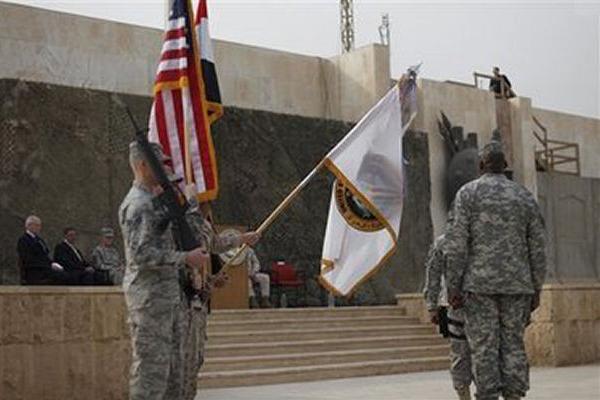
On 15 December 2011, after almost nine years, the Iraq war officially ended.
Defense Secretary Leon E. Panetta flew into Baghdad to be the guest of honor
at a ceremony formally wrapping up the 8 1/2 invasion and occupation period of
Iraq. The ceremony ended the war two weeks earlier than was necessary under
the terms of the security agreement signed by the US and Iraqi governments in
2008, which stipulated that the troops must be gone by 31 December 2011.
After speeches by various dignitaries, the flag of United States Force-Iraq
was folded away signaling the end of the mission was over, eight years, eight
months and 25 days after it began on March 20, 2003. The war resulted in an
estimated 4,487 American deaths, more than 100,000 Iraqi lives lost and more
than $800 billion invested by US taxpayers on both the military effort and
reconstruction.
Although the Pentagon had introduced planning for force reduction as early in
May, 2011, it was not until 27 January 2012 when the Army Chief of Staff,
General Raymond Odierno, in a series of public briefings describing the
overall scope of the impact on the Army, announced that the Army will remain
capable through the planned 6 year drawdown of the current 570,000 Soldiers to
490,000. Along with the loss of 80,000 Soldiers, it is planned to reduce at
least eight organizational brigades from the present capability. In 2017, the
new Army of 490,000 will be fundamentally different and more capable than the
Army of 2001, which was composed of 482,000 Soldiers.
Following the initial release of data, General Raymond Odierno told reporters
that he is comfortable with the recommendations and the time is strategically
right to reduce forces, especially since the new long term planning strategy
does not call for large-scale ground wars and the resulting "end strength" of
the Armed forces will be more effective than now because of the introduction
and use of new technologies along with the fact that today's troops are
combat-seasoned from 10 years of war.
Recently the Obama administration indicated that it might withdraw all toops
in Afghanistan after December 2014, an option that defies the present view of
the Pentagon that thousands of troops may be needed to contain al-Qaida and to
strengthen Afghan forces.
The US now has 66,000 troops in Afghanistan, down from a peak of about 100,000
as recently as 2010. The US and its NATO allies agreed in November 2010 that
they would withdraw all their combat troops by the end of 2014, but they have
yet to decide what future missions will be necessary and how many troops they
would require.
At stake is the risk of Afghanistan's collapse and a return to the chaos of
the 1990s that enabled the Taliban to seize power and provide a haven for
Osama bin Laden's al-Qaida network. Fewer than 100 al-Qaida fighters are
believed to remain in Afghanistan, although a larger number are just across
the border in Pakistani sanctuaries.
Administration officials in recent days have indicated that they are
considering a range of options for a residual US troop presence of as few as
3,000 and as many as 15,000, with the number linked to a specific set of
military-related missions like hunting down terrorists.
Table of Contents
The first Tabloid Link, "The Early Years", describes the beginning,
transition, assignment and integration of the organic elements of the 1st
Cavalry Division which became the first cavalry division of the Army. The
remaining tableaux, that follow, detail the specific reorganizations, actions,
operations and many critical missions that have been performed over its 88
year history to meet the changing threat.
Appendices
If none of the data that you have found by surfing the reference unit chapter
titles and indexes measures up to your interests, you may want to deploy the
R&S (Reconnaissance and Surveillance) Scouts to search and identify keywords
or subjects within individual unit pages. Enter the descriptive keyword or
search terms(s) in the input field and "Click" on the Search button to screen the multiple DataBases of
the Cavalry OutPost and the garrisoned occupants - "The 1st Cavalry Division
and its Subordinate Units".
The search action will open the "First-Team.US WebSite - R&S Scout Report",
which displays a listing of WebSite Titles and HTML Summaries that contain the
specific search term(s) of interest. To review any that best depicts a match
of your search term(s), "Click" on the WebSite Title to open a New Window.
After the WebSite is fully loaded, use the browser [EDIT/Find] Tool Button to
locate the search term within the page. After reviewing, close the New Window
to return to the listing of WebSites.
Notwithstanding all of the above, the 1st Cavalry Division Association also
maintains a Web Site with data on their specific Association activities which
are well worth visiting. Main topics which may be of interest to you are:
On 17 July 1944, a group of "First Team" soldiers in the Admiralty Islands
agreed to form an Association of 1st Cavalry Division soldiers and veterans to
preserve old friendships and conduct periodic reunions. The first reunion of
the 1st Cavalry Division Association was held in 1948 at El Paso, TX - Ft.
Bliss, the location where the 1st Cavalry Division was organized in 1921.
Today, the 1st Cavalry Division Association is the corporate body of veterans,
forming a fraternal organization of some 24,000 alumni on the active rolls
with a period of duty assignment to the 1st Cavalry Division which ranges from
the 1930's to today's active duty trooper. The organization is non-sectarian,
non-profit and non-political.
Who is eligible for membership? Anyone who has been assigned or attached to
the 1st Cavalry Division anytime, anywhere is eligible for life membership.
Other Military Personnel who served along side the 1st Cavalry Division and
Friends of the Cavalry who have not served with the Division can become
Associate Members.
Belonging to the 1st Cavalry Association preserves and strengthens friendships
shared over the years through chapter activities, annual reunions and the
publication of the monthly newspaper, "The Saber". Furthermore, the
opportunity to meet other people and make new friendships through association
activities; from horse cavalry through ground and airmobile infantry to heavy
armor, we share a great Division heritage and tradition.
Former members of the 1st Cavalry Division may enroll and obtain tangible
evidence of membership in this great fraternity, i.e. lapel pin, membership
card and certificate, decals, a one-year subscription to the Saber and finally
notwithstanding the opportunity to be involved in special projects such as the
Scholarship Fund. To obtain a membership application, "Click" on the Link button below and
print out the form by using your browser "PRINT" function.
Other Military Personnel who served along side the 1st Cavalry Division and
Friends of the Cavalry who have not served with the Division may enroll as
non-voting, associate members and have the privileges of attending reunions
and other outings along with the pride of affiliation with the FIRST TEAM.
To obtain an associate membership application, "Click" on the Link button below and
print out the form by using your browser "PRINT" function.
Take this opportunity to renew your subscription to the SABER Magazine. To
obtain a renewal form, "Click" on the
Link button below and print out the form by using your
browser "PRINT" function.

In addition to the above 1st Cavalry Division Association Pages, you may also
want to visit another center of interest, the Crossed Sabers Chapter Souvenir
Shop as part of your Cavalry Scout's Breakfast Report break. The Crossed Sabers
Chapter Souvenir Shop, the purveyors of 1st Cavalry Division memorabilia, will
provide the opportunity for you to share a piece of your cavalry past with
your family.
If this is your first review of the Outpost of the 1st Cavalry Division and
its Subordinate Units, you may want to record your own report on your findings
during your visit, or perhaps you may want to review the log entries of other
visitors.

To report on your findings,
"click" on the "Report-In"
Index Tab of the Troop Log. |
|

To review entries of others,
"Click"on the "View Entries"
Index Tab of the Troop Log. |
|---|
As you journey through the history of the 1st Cavalry Division and its
assigned elements, you may find it interesting enough to send a message to
your friends and extend them an invitation for the opportunity to review the
rich history of the Division. We have made it easy for you to do. All that is
required is for you to click on the Push Button below, fill in their eMail
addresses and send.


|
The TITLE and URL of this WebSite are automatically read, formatted
and entered into your standard eMail form. |
|
|
Note - The eMail Message is processed and transmitted On-Line to the
addressee(s) via your Internet Provider.
Copyright © 2002, Cavalry Outpost Publications ® |

 eMail Your WebSite Comments.

Return to "MyOwnPages"©.
Copyright © 1996, Cavalry Outpost Publications ® and
Trooper Wm. H. Boudreau, "F" Troop, 8th Cavalry Regiment (1946 - 1947). All
rights to this body of work are reserved and are not in the public domain, or
as noted in the bibliography. Reproduction, or transfer by electronic means,
of the History of the 1st Cavalry Division, the subordinate units or any
internal element, is not permitted without prior authorization. Readers are
encouraged to link to any of the pages of this Web site, provided that proper
acknowledgment attributing to the source of the data is made. The information
or content of the material contained herein is subject to change without
notice.
Revised 25 Jan '13 SpellChecked