
|
|---|

 It was not one man's dream; the notion of using aircraft or helicopters as the
fast, new steed of modern cavalry. The efforts of many went into the formation
of the first air assault division. More than a decade of flying experiments,
equipment evaluations and development of new hardware and tactics proceeded
the conversion of the 1st Cavalry Division to the Air Assault configuration.
Tests were conducted with troop carrying helicopters and those equipped with
a variety of machine guns and rockets.
It was not one man's dream; the notion of using aircraft or helicopters as the
fast, new steed of modern cavalry. The efforts of many went into the formation
of the first air assault division. More than a decade of flying experiments,
equipment evaluations and development of new hardware and tactics proceeded
the conversion of the 1st Cavalry Division to the Air Assault configuration.
Tests were conducted with troop carrying helicopters and those equipped with
a variety of machine guns and rockets.
At Ft. Benning, GA., in the mid-fifties, General John R. Tolson developed a
tactical doctrine for the use of helicopters in combat and became one of the
leading, early pioneers in modern airmobility. Several other military
personnel played key roles in development of missions, configurations, and
weapons for air cavalry operations. Lt. General James M. Gavin, Chief of Staff
for Operations of the Department of the Army, campaigned for helicopter units
that could take over, extend and add great speed to the traditional roles of
the cavalry.
Soon thereafter, at the Aviation School at Ft. Rucker, Colonel Jay D.
Vanderpool assembled a "Sky Cavalry" platoon using borrowed personnel and
equipment. The "Sky Cavalry" began giving impressive demonstrations of the
roles that helicopters could play in combat. Heralding the era of gunships,
the "Sky Cavalry" carried and tested a variety of weapons and rockets.
Additional men and other organizations played vital roles in the development
of the "air assault" concept: the Rogers Board, formed on 15 January 1960 and
chaired by Lt. General Gordon B. Rogers; the Howze Board, headed by Lt.
General Hamilton H. Howze, a man with several significant links with the 1st
Cavalry Division; Secretary of Defense Robert S. McNamara and Major General
Harry William Osborne Kinnard.
The main mission of the Rogers Board was to review aircraft requirements of
the Army in three categories: observation; surveillance and transportation.
The findings of the Rogers Board were fine as far as they went, but Robert S.
McNamara believed there was more promise in air mobility than the Rogers
Board revealed. In the spring of 1962, Secretary McNamara ordered a panel of
distinguished military leaders and civilian experts to re-examine the needs of
the Army. This panel became known as the Howze Board and it was granted
sweeping powers to conduct tests, stage war games and study combat in various
areas of the world.
The findings of the Howze Board outlined the requirements for an air assault
division. Such a unit would have five times the number of aircraft of a
regular division along with an extensive reduction in ground vehicles. After
the report was issued, McNamara gave orders to field the air assault concept
and run it through its paces in a tough series of field tests which would
further reveal the strengths and limitations of an air assault force. The unit
chosen for the exercise was the 11th Airborne Division, which was reflagged as
the 11th Air Assault Division. It was commanded by Major General Harry William
Osborne Kinnard.
|
|---|
The 11th Air Assault Division (Test) was formed in February 1963 as a tactical
training and experimental test bed at Fort Benning, GA. At the same time, the
10th Air Transport Brigade was created around an existing aviation battalion
at Fort Benning. Most soldiers had little knowledge of helicopters and their
potential. Tactics, techniques and procedures had to be created as the
division and test bed grew amid daily changes.
The first division-wide test, Operation AIR ASSAULT I, was conducted
in September and October 1963 near Ft. Stewart, GA. Four major exercises
tested the mettle of the new air assault division. Experiments and field tests
continued. Finally in the summer of 1964, the division faced its toughest
trial in Operation AIR ASSAULT II, an extensive two-sided maneuver
against the reinforced 82nd Airborne Division in the 1964 North Carolina
maneuvers.
|
|---|
The initial tests evaluated airborne command and control, assault doctrine,
formation flying, suppression of hostile fire in landing zones by aerial
artillery, air lines of communication and airspace control. The limitations of
the units included poor ground mobility, vulnerability to armored attacks and
operational vulnerability to bad weather and extended operations. However, the
shortcomings of the Division were offset by its excellence in high-tempo
operations, long-range capability, flexibility to fight simultaneously in
different directions and ability to quickly concentrate forces at critical
points.
The 11th Air Assault tested its ideas and equipment in Vietnam. It formed,
equipped and trained six airmobile companies to send into combat. Then,
troubling events in Vietnam accelerated the decision to convert the 11th Air
Assault (Test) to a combat division. The decision was initially made in March
1965. It was also decided that the new division would be formed around the
colors of the 1st Cavalry Division. On 16 June, Secretary of Defense Robert
S. McNamara made a public announcement that the Department of the Army had
been given the green light to organize an air assault division. McNamara also
stunned many observers, when he declared that the new division would be combat
ready eight weeks after its organization.
|
|---|
The colors of the 1st Cavalry Division returned from Korea in 1965, but this
new First Team was around only long enough to be reorganized and be
re-equipped for a new mission. On 01 July 1965, the 1st Cavalry Division
(Airmobile) was officially activated by General Order 185, Headquarters Third
US Army, and was made up of the resources of the 11th Air Assault Division
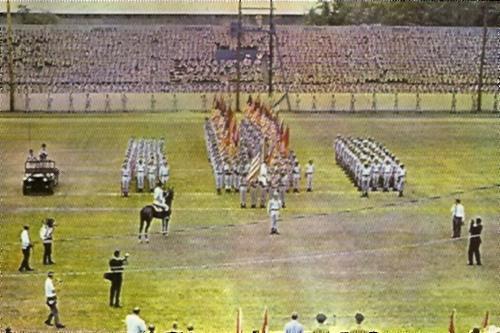
(Test), the 10th Air Transport Brigade and the 2nd Infantry Division. On 03
July 1965, in Doughboy Stadium at Ft. Benning, GA. the colors of the 11th Air
Assault Division (Test) were cased and retired. As the band played the rousing
strains of Garryowen, the colors of the 1st Cavalry Division were moved onto
the field and were passed to the commander of the former 11th Air Assault
Division (Test), Major General Harry W. O. Kinnard.
In parallel with the reflagging, the Division was reorganized with an
authorized staff level of 15,847 airborne personnel and fielded an aviation
group. The divisional helicopters numbered 335, and although the Howze Board
believed the number of ground vehicles could be cut by two-thirds, the
Division was authorized 1,500.
The Airborne Infantry Battalion had one combat support company with
reconnaissance, mortar, and anti-tank resources along with three rifle
companies. Although the battalion lacked 4.2 inch mortars and .50 caliber
machine guns, they had a number of new weapons. The M14 rifle was superseded
by the lighter M16, which put out more firepower and was supplemented by the
M79 40 mm grenade launcher. The question as to whether the airmobile division
should replace the airborne division had not been resolved. Planners decided
that one brigade of three infantry battalions and one artillery battalion was
to be authorized airborne qualified personnel as an interim measure,
Anticipating the increased requirements, the Aviation School at Ft. Rucker,
AL. held a special transition class to teach 89 aviators the skills that they
would need to fly the UH-1 Huey helicopter. In addition, another 120 aviators
were introduced to the aerial weapons firing course at Ft. Rucker.
The end result being that the newly reorganized and redesignated subordinate
units of the 1st Cavalry Division (Airmobile), in formation on the parade
ground, had been restructured by the transfer of the equipment assets and
specialized trained personnel of the following units:
| 1st CAVALRY DIVISION UNIT | RESOURCES UTILIZED |
|---|---|
| "HHC". 1st Cavalry Division, (Airmobile) | "HHC", 11th Air Assault Division (Test) |
| Division Reconnaissance 1st Squadron, 9th Cavalry |
3rd Squadron, 17th Cavalry |
| "HHC", 1st Brigade 1st Battalion (Airborne), 8th Cavalry 2nd Battalion (Airborne), 8th Cavalry 1st Battalion (Airborne), 12th Cavalry |
"HHC", 1st Brigade,11th Air Assault Division (Test) 1st Battalion, (Airborne), 188th Infantry 1st Battalion, (Airborne), 511th Infantry 1st Battalion, (Airborne), 187th Infantry |
| "HHC", 2nd Brigade 1st Battalion, 5th Cavalry 2nd Battalion, 5th Cavalry 2nd Battalion, 12th Cavalry |
"HHC", 2nd Brigade, 2nd Infantry Division 1st Battalion, 38th Infantry 2nd Battalion, 38th Infantry 1st Battalion, 23rd Infantry |
| "HHC", 3rd Brigade 1st Battalion, 7th Cavalry 2nd Battalion, 7th Cavalry 5th Battalion, 7th Cavalry (Note 1) |
"HHC", 3rd Brigade, 2nd Infantry Division 2nd Battalion, 23rd Infantry 2nd Battalion, 9th Infantry 1st Battalion, 11th Infantry (Note 1) |
| "HHB", Division Artillery 2nd Battalion, 19th Artillery (105mm) 2nd Battalion, 20th Artillery (AR) 1st Battalion, 21st Artillery (105mm) 1st Battalion, 77th Artillery (105mm) "E" Battery, 82nd Artillery (AVN) |
"HHB", Division Artillery, 11th Air Assault 6th Battalion, 81st Artillery (105mm) 3rd Battalion, 377 Artillery (AR) 5th Battalion, 38th Artillery (105mm) 1st Battalion, 15th Artillery (105mm) "E" Battery, 26th Artillery (AVN) |
| "HHC" & Band, Support Command 15th Medical Battalion 15th Supply & Service Battalion Aerial Eqpm't Sup't Co (Airborne) 15th Administrative Company 27th Maintenance Battalion 8th Engineer Battalion 13th Signal Battalion 15th Transportation Battalion 545th Military Police Company 191st Military Intelligence Detachment 371st Army Security Agency Company |
"HHC" & Band, Support Command, 11th Air Assault Div 11th Medical Battalion 408th Supply & Service Battalion 165th Aerial Eqpm't Sup't Detachment 11th Administrative Company 711th Maintenance Battalion 127th Engineer Battalion 511 Signal Battalion 611th Aircraft Maintenance & Supply Battalion 11th Military Police Company 11th Military Intelligence Detachment "C" Co, 313th Army Security Agency Battalion |
| "HHC",11th Aviation Group (Airborne) "HHC", 227th Aviation Battalion "A" Co, 227th Aviation Battalion "B" Co, 227th Aviation Battalion "C" Co, 227th Aviation Battalion "D" Co, 227th Aviation Battalion "HHC", 228th Aviation Battalion "A" Co, 228th Aviation Battalion "B" Co, 228th Aviation Battalion "C" Co, 228th Aviation Battalion "HHC", 229th Aviation Battalion "A" Co, 229th Aviation Battalion "B" Co, 229th Aviation Battalion "C" Co, 229th Aviation Battalion "D" Co, 229th Aviation Battalion 11th Aviation Company |
"HHC", 11th Aviation Group (Test) "HHC", 227th Aviation Battalion "A" Co, 227th Aviation Battalion Aviation Co, 6th Special Forces Group Aviation Co, 7th Special Forces Group 110th Aviation Co, (Aerial Weapons) "HHC", 228th Aviation Battalion 132nd Aviation Company (ASH) 133rd Aviation Company (ASH) 202nd Aviation Company (ASH) "HHC", 229th Aviation Battalion "A" Co, 4th Aviation Battalion "A" Co, 5th Aviation Battalion 194th Aviation Company (AH) 131st Aviation Company (AW) 11th Aviation Company (General Supt) |
| Note 1: On 01 April 1966, the 5th Battalion, 7th Cavalry was activated at Ft. Carson, CO, using the personnel and assets of the 1st Battalion, 11th Infantry, The advance party departed Peterson Field on 08 August and arrived Qui Nhon on 11 August. The main body departed Ft. Carson on 06 August and arrived Qui Nhon on 19 August 1966. | |
On 28 July, the First Team achieved REDCON-1, a readiness rating of highest
combat priority and on that same day President Lyndon Johnson announced to the
world: "I have today ordered to Vietnam the AirMobile Division." Work
accelerated to a torrid pace as the First Team prepared to leave for its
historic deployment. Troopers turned in their M-14 rifles and qualified on the
new M-16E1. Specialized training was stepped up. The Airborne School at Ft.
Benning graduated 659 new paratroopers for the division in just 10 days, which
allowed the round out of the new airborne brigade which had just been
approved.
In order to subdue the white name tags on faded fatigues, troopers used dark
green dye and the legend has it that the Chattahoochie River ran dark green
from the runoff of the dye used to camouflage the bright yellow, position
revealing patch. General Kinnard, enroute to Vietnam, made a stopover in Japan
to order a supply of black and dark green patches and insignia. This first use
of a subdued rank and unit insignia set a precedence for all units of the Army
to use.
In a matter of three and one-half weeks the newly formed division, organized
into a 16,000 man division along the lines of the 11th Air Assault Division
(Test), with a total of 434 helicopters, was prepared to enter combat, the
ultimate test of its capabilities. Actual movement of personnel was called
Operation PAT and was scheduled in three increments; an Advanced Liaison
Detachment; an Advanced Party and the Main Body.
The first echelon to depart was the Advanced Liaison Detachment composed of
32 officers and men. Led by Brigadier General John S. Wright, the detachment
left on 09 August and arrived in Vietnam two days later. Beginning on 14
August, for six days, the Advanced Party of 1,040 officers and men left Ft.
Benning and, along with their equipment cargo of 132 tons, including nine
UH1-B helicopters moved to Warner Robins Air Force Base at Macon, GA. From
there, they were deployed by C-124 and C-130 aircraft of the Military Airlift
Command. Flying via Travis Air Force Base, CA. Hickman Field, Hawaii and Clark
Air Force Base, Philippines; they arrived in intervals at Nha Trang between
the 19th and 27th of August 1965. Joining with the Advance Liaison Detachment,
they established a temporary base camp near An Khe, 36 miles inland from the
coastal city of Qui Nhon.
The third and final phase of troop and supply movement centered on the bulk
of the 1st Cavalry Division departing Ft. Benning, GA. and deploying by troop
and cargo ships of the Military Sea Transport Service. Approximately 13,500
men and their cargo left Columbus, Georgia by train and bus to staging areas
at port cities in the Southeastern United States. Six troop ships, seven cargo
ships and four aircraft carriers were employed in the over water movement. The
1st Brigade loaded on the Unites States Navy Ship (USNS) Geiger, the
2nd Brigade and an Artillery Battalion loaded on the USNS Buckner and
the 3rd Brigade on the USNS Rose. The remainder of the Division,
including elements of the Support Command, Aviation Group and the various
combat support units loaded on the USNS Darby, USS Alexander M.
Patch and USNS Upshure. On 16 August, the USNS Buckner and
USNS Darby departed Charleston, SC.. The other four troop ships
departed over the next four days from Charleston, SC. and Savannah. GA.
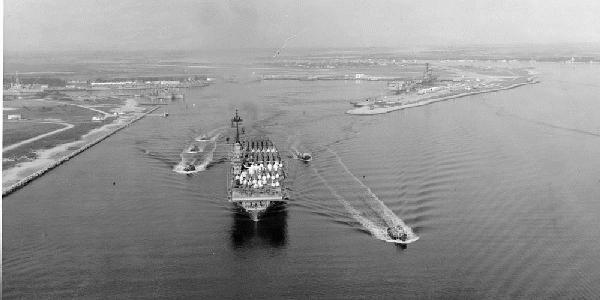 |
|---|
| The USNS Boxer Leaves for Vietnam |
The 470 aircraft of the division were loaded on the Carriers USNS Kula
Gulf, USNS Croaton, USNS Card and the USNS Boxer.
The Boxer, carried a total of 239 aircraft; fifty seven Chinooks
(CH-47s), four Flying Cranes (CH-54s), six Mohawks (OV-1s), fifty Hueys
(UH-1s), and one hundred twenty-two Sioux (OH-13s). On 11 August, the first of
the carriers, the USNS Croaton sailed from Mobile, AL. The remaining
three departed on subsequent days. The USNS Card left Mobile, AL and
the USNS Boxer and USNS Kula Gulf sailed from the Mayport Naval
Station at Jacksonville, FL. The sea movement of the echelon traversed the
world, moving both West and East. The other aircraft carriers and troop ships
sailed west through the Panama Canal, stopping at the islands of Hawaii, Guam
and the Philippines.
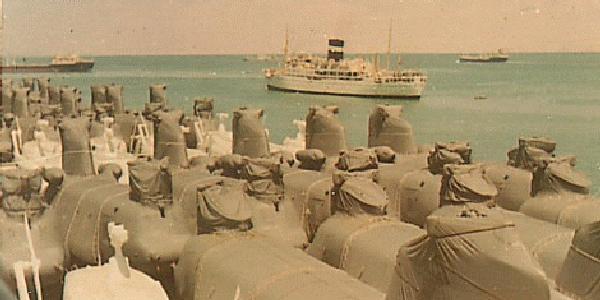 |
|---|
| Close Up Of CH-47 Helicopters On Boxer Flight Deck |
The foreground, above, shows that the flight deck of the Boxer, as it left
the North coast of Florida for Vietnam. It was litterly covered with the 200
environmentally packaged CH-47 Chinooks helicopters of the 1st Cavalry
Division. (Those in the field can quickly recognize the improvements in
packing technology that have been made with the development of "shrink wrap"
plastics.) The route of the Boxer to Vietnam was different than the other
ships, as it sailed east in the Atlantic - through the Mediterranean Sea, the
Suez Canal, Red Sea and Indian Ocean and into the Pacific Ocean and anchored
off the coast of Vietnam. Following unpackaging and service inspections, the
helicopters were flown directly to the airbase at Camp Radcliff, at An Khe,
Binh Dinh Province, Vietnam.
On 03 September, following the departure of the sea movement, a second echelon
of the Main Body departed Ft. Benning, GA. The 18 Caribou aircraft of the 17th
Aviation Company took off from Lawson Army Airfield enroute to Hamilton Air
Force Base, CA. The first, and longest leg of the trip took an average of 17
hours and was completed without an incident. On 06 September, the aircraft
departed for Southeast Asia with scheduled refueling and maintenance stops at
Hawaii, Wake Island, Guam and the Philippines, arriving at Vung Tau on 18
September. After a quick refueling stop, they moved on to An Khe.
Within a month of becoming the Army's first air mobile division, the First
Team was on its way to combat as the first fully committed division of the
Vietnam War.
As you journey through the history of the 1st Cavalry Division and its
assigned elements, you may find it interesting enough to send a message to
your friends and extend them an invitation for the opportunity to review the
rich history of the Division. We have made it easy for you to do. All that is
required is for you to click on the Push Button below, fill in their eMail
addresses and send.


| The TITLE and URL of this WebSite are automatically read, formatted and entered into your standard eMail form. |
|
Note - The eMail Message is processed and transmitted On-Line to the
addressee(s) via your Internet Provider. |
 Need a gift for an Alumni of the 1st Cavalry Division? |
|---|


 eMail Your WebSite Comments.

Return to "MyOwnPages"©.

Revised 04 Jan '13 SpellChecked