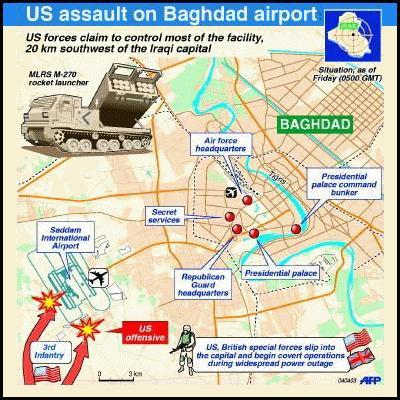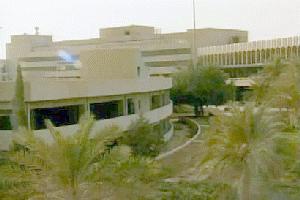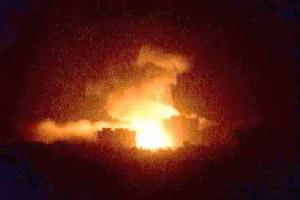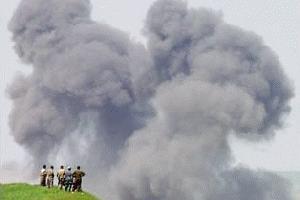

|
|---|

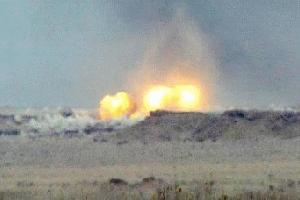
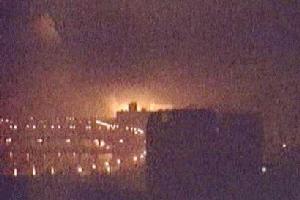
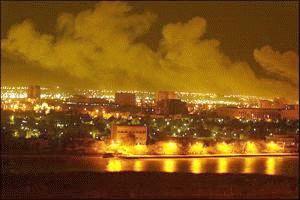
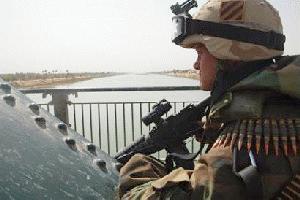
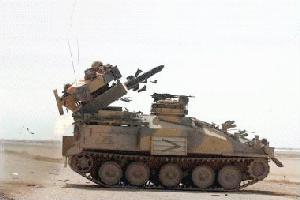
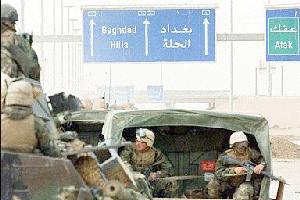
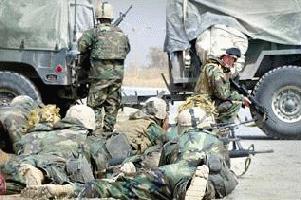
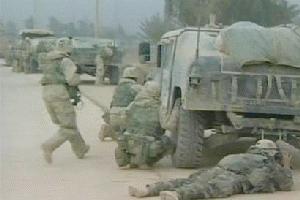
 As Operation IRAQI FREEDOM - I got underway on Thursday, 20 March (Day-1)
2003, at 0530 hours (local), with a coalition force of 300,000 troops ringing
Iraq and thousands of them poised on the Iraqi border with Kuwait, hostilities
began with a narrow focus on "selected targets of military importance",
limited to Iraqi leadership targets around Baghdad, and expanded into a
"broad and concerted campaign".
As Operation IRAQI FREEDOM - I got underway on Thursday, 20 March (Day-1)
2003, at 0530 hours (local), with a coalition force of 300,000 troops ringing
Iraq and thousands of them poised on the Iraqi border with Kuwait, hostilities
began with a narrow focus on "selected targets of military importance",
limited to Iraqi leadership targets around Baghdad, and expanded into a
"broad and concerted campaign".
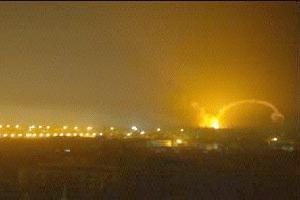
Seven warplanes pierced the night sky over Iraq, racing toward Baghdad on a
mission to behead Saddam Hussein's government and perhaps hasten a war's end.
Trying to stay invisible to the Iraqis, the planes sprinted at just under the
speed of sound. The assignment was so secret that none of the pilots had been
briefed on the identity of their target. The approach of dawn colored the sky.
The crews caught glimpses of Baghdad through breaks in the clouds. Two pilots
split their formation and dived for a bucolic retreat on the south bank of the
Tigris River. The Iraqi President slept there.
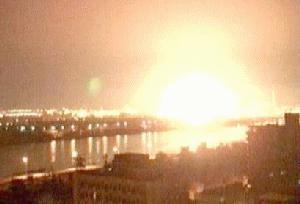
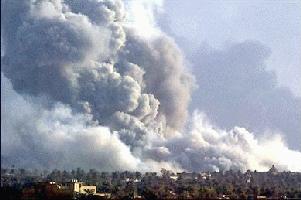
As other US Navy Tomahawk missiles and satellite guided bombs from F-117
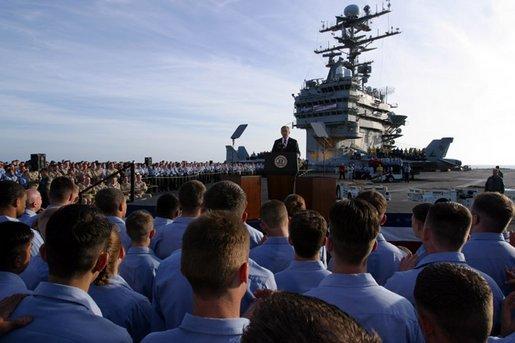
Stealth fighters struck the Baghdad area, President George W. Bush spoke from
the Oval Office. "Now that conflict has come, the only way to limit its
duration is to apply decisive force," Bush said in his four-minute address
delivered about two hours after the 2000 Hours (EST) deadline he had set for
Saddam to leave the country. "This will not be a campaign of half-measures,
and we will accept no outcome but victory."
|
|---|
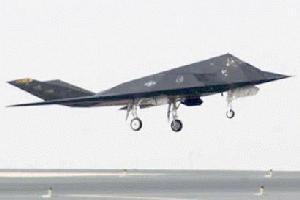
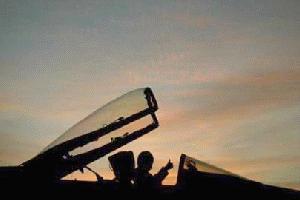
As a F-117A Stealth fighter/bomber returned to an undisclosed location after
a mission over Iraq, President George W. Bush characterized the military
campaign as an attempt to prevent future terrorist attacks on the United
States and its allies, as well as a mission to free the long-suffering Iraqi
people from decades of authoritarian rule. But it is a war that will be
watched warily in Europe and the Arab world, where distrust of US motives is
high and fears of a rising Islamic militancy are deep.
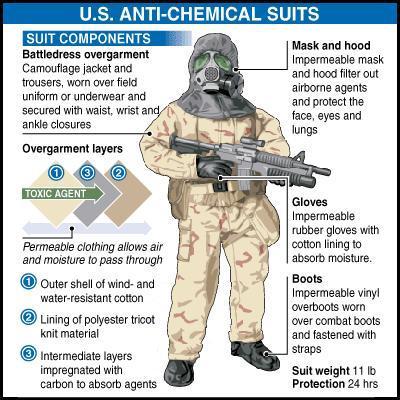
In the hours following the first strike of targets in and around Baghdad, in
retaliation, Iraqi forces fired missiles into Kuwait in a series of apparently
ineffectual counterattacks against US troops and Kuwaiti civilians, forcing
American soldiers to put on gas masks and chemical protective suits. Coalition
Defense officials indicated that at least one of the missiles fired was a
Scud. Following the missile attack, each side exchanged artillery fire in
localized battles as the Coalition Forces continued to update target surveys
for the main preparation event of "Shock and Awe" which will proceed the
ground invasion.
|
|---|
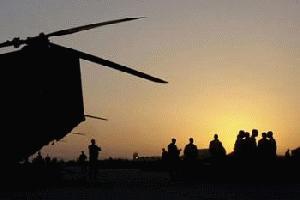
As the attack on Iraq continued on the 20th, an unrelated operation began in
Afghanistan at 0600 hours (local). In the early morning hours Operation
VALIANT STRIKE began as attack helicopters, an 800 soldier battalion of the
82nd Airborne Division, known as the "White Devils", and their Afghanistan
allies stormed villages in southern Afghanistan in raids aimed at tracking
down remnants al-Qaida and the Taliban. The attack was focused in the Maruf
district of Kandahar province where the Taliban's supreme leader Mullah
Mohammed Omar has tribal links. The US forces were looking over activities of
residents in at least three different villages in the mountainous region.
The military launched the operation on areas east of Kandahar, the former
spiritual headquarters of the Taliban, after receiving "a mosaic of different
intelligence inputs" of activity in the area. Soldiers combed rough mountain
terrain where radio transmissions had been detected coming from caves above
the villages.
The assault was one of the biggest in Afghanistan since Operation ANACONDA
just over a year ago, King said. That eight-day battle pitted hundreds of
Taliban and al-Qaida fighters against thousands of American and allied Afghan
troops. Since then, the multinational, US led coalition has carried out at
least a dozen major offensives. An operation of similar size took place in
neighboring Helmand province about a month ago in which several suspected
militants were killed and about 30 were captured.
|
|---|
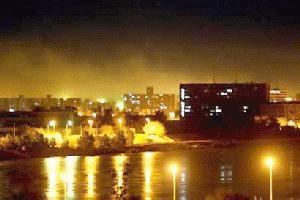
On Thursday, under the cover of the early morning darkness and cruise missile
attack on Baghdad, units of the US Marine 1st Expeditionary Force crossed the
Demilitarized Zone from Kuwait into southern Iraq to secure positions for a
thrust northward by massed US and British troops. The US 1st Marine Division
engaged Iraqi troops south of the Iraqi border in Kuwait and, in what was
believed to be the first ground combat of the war, encountered two Iraqi
armored personnel carriers and destroyed them. British troops have moved into
the Al Faw Peninsula of southern Iraq. The Al Faw Peninsula runs from the
Iraqi city of Basra to the Persian Gulf and is home to a significant portion
of the oil industry of Iraq.
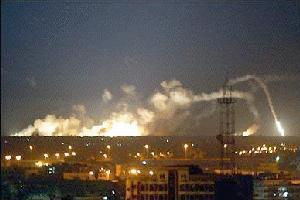
On Friday, 21 March (Day-2), another wave of sea launched cruise missiles fell
on Baghdad for the second straight night in the escalation of the war to drive
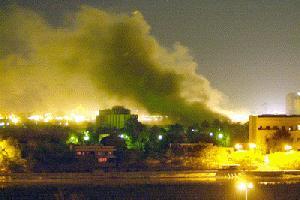
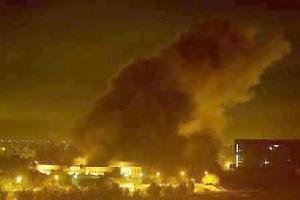
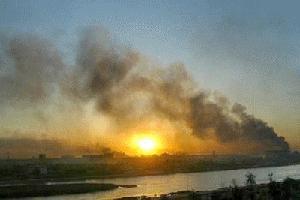
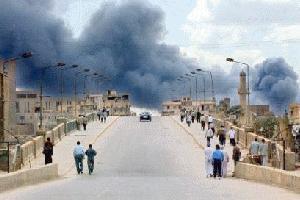
Saddam Hussein from power. In the capital, red and white anti-aircraft tracers
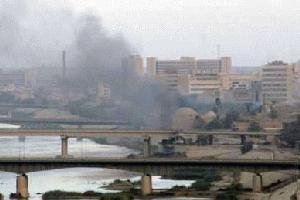
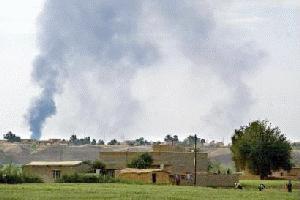
lit the night sky and a huge plume of smoke rose into the night from the west
bank of the Tigris River in central Baghdad. These attacks were not the
beginning of the massive air assault that the Pentagon plans to unleash.
Rather it was a direct, pinpointed assault of the elite Republican Guard
strongholds and the main palace of Saddam Husse in Baghdad. In southern Iraq,
white light glowed in the desert sky, and the sound of explosions could be
heard from across the Kuwait-Iraq frontier as the 3rd Infantry Division
unleashed its artillery barrage. Among the targets hit by coalition strikes
were a military site in the southern town of Basra near the Kuwaiti border and
another target in Akashat, a town about 300 miles west of Baghdad near the
Syrian border.
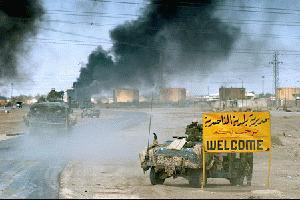
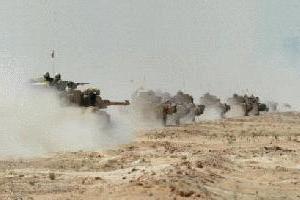
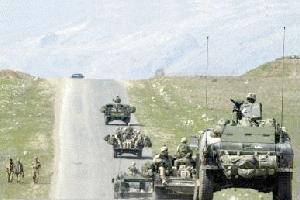
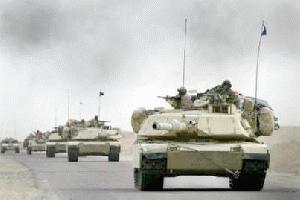
In the second day of the war, US and coalition forces swept across the Iraqi
desert, seizing key towns in the southern part of the country. A convoy of
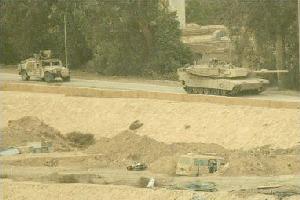
Bradley fighting vehicles and M1A1 Abrams tanks and other vehicles from the
3rd Squadron, 7th Cavalry Regiment, lead element of the 3rd Infantry Division,
raced virtually unopposed toward Baghdad in "a huge wave of steel."
In lightening raids, US and British troops seized two strategically important
air fields in western Iraq. The two western Iraq air fields, known as H-2 and
H-3, considered important to the continued military operation inside Iraq and
the field known as H-3 is also considered by US intelligence to be a potential
Iraqi Weapons of Mass Destruction (WMD) site.
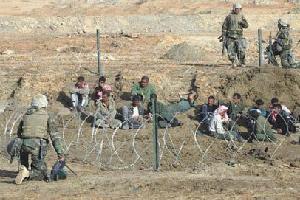
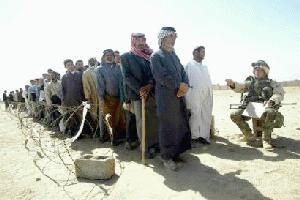
US Marines seized a portion of the main road leading from Kuwait to Basra,
suppressing resistance from Iraqi mortars and arms. Within a few hours of
crossing into southern Iraq, the 15th Marine Expeditionary Unit encountered
200 or more Iraqi troops seeking to surrender as they advanced toward key
Iraqi targets in southern Iraq, including Basra, the nation's second-largest
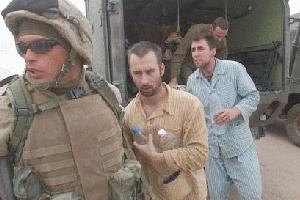
city. One group of 40 Iraqis marched down a two-lane road toward them and
surrendered. They were told to lie face down on the ground, then were searched
by Marines. Later as the 1st Marine Division entered the town of Safwan, they
were greeted by waving Iraqi civilians.
|
|---|
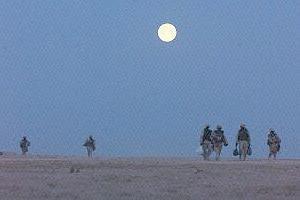
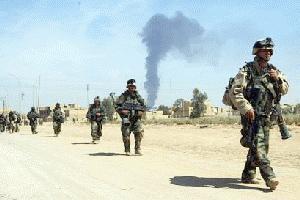
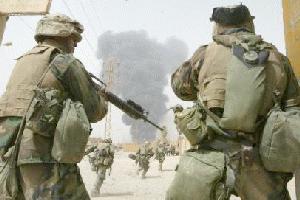
Early Friday, moving on to their interim objective into Iraq, the 1st Marine
Division saw burning oil wells that sent a black cloud into the night sky
under a nearly full moon. It was not known if the flames resulted from the
explosions. The fires could be seen on the horizon in the direction of the
southern Iraqi oil center of Basra. The Arab satellite television channel
Al-Arabiya reported that fires had erupted in Iraq's al-Rumeila field west of
Basra.
Later in the day, US and British Royal Marines, took full control of the
Al-Faw Peninsula oil installations and the strategic port of Umm Qasr in
southern Iraq. Utilizing the specialized support of US Navy Seal teams, two
main offshore Gulf oil terminals, 22 miles off Iraqi's southern coast were
seized. Umm Qasr, located along the Kuwait border about 290 miles southeast of
Baghdad, gives US and British forces access to a sea port for offloading
military and humanitarian supplies and will speed the clearing of Iraqi
resistance in the south.
Meanwhile, administration officials were debating whether Saddam survived the
first strike of the war and to what degree his senior leadership has been
shaken. Iraqi government spokesman Mohammed Sahaf said Friday that Saddam is
"safe" even though the Iraqi leader's home and family had been targeted.
Regardless of the Iraqi leader's fate, the apparent disarray within the Iraqi
leadership led US and coalition officials to alter the original war plan, which
had called for an immediate and extensive bombing campaign to create "shock
and awe" among Iraqi soldiers.
|
|---|
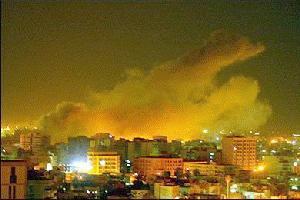
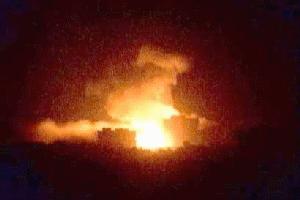
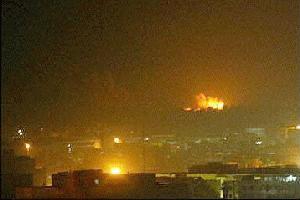
In the evening of Friday, at 2000 hours (local), the US launched the much
heralded massive "shock and awe" campaign. Described as Aerial Day, it was a
massive aerial assault on targets in Baghdad and beyond on, in a major
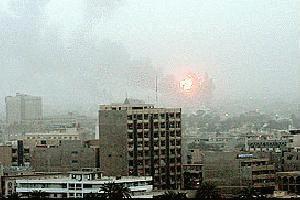
escalation of the war to drive Saddam Hussein from power. Explosions
reverberated in downtown Baghdad, sending great columns of fire and huge
plumes of smoke into the night sky as over 500 cruise missiles found their
targets and aircraft dropped bombs over the capital city. Massive cruise
missile strikes took out dozens of buildings in Baghdad and across Iraq as the
Pentagon began its promised "shock and awe" aerial campaign.
Many missiles struck the presidential compound of President Saddam Hussein. As
many as 25 buildings were blown up in a matter of 10 minutes. Other buildings
that were on fire included offices of the Council of Ministers and a
government bunker. The Baghdad strikes were from sea-based cruise missiles.
The attack lasted over 3 1/2 hours with the "all clear" not being sounded
until 2330 hours (local). In parallel with the Baghdad attack, hundreds of
sorties were carried out against targets in other Iraqi cities.
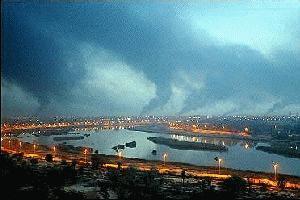
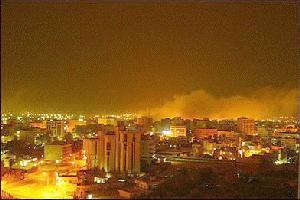
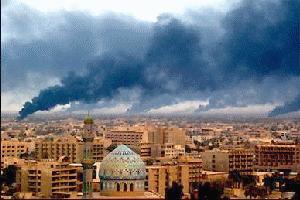
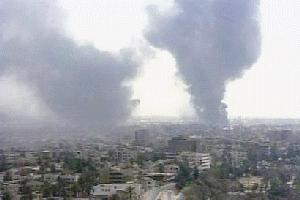
On Saturday morning, 22 March (Day-3), Baghdad awoke to brilliant sunshine
clouded by dense smoke left from the mammoth US air attack on Friday evening.
A half-dozen loud explosions from sporadic follow-up strikes punctuated an
otherwise eerie silence that settled over the Iraqi capital awaiting the next
aerial strike. During the day, at least 20 columns of dark smoke could be seen
rising from points around Baghdad after intermittent explosions were heard
throughout the day. It was reported that the plumes were coming from fires
that Iraqis had set to oil containers around the city to obscure targets. A
series of strong explosions shook the Iraqi capital soon after sunset, and
some of them appeared to be in the center of the city. Aircraft could be heard
overhead when the strike on offices of Iraqi leadership and command centers
began about 1915 hours (local).
|
|---|
To the southeast, US and British had advanced north from Kuwait about
one-third of the way to Baghdad, securing oil wells and other infrastructure
along the way. US jets bombed Iraqi tanks holding bridges supporting and US
and British forces as they advanced on the next major target, the city of
Basra, 230 miles southeast of Baghdad. Moving through moderate resistance,
they surrounded the city and position themselves to take the city that is
defended by the Iraqi 3rd Brigade, a mechanized unit, numbering 8,000 soldiers
and 200 tanks.
The battle for Basra, an oil hub of some 1.3 million people, was underway
by midday, with coalition troops trying to surround Iraqi positions and force
a surrender. As US aircraft bombed Iraqi tanks holding bridges close to the
city, Iraqi forces responded with artillery fire. The final assault on Basra
was delayed pending final results of negotiations for "a peaceful surrender"
which would avoid a bloody urban battle. The British took charge of continuing
negotiations and fighting at Basra, permitting the Marines to continue north
and advance to Baghdad on a more direct route along the Tigris River. Later in
the day, aircraft from the Golden Dragons Squadron from the Kitty Hawk dropped
seven laser-guided bombs on artillery pieces at Al-Qurnah, north of Basra, in
support of the advancing 1st Marine Expeditionary Force.
|
|---|
Unable to negotiate a satisfactory agreement, on Saturday, the Defense
Department abandoned plans to move heavy armored forces into northern Iraq by
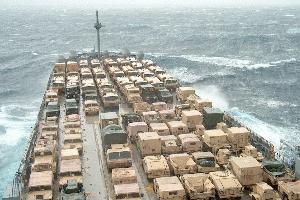
the way of Turkey. After weeks of waiting off Turkey's coast, dozens of US
ships carrying 14,000 pieces of equipment in support for the 4th Infantry
Division were redirected to the Persian Gulf and began moving through the Suez
Canal.
The soldiers of the 4th Infantry Division, who remained at Fort Hood, TX,
after their weaponry and equipment went to the Mediterranean last month, are
likely to go to Kuwait or, as an alternate, they could enter Iraq directly
through the Gulf port of Umm Qasr, now under the control of US Marines and
British forces.
At about 1500 hours (local) Saturday, a key city, An Nasiriyah, on the north
bank of the lower Euphrates River, 233 miles southeast of Baghdad fell to US
forces, opening a major route to Baghdad for US Army mechanized troops
advancing northward. The main thrust was provided by the 3rd Brigade, 3rd
Infantry Division, from Fort Benning, GA. Units from that division had come
under artillery fire Friday afternoon as it approached An Nasiriyah. After
radar tracked those rounds to their source, artillery fire was returned and
the Iraqi guns were silent.
An artillery barrage preceded the attack by tanks, mechanized infantry and
attack helicopters. The first target was the airfield at Talil, just outside
An Nasiriyah, the home of the Iraqi's 11th Division.
|
|---|
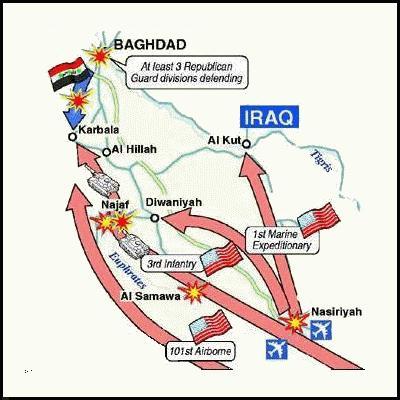
By Sunday, 23 March (Day-4), the 2nd Brigade, 3rd Infantry Division had driven
night and day to had covered 228 miles on the route that follows the Euphrates
River in less than 40 hours across rough desert terrain in a bold flanking
movement that placed US forces less than a day's march from Baghdad. at a
location 45 miles southeast of the city of Najaf.
Late Saturday, the brigade had encountered Iraqi fighters, believed to be
members of the ruling Baath party militia, and fought until dawn Sunday,
destroying 15 vehicles, killing at least 100 of the Iraqi militiamen and
capturing 20 prisoners of war.
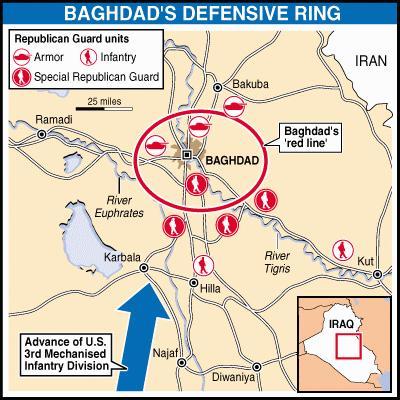
The first real test could come when the Third Infantry Division encounters the
Republican Guard, Hammurabi Division, on the southwestern approach to Baghdad.
Similarly, when the Marines encounter the Republican Guard, Nebuchadnezzar
Division on the southeastern approaches.
The relentless drive to Baghdad continued at a record pace. The 3rd Squadron,
7th Cavalry Regiment, 3rd Infantry Division has been battling a battalion size
force of the Iraqi army but remained ahead of schedule in its march. Earlier
Sunday, the 3rd Squadron was halted near the city of Najaf. They began to take
some small arms fire and called for close air support and long range artillery
to attack enemy forces to the north. In the artillery barrage, three shells
landed within 75 yards, sending troops scrambling to disperse their tanks and
armored vehicles. Once on target, the artillery pounded the Iraqi positions.
Earlier, soldiers on reconnaissance missions had seen members of the Iraqi
Republican Guard herd Iraqi women and children to military positions for use
as human shields.
|
|---|
Down river from Najaf, US Marines encountered heavy resistance and suffered
casualties at fighting near the southeastern Iraqi city of Nasiriyah on the
Euphrates River, 233 miles southeast of Baghdad. The battle raged for hours
before Iraqi resistance was vanquished. The worst fighting was along a stretch
of road between two bridges, and resistance stiffened as night fell. Marines
had decided to move around the city rather than march through it on the road
to Baghdad.
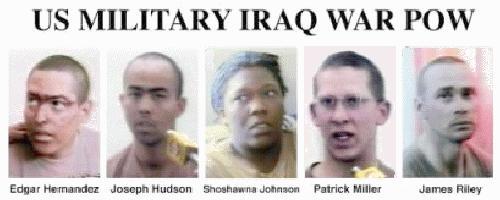
The US Marines entered the city after Iraqi forces ambushed a US military
convoy bringing supplies to coalition forces in the region. The vehicles were
destroyed, and a dozen soldiers of the 507th Maintenance Company were missing
and later determined to have been captured.
As Sunday evening came, the pace of air strikes over Baghdad picked up. Smoke
billowed into the night sky after a heavy bombardment on the palace of Iraqi
President Saddam Hussein. Multiple explosions shook Baghdad in one of the
heaviest air attacks of the war, setting buildings ablaze and clouds of smoke
into the sky. Fires were blazing in the southeast of the city and the sky was
full of smoke.
|
|---|
As Monday, 24 March (Day-5), arrived the strikes continued as a series of
blasts shook the center of the Iraqi capital at around 0310 hours (local),
with no prior warning from air raid sirens and no sign of anti-aircraft fire,
The explosions appeared to hit targets in the center and southeast of Baghdad,
sending plumes of smoke into the night sky. Although many of the targets were
new, one large blast seemed to concentrated in the area of the Iraqi Air Force
headquarters, which had been hit during previous raids.
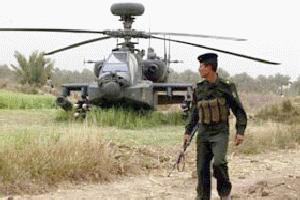
In the early hours of 24 March, Apache attack helicopters of the 1st
Battalion, 227th Aviation Regiment, 1st Cavalry Division attached to Task
Force 11th Aviation operating under the command of the US Army V Corps, fought
a fierce battle with units of Iraq's Republican elite Medina Division units
between the cities of Karbala and Al Hillah, about 96 kilometers (60 miles)
south of Baghdad.
One of the elements of the opposing force struck was Iraqi T-72 battle tanks,
the most advanced tank used by the Iraqi forces. The Republican Guard was
estimated to have at least 90 of those tanks, along with "multiple" pieces of
field artillery and armored personnel carriers, The attack started after
midnight and lasted about three hours. The Apache unit went up against the 2nd
Armored Brigade of the Medina Division, which is part of the Republican Guard, the
troops most loyal to Saddam Hussein. Many Apaches were hit by fire, but
managed to destroy 10 Iraqi tanks before cutting off their attack. They also
attacked positions between Karbala and Hillah, which straddle the Euphrates
River south of Baghdad.
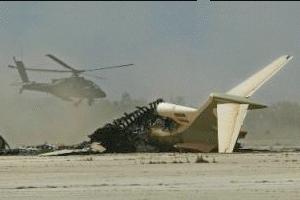
During the battle, one of the AH-64D Apache Longbow helicopters (99-5135) of
"C" Company, 227th Aviation Regiment received a hit which damaged the Flight
Management Computer. Losing control, the pilot had to make an emergency
landing and come down in a field near Karbala, about 60 miles southwest of
Baghdad, close to the site where the fierce predawn battle took place. The
attack force had not expected such strong Iraqi resistance from what they
thought were mostly civilian populated areas.
|
|---|
During the battle, two attempts to rescue the pilots were aborted due to heavy
fire. The next day, al-Jazeera, the Arab world's TV broadcast in Iraq showed
the downed AH-64 helicopter sitting upright on the ground in an open field.
From appearances, it did have any external battle damage to indicate that it
had been shot down as reported by the al-Jazeera narrator. The helicopter was
quickly located by Coalition aircraft and destroyed so that none of the
classified electronic on-board systems would be salvaged and examined by any
foreign agents.
After their Apache helicopter came down, Chief Warrant Officer David S.
Williams and Chief Warrant Officer Ronald D. Young jumped in a canal and swam
a quarter-mile but were caught by armed farmers who spotted them in the
moonlight when they tried to run for cover in a stand of trees. The villagers
beat them with sticks and were threatened at knife point. Afterwards the two
men were thrown in the back of a pickup truck and driven around "to show all
the other people that they had captured Americans. Originally, the Army
classified the two men as "missing in action", but later in the day, the Iraqi
Government showed them on local and national TV channels and announced that
the two pilots had been captured and would be treated as prisoners of war.
|
|---|
The 3rd Infantry Division dashed north Monday toward the Shiite holy city of
Karbala, only 50 miles south of Baghdad, but was stalled by a sandstorm that
came out of the desert. The troops moving on Karbala made their rapid advance
under the protection of heavy allied air cover that wiped out a column of
charging Iraqi armor, causing some of Iraqi outer defense forces to stop and
retreat.
The trip north passed bombed anti-aircraft guns, empty foxholes and berms dug
for tanks that had been abandoned by Iraqi forces. But the weather, not Iraqi
troops, halted the long columns of thousands of vehicles that were stretched
across the desert terrain and farms.
Meanwhile, outside the Shiite holy city of Najaf, south of Karbala, US
soldiers skirmished with Iraqi forces before dawn Monday. Iraqis shot rockets
and anti-aircraft guns at the US forces. Small groups using pickup trucks or
on foot tried to approach US positions but were driven back by tank and
artillery fire.
Further to the south, British troops exchanged artillery with Iraqi forces on
the outskirts of Basra. British troops had remained outside the city, unable
to move through and secure it because of pockets of resistance that was
coming from irregular units, either the elite Republican Guard, Special
Security Organization forces or Saddam's Fedayeen, the Baath Party
paramilitary organization.
|
|---|
Early Tuesday, 25 March (Day-6), Baghdad was rocked by more intense bombing
raids on the outskirts of the capital, where clouds of smoke from burning fuel
trenches blackened the sky. At 1500 hours (local), there was an intensifying
series of strikes on the fringes and outer southern suburbs areas were the
elite Republican Guard was defending Baghdad's approaches. Aircraft could be
heard roaring at high altitude over the capital, but could not be seen amid
the dark clouds.
With distant explosions growing in frequency, more and bigger defensive
trenches around the city are being constructed, including in the courtyard of
the Iraq museum, home to priceless antiquities, some dating to 7,000 BC.
US and Coalition bombers and artillery continued to pound at positions of
elite Republican Guard units arrayed in defense of Baghdad as 3rd Infantry
Division slowly advanced toward the capital and took positions within 50 miles
of Baghdad, in front of the Republican Guard's feared Medina Division.
Progress was hampered as a weather front blew in from the west, whipping up
sandstorms that slowed the advancing forces and hampered air operations,
reducing visibility near zero in some places.
Moving north, at a location 150 miles south of Baghdad, a large convoy of the
Marines' 1st Expeditionary Force, regained control of the city and crossed the
Euphrates River and Saddam Canal at Nasiriyah late, resuming their key
advance. The convoy had raced through the streets along a protective corridor
of US armor, crossing first the river and then the canal, after engaging heavy
fighting using AH-1 Cobra attack helicopters and artillery. Success in
breaking through sets up a northward advance on the far bank of the Euphrates
that could eventually form the eastward arm of a classic pincer movement.
Plans called for the 3rd Infantry Division, backed up by the 101st Airborne
Division, to attack the Medina Division north of Karbala, while the Marines'
1st Expeditionary Force would hit the Republican Guard's Baghdad Division
outside Al Kut.
|
|---|
The intense sandstorm grounded many bombing overflights over Iraq and slashed
visibility and brought progress of advancing US led military convoys in the
area near Karbal to a standstill. However, the weather had not affected the
artillery. Throughout the day, US forces pounded Iraqi targets near the
capital with howitzers and rockets.
Elements of the 3rd Squadron, 7th Cavalry Regiment, 3rd ID were east of An
Najaf, about 90 miles south of Baghdad, when they suddenly came under fire
from rocket-propelled grenades. The Iraqis advanced on foot and it was not
clear whether they were from regular army units, paramilitary forces or the
Republican Guard. Air strikes were called in support of the battle. Within
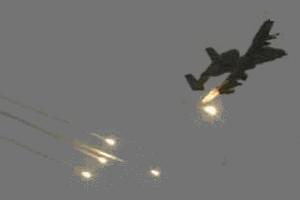
minutes, A-10's dropped 500 pound bombs and raked the Iraqi positions with
cannon fire. Early estimates of the number of Iraqis killed in the fight
varied widely, from 150 to 500.
Further south, it was the third consecutive day that US Marines have battled
Iraqi forces for control of the key north-south route in the southern city of
Nasiriyah. The city has been the site of some of the heaviest fighting of the
war. The Marines are fighting to secure control of the bridges over the
Euphrates River, which are a key to the US advance north toward the Iraqi
capital, Baghdad.
In the most southern Iraq city of Basra, British commanders reported a popular
uprising against the ruling Baath Party was under way. Groups of 40 to 50
citizens gathered at various locations on the streets and British forces had
taken out an Iraqi mortar firing on the apparent protesters. Elements of
Iraq's 51st Division have massed at Basra, bringing artillery, tanks and
infantry into some civilian areas. In addition about 1,000 irregulars of the
Iraqi army have withdrawn into the city. In support of the Iraqi forces, a
militia called the Saddam Fedayeen, dressed in civilian clothes, is on the
outskirts of Basra are resisting with human shields in front of them and are
firing toward the British.
|
|---|
As early dawn broke on Wednesday, 26 March (Day-7), more than 30 large
explosions struck the southern outskirts of the Iraqi capital and another hit
the city center. No anti-aircraft fire could be seen and air raid sirens
remained silent in this city of over five million people. The bombing
continued for 3 hours. Smoke rose from the areas of Baghdad where the ministry
of information, television station and satellite link sites were situated.
Later in the morning, Iraqi's satellite television was showing either a blank
screen or sporadic still pictures which suggested technicians were struggling
to bring it back on the air.
The decision to take down the television station which would potentially kill
civilian employees was made at the Presidential level. This action was taken
so that the station could not be used as an alternate method of communicating
with the Iraqi soldiers in the impending battle with the Republican Guards
that are believed to be dug in on the southern flank of the city to defend it
against the US and British forces.
Meanwhile, thousands of Iraqi troops were reportedly moving south from Baghdad
under the cover of blinding sandstorms on a route that appeared likely to
place them in the path of the 1st Marine Expeditionary Force. There were
conflicting reports about whether Republican Guard units were among those on
the move.
Further south, unexpectedly stiff resistance from Iraqi forces, possibly
including the Saddam Fedayeen militia, and a powerful sandstorm combined to
slow the 1st Marine Expeditionary Force who had been fighting in recent days
around An Nasiriyah. The unit is now on its way north toward Baghdad where
Saddam and his regime are expected to make their last stand.
By the evening of Wednesday, the column had moved with mortar fire coming in
front and behind, to at least as far as the city of Qal at Sukkar, about 60
miles north of Nasiriyah and 140 miles southeast of Baghdad. The Marines
acknowledged they have been forced to abandon their breakneck race to the city
and instead take the time to destroy Iraqi mortar nests and other targets
along the route.
|
|---|
Desert Rat units from 7th Armored Brigade British forces entered the outskirts
of Iraq's second largest city of Basra after Iraqi troops reportedly fired
mortars at their own people to quell an uprising. On the ground, the Desert
Rat units were fighting rain and mud as well as roaming bands of dedicated
Saddam loyalists as they maneuvered around the city in search and destroy
patrols. Aggressive patrols were mounted across all the territory controlled
by 7th Armored Brigade. By the afternoon, they were involved in fighting on
the outskirts of the town.
As ground troops ringed the city, two Harrier jet aircraft used
satellite-guided bombs to obliterate the Basra headquarters of Saddam's ruling
Baath party located in the middle of the town. As aircraft attacked, a Iraqi
convoy of 70 to 120 vehicles, armored vehicles and armored personnel carriers
moved out of Basra under cover of sandstorms. They were quickly attacked by
coalition aircraft and artillery, raising hopes that British troops could soon
enter a city on the verge of a humanitarian crisis.
|
|---|
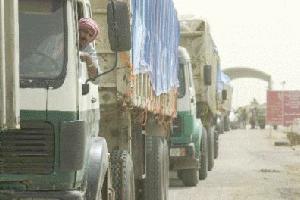
As allied forces struggled to clear the way for more aid shipments, using
dolphins to assist in the removal of mines from waterways and while trying to
subdue Iraqi fighters in the city of Basra, the first sizable relief convoy
rolled into Iraq in a sandstorm Wednesday.
Aid agencies had been trying to rush water to the besieged population of some
1.2 million people amid fears of a humanitarian crisis in the mainly Shiite
city unless local water processing plants can be placed back in operation
soon. The first convoy of shipments, five trucks, loaded with 45,000 boxes
filled with water and food was managed and operated by the Red Crescent
Society in Kuwait. More will be heading over the border Thursday.
A unit of the Army's 173rd Airborne Brigade, based in Italy, stepped out of
C-17 Globemaster transports and parachuted in to seize Harir airfield 45
miles northeast of the Kurdish city of Arbil, about 30 miles south of the
Turkish border in territory controlled by the Kurdish Democratic Party, This
unit becomes the first sizable American military presence on the ground in
that part of the country signaling the beginning of an American strategy of
opening a northern front against Saddam Hussein's regime. Previously, before
this operation, several hundred special forces troops were the only US units
operating on the ground in northern Iraq.
The denial of Turkey to open up a northern flank prevented a pincer attack on
Baghdad from happening and required the movement of airborne units to secure
air fields and preparation to airlift elements of the US 1st Infantry
Division, equipped with Abrams tanks and Bradley fighting vehicles to establish
a staging area.
Increased attention of US Forces to the northern front was emphasized when
earlier in the day, US warplanes pounded Iraqi positions in the north. Five
large explosions threw up plumes of black smoke on the hilltops overlooking
Chamchamal, a town in the Kurd-controlled Iraqi enclave wrested from Baghdad
after the 1991 Gulf War.
|
|---|
Early Thursday, 27 March (Day-8), at 0400 hours (local), waves of explosions
rocked Baghdad overnight as the Iraqi capital marked a grim week since the
start of a US led war aimed at ousting President Saddam Hussein. More than 30
blasts could be heard around the city in at least four rounds through the
night, keeping sleep-deprived residents on edge. Anti-aircraft fire could be
heard during the latest 10 blasts and almost exactly a week since US led
forces began the war on March 20 with a dawn raid at 0533 hours (local). Some
of the overnight explosions were near the center of the capital, others around
the fringes of a sprawling city that is home to five million people. Smoke,
from the burning oil trenches, continues to blanket the sky over Baghdad.
Following up on previous overnight reconnaissance reports, waves of B-52
bombers pounded the convoy of Iraqi military vehicles before they could reach
the lead elements of the 3rd Squadron, 7th Cavalry Regiment, 3rd Infantry
Division in Najaf, about 60 miles south of Baghdad. The force was smaller than
initial intelligence reports suggested and that most of the force was
destroyed. Air traffic controllers with the US Air Force that the bombers
pounded the convoy "almost into oblivion."
The vicious sandstorms that blunted US airpower for days began to abate as US
forces headed north toward Baghdad, warned of a possible confrontation with a
huge Iraqi convoy moving south - Saddam Hussein's best-trained, best-equipped
and most tenacious fighters, the Republican Guard. Through reconnaissance, it
was later confirmed that the convoy consisted of "Technical Vehicles" (a
pickup truck with machine guns mounted on the truck bed) manned by Militia
units.
|
|---|
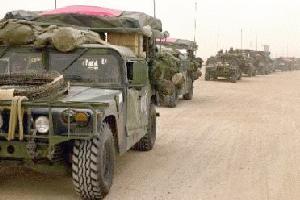
Vast columns of US military vehicles, one 10 miles long, rolled along a
six-lane highway toward the Iraqi capital under skies clearing of the thick
dust and sand that had made flying and often driving nearly impossible. A
weather shift means a change in fortunes for allied forces likely able to
resume bombing missions necessary to support troop advances to Baghdad.
As an indication that the push to Baghdad continues to build, the first
American aircraft, a C-130 cargo transport, at Iraq's second largest airport,
Tallil Airbase, just outside Nasariyah. Tallil Airbase was captured by US
soldiers on Saturday. It is now an important base that will become a major
forward resupply base for American forces. Supplies and men can be delivered
there, without having to travel by ground from Kuwait and risk bloody
encounters with Iraqi forces still roiling the south.
Tallil Airbase is the second largest airport in Iraq after Saddam
International Airport at Baghdad. It was covered by the US - British enforced
no-fly zones and has not been used since the 1991 Gulf War. Several American
units already are operating at Tallil, where troops have designated it as
"Bush International Airport."
Adding to the 90,000 ground troops that has flowed into Iraq since the start
of the campaign, some 36,500 additional will soon join in the battle. Task
Force IRONHORSE, consisting of 12,500 soldiers from the 4th Infantry Division
based at Ft. Hood, TX, 4,000 soldiers from the 3rd Brigade, 4th ID based at
Ft Carson, CO and 20,000 others from 10 different CONUS installations are in
process of deployment. Soldiers from the US Army's 4th Infantry Division,
which had planed to enter northern Iraq through Turkey, cased their colors and
their advance parties began deployment - flying out of Fort Hood, TX on
Thursday.
|
|---|
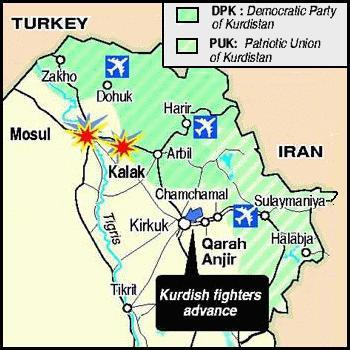
As the northern front continues its buildup, Iraqi troops abandoned a key
frontline position guarding access to the northern oil capital of Kirkuk,
allowing Kurdish Patriotic Union of Kurdistan (PUK) militia to take it over.
The pershmerga fighters of the PUK advanced through an exposed no-mans land
after spotting Iraqi troops pulling back from the ridge, situated 40
kilometers due east of Kirkuk. The ridge overlooking PUK held Chamchamal was
previously dotted with a string of Iraqi army bunkers, which have been twice
targeted by limited US-British airstrikes.
The ridgeline is the main geographical obstacle between PUK held areas and
Kirkuk. Several peshmergas moved along the ridge checking for any remaining
Iraqi troops. They took over the first main Iraqi checkpost position on the
road, passing over the ridge, to Kirkuk. The buildup of the northern front is
intended to 1) form a controllable buffer zone between the southern border of
Turkey and Iraq which prevents Turkey from entering the war on a political
basis, 2) support the interdependence of the Kurdish population and 3) the new
threat represented by US forces and equipment beginning to land in the Kurdish
held north might force the Republican Guard units to move away from Baghdad in
response to the threat, exposing them and making them more venerable to air
attack.
The impact of Turkey's refusal to use their southern border territory for the
launch of a northern front will cause the political winds to swirl long after
the war ends in Iraq. Testifying in a supplemental budget request meeting,
deputy Defense Secretary Paul Wolfowitz told Congress "Turkey made a big
mistake - There's no question, if we had a US armored force in northern Iraq
right now, the end of the war would be closer,"
Continuing the relentless targeted attacks on the capital city, explosions
shook central Baghdad and more blasts rocked the city's outskirts. A new wave
of bombing targeted the outskirts of the city in the latest of a series of
attacks through the day and into the evening. New military defensive positions
on the eastern and southern perimeter of Baghdad were pounded hard. Hours
later, shortly after 2300 hours (local), the air assault delivered one of the
strongest blasts felt in the city in days as allied forces zeroed in on one of
Saddam Hussein's presidential compounds in the heart of Baghdad.
|
|---|
(Following the attack, information released by the Defense Department
indicated that the presidential compound was specifically targeted with a
4,700 pound GBU-37/B, satellite guided, "Bunker Buster". This was its first
use in the campaign.) Iraq's satellite television channel has been cutting
in and out since the overnight attacks, which marked one of the heaviest
bombing days of the war in Iraq.
Another round of powerful explosions began on Friday, 28 March (Day-9) at 0230
hours (local). and went on for a half hour, with aircraft heard flying
overhead and bursts of antiaircraft fire. The Palestine Hotel, where many
reporters were staying, shook violently during the blasts. Coalition air
forces and Tomahawk missiles took out a communications and command and control
facilities in the capital city during the night.
On Friday, in the first major movement on the northern front against Baghdad,
fighters from the Patriotic Union of Kurdistan (PUK) captured the town of
Qarah Anjir, situated in hills east of Kirkuk. A major task in the undertaking
was the clearing scores of anti-tank and anti-personnel mines left behind by
the retreating Iraqi army.
The Iraqi Kurd rebels advanced to within 16 kilometers (10 miles) of the
northern oil capital Kirkuk after Iraqi government forces abandoned their
positions, bringing them to within striking distance of their most prized
objective.
America's battle plan for Baghdad is taking shape, with US forces now in
position to strike the Iraqi capital from nearly all sides, or to mount a
siege and wait for Saddam Hussein's regime to surrender or fall to internal
opposition.
|
|---|
US forces heading for Baghdad from central and southeast Iraq were massed in
three large forces, the 3rd Mechanized Infantry Division near Karbala, about
50 miles southwest of Baghdad, and the 1st Marine Expeditionary Force fighting
its way north toward Al-Kut along Highway 8, about 100 miles away. In the
longest air assault over hostile territory in the history of warfare,
Operation HUGE INROAD, elements of the Army's 101st Airborne Division advanced
well out of southern Iraq deep into the center of the country, in a location
about 120 miles from Baghdad. To counter the buildup, Iraqi commanders have
been reinforcing their units in both cities, built around Republican Guard
armored divisions.
In the early stages of a growing indication of a major battle, US troops used
tanks, artillery and helicopters in a clash with an Iraqi force of about 1,500
men overnight near the town of Najaf in central Iraq. It was not immediately
apparent whether the Iraqis were regular troops or elite Republican Guards.
Armed with artillery, they were moving from a position northeast of Najaf when
they were detected.
One group of Marines traded fire with Iraqi forces amid the burning
buildings of An Nasiriyah, while others pushed north of the strategic city
in a grinding bumper-to-bumper movement of weapons and supplies. Clashing
repeatedly with Iraqi fighters in front and behind, the convoy was moving
and night, headlights out, on a fighting drive north toward Baghdad.
|
|---|
At both the southern city of An Nasiriyah and Ad Diwaniyah in the south,
central part of the country, the Marines called in Cobra helicopters and other
aircraft to pound Iraqi ground forces. In An Nasiriyah, Marines and Iraqi
forces exchanged tank and artillery fire in a clash that set the power plant
and other buildings on fire and cast thick black smoke over the town.
A CH-46 Marine transport helicopter was forced to turn back after being
fired on while trying to pick up casualties and deliver supplies to Marines
fighting in An Nasiriyah. Iraqis fired small arms and rocket-propelled
grenades.
An Nasiriyah, located on the Euphrates River near a junction of roads that
lead from Kuwait to Baghdad, has been the scene of some of the fiercest
fighting of the war, prompting Marines to call the southern entrances to
the city "Ambush Alley".
Late Friday, US led air forces diversified their campaign over Iraq, bolstered
by forces of the Army's 101st Airborne Division. Apache helicopter gunships
raided Republican Guard units south of Baghdad. In the 101st Airborne's first
major attack during the war two of the Apaches crashed, but all crew members
escaped injury. Helicopters from the 2nd Battalion took out four tanks, six
armored personnel carriers, 15 vehicles, a fuel site and a fiber-optics
tower.
The attack force also included artillery and Air Force jets. There was no
substantial damage from enemy fire to the helicopters beyond some small-arms
and anti-aircraft fire, but two of them crashed in conditions pilots called a
"brown-out", which is caused by clouds of brown desert sand stirred up when a
helicopter approaches the ground. One pilot from the first crash had a
possible broken leg, but the others were in relatively good shape.
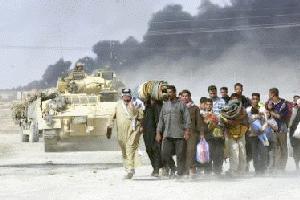
As British troops encircled the southern city of Basra, a few thousand Iraqi
civilians tried to flee the besieged city but were chased back into the city
by mortar and machine gun fire from Iraqi local paramilitary forces. Soldiers
from the British 1st Black Watch battalion, 7th Armor Brigade positioned their
Warrior armored fighting vehicles between the militia fire and the targeted
civilians. This action is perhaps are the first pieces of evidence that the
Iraqi paramilitary wants to keep their population in the city as a shield. and
they fired on them to force them to return.
|
|---|
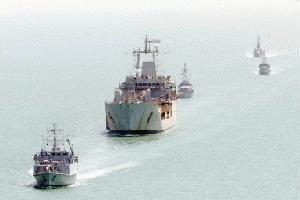
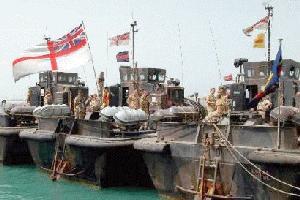
The first humanitarian relief supply ship, the Royal Fleet Auxiliary (RFA) Sir
Galahad (L3005), flanked by patrol boats and assault helicopters, approached
the southern port of Umm Qasr on Friday. The ship, a British naval supply
vessel, brought the first shipment of aid to Iraq since the start of the US
led invasion. It carried 200 tons of food, medicine and blankets and also
water, was due to dock at Iraq's only deepwater port at about 1600 hours
(local). The arrival of the ship was delayed because of mines in the
waterway.
Just ahead of it was the British mine-detecting ship HMS Sandown, clearing
a route. The security escort only underscored the lingering risks of
navigating the Khor Abdallah waterway, where US and British mine sweeping
teams had found and detonated six potential mines in the past 36 hours.
Working intensively to clear the port entrance of mines, the teams had cleared
a 200 yard-wide channel along the 40 mile-route from the Persian Gulf into the
port of Umm Qasr, which allied forces are hoping to make the center for
humanitarian relief distribution.
On Friday, the UN Security Council unanimously approved a resolution to
restart the UN humanitarian aid program once the US led war winds down. The
program had providing food to 60 percent of Iraq's 22 million people until it
was halted last week before war erupted. The resolution aims to hasten
delivery of aid by giving Secretary-General Kofi Annan control for 45 days
over the oil-for-food program that utilized Baghdad's oil revenues to get in
medical supplies and food.>
Taking a more aggressive posture against the besieged Iraqi city of Basra on
Friday evening, US warplanes fired laser-guided missiles destroyed a two-story
building where some 200 Iraqi loyalist paramilitary fighters were meeting. In
what the Central Command called "an emerging target.", a pair of F-15E Strike
Eagles fired laser-guided munitions fitted with delayed fuses, meaning they
penetrated the building before detonating to minimize the external blast
effect. The report describing to mission indicated that, a church 300 yards
from the two-story building was undamaged.
|
|---|
The bombing cycle of the capital city is now almost in a 24x7 sequence. The
US and British forces maintained its relentless, round-the-clock bombing of
Baghdad. A few hours' lull ended when blasts hit the southern outskirts again
Saturday, 29 March (Day-10), shortly after midnight at 0100 hours (local), at
least one missile plowed into the Information Ministry, where top government
officials have held numerous press conferences since the start of the war.
Clouds of white smoke rose into the sky and the explosion shook windows in the
city. Anti-aircraft fire lit the sky as the sound of warplanes droned
overhead. Observers indicated that a missile may have pierced the roof of the
main 11-storey building. Aerials and satellite dishes on the roof were broken
and the area around the building was littered with broken glass.
The city's mosques began broadcasting the call to prayer over their
loudspeakers as the raid began. A media pool television camera on the
Information Ministry building was still filming after the blast, indicating
that if the building had been targeted, it was not destroyed. As dawn broke
on Saturday, the distant thud of air raids shook the southern approaches of
the Iraqi capital where the crack Republican Guard are believed to be dug in,
preparing for an expected attack by US forces. The fires, started a week ago
by authorities around the capital to conceal targets, burned furiously,
sending darker than usual clouds over the city on an otherwise clear day.
|
|---|
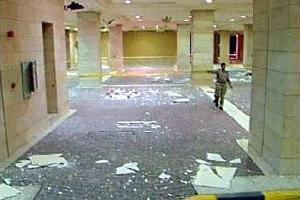
The war escalated to a new level as a missile fell into the sea at 0145 hours
(local), Saturday and exploded near the Souq Sharq Mall, one of the largest,
multi level shopping center in Kuwait City early Saturday, but it caused no
injuries and little damage. Parts of the ceiling and walls littered the ground
in a covered entry way after the explosion. Glass doors and windows were
shattered and some doors were knocked off their hinges. Television images
also showed smoke rising over the Kuwaiti skyline.
Souq Sharq is on the Kuwaiti seafront and includes a marina, shops and
restaurants. The missile, subsequently identified as a Chinese built Silkworm
ship-to-ship missile fired from the vicinity peninsula in Iraq, was the 13th
fired at Kuwait since the US led military campaign to oust Iraq's Saddam
Hussein began on 20 March. None is believed to have carried chemical or
biological warheads, and none has caused damage or injury.
|
|---|
In the new northern front, US forces and Kurdish fighters struck at Islamic
militant camps and advancing against Saddam Hussein's army after the Iraqi
soldiers fell back at least 12 miles from the Qushtapa checkpoint to
apparently regroup near Perdeh, also known as Altun Kupri, to about 30 miles
from Kirkuk, the oil center of Kirkuk. The town has an important bridge over
the Little Zab River. Bypassing the bridge would require coalition forces to
make difficult and potentially dangerous detours through rolling hills where
Iraqis could stage guerrilla-style ambushes.
An official on the Kurdistan Democratic Party (KDP), which controls part of
the autonomous Kurdish enclave, indicated that during the pullback, Saddam
Hussein's forces had executed as many as 60 Iraqi soldiers who tried to cross
from government territory to the Kurdish-held north to join their ranks.
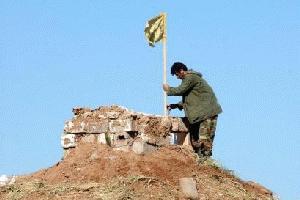
Kurdish scouts advanced slowly along an emptied stretch of the Irbil-Kirkuk
road, which appeared to be mined in places. Iraqi soldiers left behind cinder
block bunkers, coils of barbed wire and sandbags. Kurds planted the yellow
flag of the Kurdistan Democratic Party, one of the two main Kurdish factions,
atop a small hill overlooking an abandoned village.
|
|---|
On Saturday, striking before dawn, British tanks and infantry staged a
lightning raid into besieged Basra, destroying five Iraqi tanks and blowing up
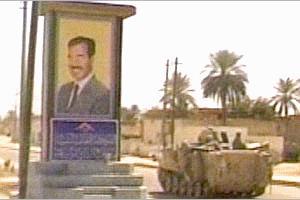
two statues of Saddam Hussein before withdrawing without casualties. The
strike was the first thrust into the city and it and other limited attacks
around Basra could be a preview of how coalition commanders might deal with a
siege of Baghdad.
Not to forget, while the swamp is being drained in Iraq, that the battle
against world terrorism continues. as the US broke up alleged Iraqi terrorist
plots in at least two countries in the Middle East which may uncover
information on similar plans to be carried out in almost a dozen cities around
the world, The disrupted attacks had been planned by members of Iraq's
intelligence service masquerading as diplomats and had targeted US and British
interests.
Earlier in this month the US had requested some 60 countries to expel Iraqi
intelligence agents posing as diplomats had been instrumental to breaking up
of the plots. The two countries in which the attacks had been thwarted were
not identified, but those nations did assist in disrupting the plans. On
Sunday, Jordan expelled five Iraqi diplomats, accusing them of trying to
undermine "security" in the kingdom.
Information obtained from Iraqi POWs indicates that al-Qaeda fighters may be
in southern Iraq, operating in Az Zubayr, coordinating grenade and gun attacks
on British forces in a town near Basra. If the prisoners' report is true, it
may provide a concrete link between Saddam Hussein's regime and the
terrorists who attacked the World Trade Center.
Several links between al-Qaeda and Iraq have been reported previously in
northern Iraq, an al-Qaeda-affiliated group called Ansar al-Islam who is
allegedly plotting suicide attacks on US forces and has allegedly experimented
with chemical weapons. Other reports indicate that Ansar al-Islam has about
600 members and it may be getting reinforcements from al-Qaeda cells in
Chechnya and other regions as indicated by the information that two members of
an Afghanistan-based al-Qaeda cell were killed this week in a shootout between
US and Ansar al-Islam forces.
|
|---|
Coalition forces continued to attack Baghdad from the air Saturday, pummeling
the Iraqi capital with thunderous bombs and strafing fire. Returning waves of
aircraft and missiles starting with the first strike of four heavy explosions
in the center the city at 1930 hours (local), two more loud explosive blasts
at 2200 Hours (local) and a continuous bombardment before and after midnight.
Three of every four allied airstrikes are now targeting Republican Guard
forces that ring Baghdad standing between advancing columns of US ground
troops and Saddam Hussein's government.
A series of the "key" strikes of satellite-guided bombs targeted the main
training site for Iraqi Fedayeen paramilitary forces who are in charge of
security functions in eastern Baghdad, a presidential palace, intelligence
complex and surface-to-air missile sites.
Early on Sunday, 30 March (Day-11), four very loud, deafening explosions
rocked a Baghdad residential compound where many government officials live
northwest of the Information Ministry, as one of the fiercest US led air
assaults of the war stretched into a second day. Black smoke was seen
billowing from apartment buildings in the area, which is believed to contain
underground bunkers and is usually off-limits to ordinary Iraqis. At one
point, an orange fireball illuminated the sky, followed by columns of white
smoke. The bombing in central Baghdad targeted a complex inside a presidential
palace that was used by President Saddam Hussein's powerful son Qusay. In a
second round of attacks at first light, explosions thudded around the edges of
Baghdad and nearby areas where Republican Guard defenders are based.
|
|---|
Further south, the 2nd Battalion, 70th Armored Regiment launched an intense
artillery and mortar barrages at Iraqi troops close to the southern city of
Najaf overnight. The battle carried on through most of the night but was
particularly heavy between 0100 and 0200 hours (local). The focus of the
bombardment took place close to a bridge across the Euphrates river just north
of Najaf, a holy Shiite city 100 miles south of Baghdad. The Iraqis returned
fire with rocket propelled grenades and small arms fire.
US and British forces overriding impression of "Lessons Learned" by the first
week's combat is that the Iraqis have developed an elaborate set of "dirty"
tactics to capitalize on the Coalition's reluctance to endanger civilian
lives. According to troops here, Iraqi forces have:
The Iraqi troops using these tactics are, for the most part, not regular army
soldiers. Rather than rely on his regular soldiers, Saddam has pushed up to 30,000
of his most loyal paramilitary troops south from Baghdad into the towns and cities
of southern Iraq.
|
|---|
Sunday, thousands of US Marines pushed north along Route 80, known as the
"Highway of Death", toward Baghdad in "seek and destroy" missions, trying to
open the route to the Iraqi capital and stop days of attacks along a stretch
that has become known as "Ambush Alley." Moving into previously unsecured
areas, US Marines provoked hidden Iraqi fighters into attacking them in order
to identify their positions and engage in battle. Fierce fighting was under
way meanwhile in Najaf, 100 miles south of Baghdad, bringing their
reconnaissance helicopters into direct contact with Iraqi forces firing
mortars.
Army supply trucks appeared on the Marine route north for the first time
Sunday, supporting field reports that US Army and Marine forces were meeting
for the first time and may join in together for the ground invasion, which
previously had the Marines moving along Route 80 and Army forces punching
their way northwest across desert terrain.
|
|---|
Troops of the 3rd Infantry Division and 101st Airborne Division encircled the
Iraqi city of Najaf on Sunday, blocking roads into town and preparing to go
door to door to root out paramilitary supporters of Saddam Hussein. Najaf,
about 100 miles south of Baghdad, is a key stepping stone to the capital, but
moving into the Shiite holy city could be a dangerous operation.
Coalition forces are concerned about resistance from paramilitary groups and
other die-hard supporters of Saddam who often travel in civilian vehicles and
use unconventional war tactics to maintain the regime. Using loud speakers
mounted on their Humvees, the soldiers will soon begin requesting that the
townspeople take the initiative and turn over paramilitary members. They also
will stress that the Americans have no intention of harming civilians.
There has been no time line established for possibly entering the city. The
most successful outcome would be that the Najaf residents would first rid the
town of any paramilitary fighters. The alternative, and probably the most
dangerous, would to engage in urban combat. In that case the enemy is
positively identified only when he begins to shoot.
|
|---|
Two large blasts rocked central Baghdad shortly after midnight on Monday, 31
March (Day-12), as US and British warplanes, flying low, kept up a fierce
barrage on the Iraqi capital.Two explosions hit the city center, while more
blasts were heard, along with anti-aircraft fire, in the southern outskirts,
where Republican Guard are believed to be dug in to defend the capital from
advancing Coalition forces.
The raid came as large fires continued to rage near the center of the city,
sending clouds of black smoke billowing into the sky. The blaze was apparently
from an oil-filled trench set alight in the hope of hampering laser targeting
by US and British air strikes.US - led troops fought pitched battles with
Saddam Hussein's Republican Guard within 50 miles of the capital Monday as
coalition warplanes pounded the city and dozens of other Iraqi positions in
advance of the battle for Baghdad. Early Monday, a few US military units moved
into the "red zone" around Baghdad as others cautiously made their way up the
Euphrates River, taking on stubborn clusters of resistance.
|
|---|
In the closest battle yet to Saddam's seat of power, an armored unit of the
3rd Infantry Division, Task Force 4-64, spearheading the drive on Baghdad
battled their way into the town of Hindiyah, 50 miles from the capital Monday,
trading fire with Iraqis hidden behind brick walls and hedges, and captured
dozens of members of Saddam Hussein's vaunted Republican Guard. The
street-to-street fighting at the key Euphrates River crossing was the war's
closest battle to Baghdad.
At least 35 Iraqi troops were reported killed in the fighting in Hindiyah,
situated between the sacred city of Karbala and the ruins of ancient Babylon.
The prisoners told the Americans they belonged to the guard's Nebuchadnezzar
Brigade, based in Saddam's home area of Tikrit, and they had the guard's
triangular insignia.
|
|---|
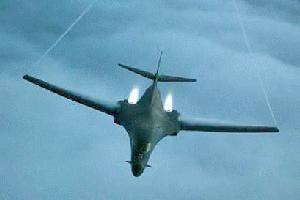
In Baghdad, coalition attacks on leadership and command and control centers
were carried out simultaneously by multiple B-1, B-2 and B-52 bombers on the
same target, according to US Central Command, which oversees the war in Iraq.
At 0200 hours (local), a missile strike on the information ministry touched
off a fire at the nearby 28 April Shopping Center, named for Saddam's
birthday. A telephone office was struck later in the day.
Further south, Apaches of the US army's elite airborne unit, the 101st
Airborne Division, were involved in "medium" intensity battles with Iraqi
forces near the holy Shiite city of Najaf. The Apache and Kiowa Warrior
helicopters have struck a range of military targets around Najaf, about 160
kilometers (100 miles) southwest of Baghdad, in support of ground troops in
the area.
During the engagement,described as "medium intensity" combat, they destroyed
several ammunition storage facilities, some air defense systems, many vehicles
as well as ammunition trucks. However, one of the several helicopter that took
small arms fire from forces hiding "inside houses", was unable to respond to
the fire because its weapons system failed after being struck.
|
|---|
British forces engaged in fierce fighting as they tried to push towards Basra
to take Iraq's southern metropolis, seen as the linchpin to coalition control
of the entire south. In Operation JAMES (Bond), the Royal Commandos with tanks
and armored vehicles attacked from the southeast, where 600 soldiers were in
their second day of combat after moving through the neighboring town of Abu
Al Khasib 20 kilometers (12 miles) away.
British aircraft provided close air support for tanks moving into Basra
itself. Meanwhile, British artillery pounded the western suburbs of the city,
according to the Arabic news channel Al-Jazeera, which showed live pictures
of clouds of smoke and debris said to be concentrated on an area six
kilometers (four miles) from Basra's center. Conquering the city would mark
the first major victory for coalition forces.
|
|---|
In the Northern sector of Iraq, US forces and their Kurdish allies have
captured a suspected terrorist camp near Biyare, Iraq, located in the
northeastern rocky border region between Iraq and Iran, that was the one US
Secretary of State Colin Powell mentioned in his much-publicized speech
before the UN Security Council last month as one of the proofs of the Iraqi
government's secret ties to Osama bin Laden's al-Qaeda network, blamed for the
11 September 2001 attacks on the United States.
The camp, run by Islamic radicals who call themselves Ansar al-Islam, had been
pummeled by US AC-130 gunships and British aircraft and missiles pounded the
Ansar compound from the air for several days before the coalition and Kurdish
ground forces entered the compound, located in a Kurdish-controlled area near
the border with Iran. The Ansar al-Islam training camp bore a striking
resemblance to al-Qaeda bases in Afghanistan, thriving in desolate areas
beyond the control of local officials. An undisclosed number of captured
defenders are not Iraqis, nor are they Iranians, but they're most likely
al-Qaeda.
Analysis of the cache of documents discovered at the Ansar al-Islam compound,
including computer discs, list of names of suspected militants living in the
United States and foreign passports belonging to Arab fighters from around the
Middle East, may be the strongest evidence yet linking the group to al-Qaeda.
In addition, there were indications that the group had been getting help from
inside neighboring Iran.
|
|---|
As darkness fell on Baghdad, US and British forces delivered a dozen cruise
missiles in a lightning attack, including two that slammed into a sprawling
presidential compound of Saddam Hussein. The ominous whistle of the missiles
was heard in the sky before a series of explosions shook the city, with the
effect of knocking out electrical services of entire neighborhoods.
The missile attack appeared to be most concentrated strike on the center of
Baghdad since the war began, and state buildings appeared to have been hit.
Balls of smoke slowly merged into a single cloud above the battered city. War
planes were briefly heard high above in the sky, carrying out another of what
coalition commanders had said are thousands of bombing raids that have been
chipping away at Saddam's 24-year grip on power.
|
|---|
US air forces have dropped more than 8,000 precision guided munitions and 700
Tomahawk cruise missiles since the war began 12 days ago. These intensive US
and British air strikes have significantly degraded Republican Guard units
defending the approaches to Baghdad. Along with the airstrikes, the US and
British ground forces are conducting armed reconnaissance maneuvers close in
to the defense lines of Baghdad to flush out and destroy them. The Republican
Guard, Iraq's best armed, best trained and most loyal divisions - are the most
formidable line of conventional military defenses around Baghdad.
Of the 1,000+ strike sorties that were launched yesterday in Iraq, eighty
percent were against the four elite divisions around Baghdad - the Medina, the
Hammurabi, the Baghdad and the Al Nida Divisions. Analysis of the results of
this constant bombardment indicates a significant degradation and weakening of
those forces. Interviews with captured Iraqi Generals indicate that the
Republican Guard may now be degraded to a manpower level equal to one-half of
their original staff. Republican Guard formations have moving around the
battlefield, apparently to reinforce other forces that have a degraded
capability or been significantly damaged by air strikes.
|
|---|
Explosions, thundering in the outskirts of Baghdad, started on Tuesday, 01
April (Day-13), right after midnight 0000 hours (local),shaking buildings in
the center of the city as the coalition maintained its relentless bombardment
of the Iraqi capital. The compound, on the banks of the River Tigris, used by
Saddam, his son Qusay and aides, was one on the reoccurring targets. Another
large explosion came from the headquarters of the Iraqi Olympic Committee,
headed by Saddam's eldest son, Uday. Scores of additional explosions sounded
from the edges of the city through the rest of the night, lighting the sky
with flames and clouds of dense smoke rising into the night sky.
The latest attacks followed three days of concentrated bombardment on key
targets of key government buildings, military and presidential sites in the
heart of the city of Baghdad as US led ground troops fought their way,
through heavy resistance, to within 50 miles of the capital city.
Coalition bombardments have focused recently on Republican Guard units
protecting the approaches to Baghdad. The goal is to wear down Saddam's
best-trained forces ahead of a US led ground assault on the capital. At least
8,000 members of the Republican Guard's Medina division are positioned between
Karbala and Baghdad, reportedly in the Karbala Gap, an area between a large
reservoir and the Euphrates River. Inside Karbala, at least 4,000 Iraqi
militiamen and soldiers may be laying in wait,The Iraqis are also believed to
have positioned several dozen tanks near the city, mainly vintage T-55s and
T-62s.
|
|---|
A team of Navy SEALs and Army Rangers, in a daring night time air assault,
rescued 19-year-old, prisoner of war, PFC. Jessica Lynch of the 507th
Maintenance Company, on 01 April, while Marines created a diversion elsewhere
in Nassiriya. Lynch had been captured on 23 March after her convoy was
ambushed in the southern Iraqi city of Nasiriyah. As soon as Iraqi had
televised the capture of the 507th's other members, the US agencies began an
exhaustive search to determine their location. They had intelligence on
Lynch's whereabouts even before an Iraqi lawyer identified only as Mohammed
scouted the hospital and after finding her, hiked 6 miles to tip off the
Marines after seeing her slapped around at the hospital. In addition a
courageous Iraqi spy working for the CIA video taped the Nassiriya hospital
where PFC. Jessica Lynch was being held before her daring rescue.
The first decisive battle of the war in Iraq may be coming in a place called
the Karbala Gap. After days of pounding the Medina Division of Iraq's
Republican Guard with airpower and artillery, the US 3rd Infantry Division is
preparing to launch the war's first major ground attack against Saddam
Hussein's best soldiers. It was reported that on Monday, the Guard's
Nebuchadnezzar Division had been moved from near Tikrit, Saddam's hometown,
south to reinforce the Medina Division near Karbala.
|
|---|
On Tuesday, US forces resumed their northward advance toward Baghdad after a
pause of several days. US forces pressed their military operations south of
Baghdad ahead of an expected major push on the Iraqi capital. US Army soldiers
edged closer to Baghdad, fighting from behind sandbags and punching through
one front-line Republican Guard unit outside Saddam Hussein's capital. A
series of ruse attacks by militants in civilian clothes had made the trek
north increasingly dangerous for coalition troops. In the first major clash of
American soldiers, on the road to Baghdad, are fighting bloody
street-to-street battles with militants loyal to Saddam Hussein.
The campaign began with the bombing and engagement of Iraqi troops across a
large arc south of Baghdad on Tuesday, a day-and-night pounding meant to pave
the way for an attack on the capital. Warplanes unleashed a thunderous
nighttime barrage against Republican Guard units positioned around Karbala,
about 50 miles from the capital. The 101st Airborne and the US Army's 3rd
Infantry Division were active in a concerted drive against Baghdad with two
formations of US marines to their east also moving toward the capital.
|
|---|
About 80 miles southeast of Baghdad, on the outskirts of Diwaniyah, Marines
battled Iraqi Republican Guardsmen and other fighters who fired on them from
fortified bunkers and positions in buildings and behind vehicles. The Iraqis,
armed with rocket-propelled grenades, machine guns and small arms, were
outmatched, but kept fighting for about 10 hours.
At least 75 Iraqi fighters were killed and 44 were taken prisoner, including
two Republican Guard officers. The Marines, who provoked the fight by going
into an area where they had been fired on before, used 155mm artillery to
clear mortar nests and destroy Iraqi tanks.
|
|---|
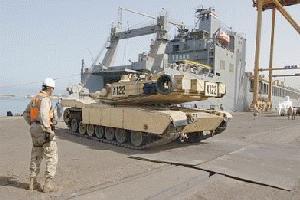
US forces are "very close" to securing the strategically important central
Iraqi city of Najaf located 150 kilometers (95 miles) south of Baghdad. Najaf
is a key city in the US military push towards Baghdad because control of it
would allow smoother supply and communication lines. The 101st Airborne
Division has been heavily involved in the Najaf campaign. Increasing the
tempo of the battle, they sending infantry troops as well as Kiowa Warrior and
Apache helicopters, with the 3rd Infantry Division supplying mechanized and
armored support.
During the battle, the infantry, helicopters and tanks met strong resistance
in the city over the past three days, but Iraqi soldiers now appears to have
given up their defense posts.
Meanwhile in Basra, a southern city of 1.3 million, warplanes dropped 500
pound and 1,000 pound laser-guided bombs on an Iraqi intelligence complex.
Flares lit the night so that the British units could more closely observe the
actions of die-hard Iraqi defenders have kept them at bay for days. After
nearly two weeks of war.
|
|---|
Further south, in the port city of Umm Qasr that is firmly under British
control, lights went on for the first time in months. Exhibiting a degree of
confidence, some British forces in southern Iraq were wearing berets in
public, shedding their more warlike helmets in areas deemed safe. Fresh water
also began flowing into Umm Qasr from a pipeline in neighboring Kuwait.
American and British commanders indicated that the Iraqi civilians residents
were showing signs that they becoming more acceptable in providing assistance
to forces fighting Saddam's regime.
In support of the final drive to Baghdad. fresh US forces are flowing to the
Persian Gulf, including 500 members of the 2nd Armored Cavalry Regiment who
left their Ft. Polk, LA base on Sunday. Personnel along with their Humvee
scout vehicles, Kiowa reconnaissance helicopters and other equipment were sent
by air, enabling them to get to Iraq quicker than if the equipment had been
sent by sea as originally planned. Other members of the 2nd Armored Cavalry
are to go by sea. Their mission is to help protect US supply lines from Iraqi
attack.
The first echelon of soldiers from the 4th Infantry Division, Task Force
IRONHORSE, began to arrive in Kuwait on American Airlines flight 777 to join
up with their military equipment, including Apache fighter helicopters,
Bradley fighting vehicles and Humvee armored vehicles, on ships which was
diverted from their holding position off the shores of Turkey. The first four,
of a total of 36 ships, offloaded at the port of Shuaibah.
The 3rd Armored Cavalry Regiment, based at Ft. Carson, CO, will also be
arriving. Five transports, carrying its equipment from ports in Texas, are now
on their way to the Gulf and two more are in process of loading.
|
|---|
Early on Wednesday, 02 April (Day-14), at 0200 hours (local), US warplanes
returned to pounded central Baghdad striking a presidential compound where
President Saddam Hussein's son Qusay has his headquarters and sending thick
smoke into the sky above the Iraqi capital. Three bombs hit the compound near
the Tigris River where Qusay Hussein, who commands the Republican Guard, is
based. The compound has been bombed several times before in recent days.
Smoke poured out of a tall building to the west of the city center, where many
government buildings were located. A communications center near a bridge
across the river Tigris also appeared to have been hit as fames rose from the
area. Smoke also rose to the east of the center in an area where airforce and
other military buildings are situated. Tracers, profiling the trajectories of,
anti-aircraft fire lit the sky as aircraft could be heard flying overhead.
Sustained explosions could also be heard toward the southern outskirts of the
sprawling city, where Republican Guards are believed to have dug in to defend
Saddam, in the path of advancing US troops.
The US Coalition offensive had planned a major ground offensive in the days
following intensive bombing of the Adnan (to the north), Baghdad, Medina.
Hammurabi, Nebuchadnezzar and Al Nida Divisions of the Republican Guard,
Iraq's best trained, best armed and most loyal forces. On Wednesday, US
troops, entering what is expected to be the fiercest combat of the war in
Iraq, launched a major ground offensive south of Baghdad in a twin-pronged
attack, Army forces from the southwest and Marines from the southeast,
passed two key hurdles in their advance on the Iraqi capital and battering
elite Republican Guard units in punishing raids.
|
|---|
In the southwest, in an attack launched at midnight, elements of the 3rd
Infantry Division, spearheading the attack, surged past the strategic city of
Karbala, some 80 kilometers (50 miles) to the southwest of the capital,
targeting an estimated 2,000 paramilitary fighters. The Shiite Muslim shrine
city of Karbala sits on the main approach to Baghdad from the southwest, was
encircled and hit by night-long bombardment from artillery and aircraft.
Foregoing an entry to the city, they went around it and, passing through a key
strip of desert to the west of Karbala, engaged the Medina Division of the
Republican Guard and took control of the dam on Lake al-Milh. Following the
attack, battle assessments indicate that the Medina Division, Republican Guard
was degraded, rendering them incapable of effective maneuvering.
To the southeast, the Marine 1st Expeditionary Force bombed Al-Kut, a key city
on the Tigris river, on Wednesday, in a renewed advance toward the Iraqi
capital Baghdad. They seized the strategic town of Al-Kut, around 150
kilometers (90 miles) southeast of the Iraqi capital and routed the Baghdad
Division of the Republican Guard division force that had been guarding the
highway leading to Baghdad.
After securing the bridge, Marines manned machine-guns from cover, wary of
possible attack from nearby palm groves or houses. A Humvee all-terrain
vehicle broadcast loudspeaker messages to the local people, telling fighters
to surrender, while Huey combat helicopters circled overhead. Crossing the
Tigris river at Al-Kut taking control of the important Highway 6, they opened
a vital route for supply and troop movements towards Baghdad. Heralded as a
major movement, the operational capability of the Baghdad Division, Republican
Guard was degraded, rendering them incapable of effective maneuvering and
being able to stop coalition maneuvers.
|
|---|
In a separate engagement, the 101st Airborne Division troops moved into
central city of Najaf from the south, US and British fighter jets attacked
from the air. Mounting a fierce attack on suspected Fedayeen positions around
the city, strafing buildings from A-10 Warthog ground attack planes and
calling in British fighter jets to bomb the city's Baath Party
headquarters.
The attack on Najaf was aimed at clearing out the Fedayeen, paramilitary
fighters who have spearheaded resistance to the US and British invasion. The
attack drew return fire from defenders who took refuge by hiding in one of the
world's holiest Muslim shrines. Attacking such holy sites would alienate
Iraq's majority Shiite population, whose support the coalition has been trying
to rally, and inflame Shiite feelings against the United States worldwide,
particularly in Iran. Although return fire is allowable under the rules of
engagement, with restraint, none was returned in fear that the shrine would be
damaged.
|
|---|
But confidence over the steady northward advance was tempered by fear of the
unknown. Lead US infantry units donned their chemical suits after capturing a
bridge 40 miles southwest of Baghdad. Some Marines began putting on their
protective boots, adding to the chemical environment resistance provided by
the suits they already wear, and Marine helicopter pilots were advised for the
first time to be ready to don chemical suits at a moment's notice - now that
the so-called red zone, the range of guns and missiles defending Baghdad, has
been breached.
On Wednesday the US bombing, part of a gradual escalation along the northern
front, continued as aircraft bombed Iraqi troops in Kurdish-held northern Iraq
them to retreat in several areas on the second day. The Iraqi forces left some
of their front-line positions in such a hurry that they abandoned valuable
supplies of ammunition and injectors containing the nerve gas antidote
atropine. They also left behind a deadly trail of mines.
As the bombing was in progress, Kurdish fighters and residents of Kifri, a
town of 20,000 people 75 miles northeast of Baghdad, ran into the streets,
pocked with shell craters, and climbed onto rooftops to watch planes. pound
Iraqi positions about one mile away. They cheered as smoke rose above hilltop
bunkers.
Late Wednesday the 3rd Infantry Division came to within 20 miles of the
southern outskirts of Baghdad and were firing rockets north at the Iraqi
positions. US spy planes spotted the reinforcement units of Iraq's Republican
Guard moving south from the capital during the night and early Thursday, 03
April (Day-15), other Iraqi units began to reinforce positions around the
capital's airport which is a prime candidate for an air assault base for
spearheading entering and operating around the city of Baghdad.
Also on early Thursday morning, a UH-60 Black Hawk helicopter went down in
southern Iraq, killing two of the 6 soldiers aboard. The helicopter, the
second to go down in combat, was downed by small-arms fire near Karbala, the
site of fierce fighting between the 3rd Infantry Division and Iraqi troops,
including Republican Guard forces. The other four wounded soldiers on board
the Black Hawk were rescued. An investigation surrounding the incident is
ongoing.
Huge explosions shattered the silence across Baghdad early Thursday at 0300
hours (local), with blasts rocking the center of the city and a plume of white
smoke rising from the southern end of the Old Palace grounds in the capital.
More cruise missiles and bombs hit Baghdad in the next 30 minutes. Afterward,
the sound of intermittent explosions and occasional bursts of antiaircraft
fire could be heard in the distance.
On Thursday continuing their northern drive, the 3rd Infantry Division and
Marine 1st Expeditionary forces surged forward into the outskirts of Baghdad,
yet to be slowed by the Republican Guard which appeared on the verge of
collapse. Lead units of the multi-pronged US assault force were within about
10 miles of Baghdad, approaching Saddam International Airport. Army troops
closed in from the southwest after crossing the Euphrates River and the
Marines advanced from the southeast in a long column along the Tigris River.
Both main force elements incurred minimal losses in those battles.
|
|---|
US led bombing raids around the outskirts of Baghdad appeared to have been
intensively stepped up. Continuing air strikes pounded the southern edges of
the city, whose approaches are controlling and are 15 kilometers (nine miles)
from the center of Saddam Hussein's capital. The massive, booming explosions
could be heard from the center of Baghdad.
Saddam's elite Republican Guard troops defending the capital have come under
intense and regular bombardment, but it seemed to have been strongly stepped
up after midday on Thursday. Explosions and the wail of air raid sirens have
become a staple of Baghdad's nights since the campaign began with the first
missile attack on 20 March.
|
|---|
On Thursday, the first group of four sea transports, carrying weapons and
equipment of the 4th Infantry Division, completed unloading its cargo at the
Kuwait City port. Upon completion of inspection and maintenance checks, the
equipment will be loaded on Heavy Equipment Transporters and moved to a
Tactical Assembly Area - Camp Pennsylvania, Kuwait, located close to the Iraq
border, to meet up with 4th Infantry Division personnel. Almost
simultaneously, the 1st echelon of the 4th Infantry Division, Task Force
IRONHORSE were processed at a costal camp in Kuwait and relocated to camps
near the Iraq to await deployment. The remainder of the Division personnel are
being flown into Kuwait from their Ft. Hood, TX and Ft. Carson, CO bases on a
schedule that matches their equipment arrivals.
Meanwhile in the city of Baghdad, a flood of deserters and civilians began
moving out on buses, trucks, taxicabs and whatever they can catch a ride on,
trying to make their way south to their families or American forces to
surrender. US support aircraft had counted more than 60 buses filled with
Iraqis fleeing Baghdad. With so many people on the road, it was impossible to
conduct further military operations, it was necessary to stop and set up a
hasty prisoner of war compound.
|
|---|
Also on Thursday at the northern front, Kurdish fighters awaiting
reinforcements, backed by small groups of US soldiers, battled Iraqi forces on
a road from Kalak which leads to Mosul, a city of 600,000, in northern Iraqi.
Fighting broke out when the Kurdish forces were some 25 miles east of Mosul.
During the firefight, which lasted around an hour, explosions could be heard
from air raids on Iraqi positions and aircraft heard as US aircraft also
pounded Iraqi positions. The Iraqi forces then pulled back about three miles
toward Mosul. Late in the afternoon fighting resumed, with peshmerga fighters
coming under mortar fire.
The 3rd Infantry Division continued the main drive north toward Baghdad, with
a rain of US shells directed at the Saddam International Airport, about 12
miles southwest of the of the sprawling city of five million. Residents of the
Iraqi capital heard artillery fire for the first time on the edge of the city.
The Iraqi regime was headed into a third week of war, voicing undying
defiance, as the aerial blitz of Baghdad appeared to grow heavier and US
ground forces closed on the battered capital. Meanwhile there were indications
of a continuous barrage of pounding fire that appeared to be coming from the
southwestern Iraqi defense lines at 1700 hours (local).
|
|---|
Later Thursday night, troops of the 1st Brigade, 3rd Infantry Division, with
the Iraqis waving and cheering as they moved forward, have captured the
Baghdad Saddam International Airport, with tanks and armored units, against
minimal Iraqi resistance. The assault began shortly after Baghdad was plunged
into total darkness by a citywide power outage at 2000 hours (local). The only
exception being a hotel that had its own electrical generating system. With
artillery fire converging on the airport, US forces rolled through a six-mile
shooting gallery, a single-lane road on the southern outskirts of the capital
with Iraqi fighters firing from all sides.
In a Pentagon briefing describing the mission, it was
alleged that the Iraqi Defense must have taken the initiative and turned off
the electrical generating system for Baghdad, because the US Central Command
had always avoided targeting any of the electrical power grids for
humanitarian reasons.
|
|---|
In punishing heat, the tanks and Bradley armored vehicles targeted the Iraqi
soldiers and fighters amid civilians standing next to their houses, watching
the armored column pass. The operation was completed in less than four hours
after allied troops launched the attack. Some units of the 3rd Infantry
Division did encounter scattered firing by Iraqi foot soldiers and men in
Technical Vehicles (pickups). Elements of four regular Iraqi army divisions
had been stationed at the airport to defend it against the Coalition troops.
Allied forces scouted out enemy positions before the 3rd Infantry Division
closed on the airport.
The struggle for control of Baghdad gathered pace as US forces took partial
control of the Iraqi capital's airport after racing to the outskirts of the
city. More than 1,000 troops could be seen in and around the airport located
20 kilometers (12 miles) southwest of Baghdad, which came in for new bombing
raids in the early hours of Friday, 04 April (Day-16) at 0200 (hours), that
left buildings in flames. More explosions were heard in central Baghdad,
bringing the total figure to 16 in the space of about three hours as US ground
forces closed in on the Iraqi capital. Many of the strikes hit presidential
palaces belonging to Iraqi leader Saddam Hussein.
Before dawn Friday, US infantry occupied part of Baghdad's airport and sealed
the entrance closest to the capital, fighting to seize a strategic prize as
coalition forces converged on Saddam Hussein's seat of government and closer
to gaining control of a key lever of power. Tanks of the 3rd Division rumbled
through the entrance of the sprawling Saddam International Airport, past a
building-high portrait of the saluting Iraqi President. Gunshots were heard
from inside, and it was unclear how many Iraqi troops remained in the airport,
about 10 miles southwest of central Baghdad.
|
|---|
The United States claimed control over Baghdad airport, a strategic key in
Saddam Hussein's regime, and defiantly announced his name had been stripped
from the site. The facility, formerly known as "Saddam International Airport."
airport, was designated as "Baghdad International Airport", a gateway to the
future of Iraq. As US and British forces continue their military assault to
end Saddam's 24-year iron grip on power in Iraq, the massive airport cannot be
used by any regime officials trying to flee the country.
Combat patrols were moving through the area, which has numerous military and
civilian buildings.The airport was a key first objective for the 3rd Infantry
and Marines converging on the capital from the south. Securing it allows
coalition forces to bring in more troops, military equipment and humanitarian
aid.
|
|---|
Tracer fire, explosives and burning buildings lit up an otherwise blacked-out
Baghdad in the early morning hours of Friday, as a new round of explosions in
the center of the city sent huge fireballs and plumes of smoke into the skies.
Anti-aircraft fire could be heard near the airport, tracer rounds raced
through the sky and artillery shells exploded in the air as aircraft roared
overhead. Most of the blasts, on the outskirts of the city, where a number of
presidential palaces were hit.
On the northern front, heavy fighting and bombardments continued. Kurdish and
US forces were less than 18 miles from Mosul, Iraq's third-largest city, after
Iraqi forces retreated. Iraqi soldiers, meanwhile, were struggling to hold
control of the village of Khazer, six miles from the vast fortifications
overlooking Kurdish-held Kalak, which they fled Wednesday. The allies fired
artillery on Iraqi front-line positions Friday morning. The Iraqis returned
fire with rockets and artillery and hit Kalak with several mortar strikes.
|
|---|
F-14 Tomcats circled over the Iraqi positions about every 15 minutes during
the heaviest bombing. Columns of black smoke rose from the Iraqi lines. The
Iraqis could do nothing against the warplanes but answer with mortars and
machine gun fire on Kurdish positions. Kurdish forces seized a key bridge at
Khazer near the major northern city of Mosul on Friday and crossed into the
village under artillery fire from retreating Iraqi troops. The Iraqis had
struggled to hold Khazer since Thursday, after falling back six miles from
their hilltop positions at Kalak on the main road between Kurdish-controlled
Irbil and Iraqi-controlled Mosul, the third-largest city in Iraq.
In Saddam's hometown of Tikrit, about 56 miles northwest of Baghdad, US
special operations forces seized the presidential palace, a summer vacation
retreat for Saddam and his sons. The fighters encountered sporadic and light
resistance on the ground, but troops overwhelmed them. No regime leaders were
present when US forces raided the building. There was no indication that
Saddam had been there recently. During the raid, US forces retrieved important
documents and other material from the palace that could help in future battles
and in the hunt for chemical and biological weapons.
The soldiers of "A" (Attack) Company, 2nd Brigade, 3rd Infantry Division made
steady progress through the southern outskirts of Baghdad, coming upon small
pockets of Iraqi resistance and destroying them, one by one, for more than
four hours, leaving pillars of black smoke rising in their wake. The armored
juggernaut of sand-colored Bradley fighting vehicles and M1A1 Abrams tanks
rolled down the narrow, single-lane farm roads and overwhelmed the Iraqi
defenders, who fired small arms and rocket-propelled grenades from palm
groves. Overall, US troops and warplanes involved in the sweep destroyed more
than 13 tanks, three armored personnel carriers and four technical Vehicles
(civilian trucks) used by Iraqi fighters. The roads around Baghdad were filled
with burning trucks and military vehicles, the acrid black smoke creating a
haze in the otherwise sunny day.
US Marines have reported that about 2,500 Iraqi Republican Guards surrendered
between Kut and Baghdad. The surrender after clashes of the 1st Marine
Expeditionary Force and the Baghdad Division of the Republican Guard's who
laid down their arms. Those who showed a propensity to fight become prisoners
of war, while others who have shown they do not want to fight will be allowed
to return home. Before this action, US Central Command had more than 4,500
POWs in custody.
|
|---|
A battle Friday for a crucial crossroads 12 miles southeast of Baghdad
involved the heaviest combat Marines had undertaken so far in Iraq, as members
of the Al-Nida's 42nd and 43 Brigades, Republican Guard put up "a coordinated
defense." The crossroads is one of the anchor points of a loose cordon that
the Marines and the US Army's V Corps intend to hold around Baghdad, to keep
military vehicles from entering or leaving but allow civilians to pass.
The Marines lost three of their best tanks in the two-hour battle and at least
eight Marines were wounded, though they still captured their last objective
before moving on to start operations into Baghdad. Two Cobra attack
helicopters were hit by ground fire and made emergency landings, but returned
to their bases in southern Iraq and were expected to return to the battle
Saturday.
Army tanks and infantry of the 3rd Infantry Division, reinforced by elements
of the 101st Airborne Division and the 94th Battalion, an engineering unit
defended the Baghdad International Airport overnight after US forces won
control early Friday. In addition, hundreds of US troops would added to the
estimated 1,500 now at the airport. With US commandos already inside Baghdad,
columns of Army and Marine armored vehicles advanced on the city from the
southeast. meeting occasional stiff resistance.
|
|---|
Meanwhile, US Army and Marine units traded occasional heavy fire with Iraqi
forces on the city's perimeter. The completion of mop-up operations in central
Iraq will free up additional resources which will permit force concentration
on the Baghdad perimeter security, rather than immediately launching a major
effort to take immediate control of the city. In anticipation of a major
urban warfare battle for Baghdad, thousands of frightened residents are
fleeing the city in bumper-to-bumper traffic.
Deep in the "Red Zone" of Baghdad, US and Coalition Forces, with images of the
apocalyptic urban warfare of Stalingrad and Grozny to sober them, have slowed
down the direct attack on Baghdad, regrouping and are studying alternate
warfare approaches to avoid revisiting some of the darkest chapters in modern
military history. The chaotic battles for those cities in the 1940s and 1990s
stand as testament to the carnage and military humiliation that characterizes
urban combat. Avoiding that trap in Baghdad, where Saddam Hussein and his
personal security force of at least 15,000 and loyalists that are expected to
fight to the death, is the keystone of a successful war-end-game, both
militarily and politically.
|
|---|
US Aircraft and artillery launched a blistering barrage against Baghdad's
eastern flank early on Saturday 05 April (Day-17), in what appeared to be a
new focus of attack on the Iraqi capital. There were surface-to-air missiles
and bombs as well as intense blasts of artillery fire, going off across the
whole front in the distance. The ferocious assault on eastern Baghdad came one
day after US troops approached from the southwest to seize the city's
international airport. After a brief lull in the early hours of Saturday, the
bombing resumed with aircraft taking over from the artillery and pummeling the
area where army barracks were believed to be. Aircraft also pounded the
southeastern outskirts of Baghdad shortly before dawn, with a series of
powerful flashes clearly visible from the city center.
Saturday, US Army soldiers Saturday captured the headquarters of the Medina
Division, Republican Guard in the town of Suwayrah, about 35 miles southeast
of Baghdad. Two tank companies and an infantry company of the 3rd Infantry
Division rolled through the headquarters unopposed and quickly took over the
entire base. It appeared that the Republican Guard defenses had completely
collapsed.
Outside the base on a three-mile stretch of road were hundreds of bunkers and
foxholes and dozens of artillery pieces, anti-aircraft guns, tanks, and
armored personnel carriers. All of them had been abandoned by Iraqi troops.
No troops could be seen. When US troops pulled into Suwaryah, the Republican
Guard artillery pieces were sandwiched between civilian homes and business.
Hundreds of young men in civilian clothes stood on the side of the road waving
as US troops drove by.
On Saturday morning, the Army's V Corps moved into the city from the south.
The 1st Marine Expeditionary Force came in from the southeast. The 1st Marine
Expeditionary Force engaged the Al Nida Division of the Republican Guard and
penetrated the division. On the southern outskirts, Marines had engaged in a
close-quarters fighting with pro-Saddam volunteers from Jordan, Egypt, Sudan
and elsewhere. They were given a rifle and told to become a martyr. As other
Marine units advanced north, Iraqi civilian vehicles fled south, packed with
bundles and bearing improvised white flags made from torn-up towels or
T-shirts.
|
|---|
On the day after Saddam Hussein apparently reappeared to urge loyalists to
resist US forces with "heroic confrontations.", the city of Baghdad awoke to
the sounds gunfire and sirens heard in the neighboring areas. Ground troops
and tank units of the 2nd Brigade, 3rd Infantry Division moved into the heart
of the Baghdad, in a "Thunder Run" (reconnaissance of force) operation into
sections of the city. The goal of the probes were not intended to seize and
hold the city. Instead, they were the first of many limited operations to
locate and test Iraqi defenses and to destroy Iraqi armor and anti-aircraft
guns or artillery. Another goal was to demonstrate to residents of Baghdad
that the American Army is operating in Saddam's capital.
The tanks came up from the south and made a reconnaissance swing through
Dawra suburb, some 7 to 8 miles from the city center until they reached a loop
in the Tigris, across the river from Baghdad University, where the road swings
to the west. Tanks came under small arms fire but did not encounter any heavy
fighting. Completing their first mission into Baghdad, the tanks turned south
and returned to the security of the International Airport area for the
evening. The US.troops will continue moving into Baghdad as and when it chose,
however recognizing that the war against Iraqi President Saddam Hussein's
forces is far from over.
In the town of Aziziah, 80 km (50 miles) southeast of Baghdad US Marines are
digging up a suspected chemical weapons hiding place in the courtyard of an
Iraqi girls' school. They were making slow progress through reinforced steel
and thick building material.
During an interrogation of the residents, one of the local people grabbed a
Marine's gas mask and pointed to this site The Marines said that a man who
described himself as an ex-member of the Iraqi special forces said that a
group of Iraqi men had knocked down a wall of the school two months ago,
hidden something and concreted it over in the course of three nights.
The US 101st Airborne Division launched an air assault to secure the central
Iraqi town of Karbala, 100 kilometers (60 miles) south of Baghdad, that had
been bypassed by the 3rd Infantry Division in its northern drive. A fleet of
Black Hawks, Chinooks and Apache helicopters were involved in transporting
more than a battalion size of soldiers into the outskirts of Karbala. The
helicopters encountered little resistance and that the infantry troops would
secure the outside of the city before moving in. They are on the ground to go
through and secure the highways and supply routes, and also they are looking
to put down any paramilitary threat in the area.
Later, in an attack that began just before dusk and lasted for nearly two
hours, Apaches of the 101st Airborne Division and air force warplanes,
including F/A-18s, carried out "a very successful" air attack against troops
of the Hammurabi Division, Republican Guard north of the Iraqi city of
Karbala, which is 80 kilometers (50 miles) southwest of Baghdad. Iraqi weapons
caches, anti-aircraft batteries and "military complexes" were destroyed in the
attack. The ease in carrying out the mission indicated that Iraqi army lacks
organization and is in disarray.
|
|---|
On Saturday, in perhaps is a move toward closing out the fiercest battles that
have surrounded Basra, leaders of President Saddam Hussein's ruling Baath
Party in Iraq's second city Basra fearing public reprisals, want to surrender
to British military forces besieging the city. British forces have been
besieging the city of 1.5 million almost since the Iraqi war began on 20
March. Instead of an all attack on the city, British forces have adopted a
tactic of brief incursions into the city to try to target Saddam loyalists and
gunmen.
In the latest engagement, 10 British tanks and armored vehicles entered a
shanty town just ahead of their positions on the city's edge, looking for
militiamen, and were fired on. In the battle, eight Iraqi fighters were
killed in the battle, one of the fiercest here for days, which continued in
the area about three miles from the heart of the city.
The United States indicated that it plans to install the first stages of a
civil administration to run post-War Iraq in the southern port of Umm Qasr
within days. Members of the Office of Reconstruction and Humanitarian
Assistance (ORHA) of the Pentagon are scheduled to start operating in the port
as early as Tuesday. In an attempt to do, even before the fighting is over in
Iraq, is to move to the areas in Iraq that are relatively peaceful, places
like Umm Qasr, and to start moving ORHA into Iraq.
ORHA has become the focus of international controversy. The United States
faces criticism for assuming the leading role in immediate post-war Iraq
instead of the United Nations because Secretary of State Colin Powell has
rebuffed the near unanimous demands from members of the European Union and
NATO to put the United Nations in the driving seat. Retired US General Jay
Garner is set to make his media debut in Kuwait on Monday as the man whom the
United States has named to be temporary postwar civilian administrator of
Iraq.
|
|---|
Late Saturday evening, a huge explosion resounded across the central part of
the Iraqi capital after low-flying aircraft were heard, shaking buildings
including the Palestine Hotel, where foreign journalists are staying. Clouds
of black smoke darkened the skies from trenches of oil set alight as a
defense, but a steady stream of cars and buses passed through the plaza in
front of Baghdad's large, ornate Mosque of the Unknown Soldier. Several
rockets were launched from a truck in the central Baghdad district of
al-Salhiya, making a roaring noise as they headed south.
The rumblings of explosions could be heard throughout the city, growing ever
louder as they shook buildings. Bombing and artillery fire sounded throughout
that area, anti aircraft guns and mortars lined the southern entrance to the
city, but they were mostly off the road away from the main road, the most
likely entry point of American forces. On the northern and northeastern
districts of the city, army tanks could be seen at major intersections.
Armored personnel carriers with troops on top roamed the streets.
Following the raid, visible evidence of what may be potentially an arming for
conflict with an assault force. On the northern and northeastern districts of
the city, army tanks could be seen at major intersections. Armored personnel
carriers, with troops on top, roamed the streets. Members of Saddam's
Fedayeen, a militia led by Saddam's son Odai, appeared in the city center for
the first time since the war began. They were easily identified in
distinctive black uniforms. Groups of soldiers clad in Republican Guard
uniforms, distinctive by their red triangular insignia, patrolled the southern
outskirts of Baghdad around the neighborhood of Baladiya.
Air Force and Navy Air controllers went on a 24 hour alert, along with US
bombers, attack jets, and unmanned spy planes that were stacked up over
Baghdad on Saturday to support ground forces, virtually ringing the capital,
in what could become a battle of bloody urban combat. If remnants of battered
Republican Guards Divisions and other Iraqi military units that have filtered
into Baghdad chose to fight, warplanes are ready to launch a range of
precision bombs and rockets day and night in a new operation designed for
urban Combat Air Support (CAS).
|
|---|
Two large explosions rocked the center of Baghdad early on Sunday, 06 April
(Day-18) just after midnight, while the sound of heavy artillery shook the
southwest of the Iraqi capital. The artillery fire started up in the direction
of the city airport. Allied warplanes began flying missions specifically
designed to prepare for any future ground attack on downtown Baghdad. This
initial attack was followed up with heavy artillery shelling that rocked
central Baghdad shortly before 0100 hours (local).
Again at 0500 hours (local), Coalition forces pummeled Iraqi positions around
the southern outskirts of the city with artillery, missiles and bombs.
Aircraft flew along both sides of the Tigris River, which winds through the
center of Baghdad, acting as "airborne forward air controllers" to direct
airstrikes in the event ground forces begin fighting in the center of the
city.
US artillery and planes kept up a relentless bombardment as armored columns
circled the fringes of the sprawling city of five million people. Bombs and
artillery thundered across Baghdad on Sunday as US forces tightened their grip
on the capital's outskirts, bringing up more troops and cutting approaches on
three sides of the embattled city.
|
|---|
In the early hours of Sunday, a convoy of 3rd Infantry M1A1 Abrams tanks
crossed the Euphrates River as hundreds of armored vehicles push towards the
outskirts of Baghdad in response to. assignments to newly defined sectors of
operation around Baghdad. The elements of 3rd Infantry Division were divided
into three Task Forces. The first was assigned to probe for areas of hostility
and secure the southern perimeter of Baghdad; the second, the 2nd Brigade, was
assigned to airport security areas, backing up the 101st Airborne Division who
held Baghdad's main airport, seized last Friday. The third was assigned to
probe sectors located to the west and to the north of the airport.
The balance of the units of the 3rd Infantry Division, that allowed the main
body to drive toward the capital by providing blocking to secure the perimeter
of the city of Kerbala south of Baghdad, are now closing on Baghdad. The
elements of the 1st Marine Expeditionary Force were assigned two sectors to
probe - the first, the area east of Baghdad, the second, one mile from the
northeastern city limits.
Between 2,000 and 3,000 Iraqi fighters were killed in a show-of-force foray
into Baghdad by American armored vehicles. The blitz took the 3rd Brigade,
3rd Infantry Division from the southern outskirts of the city past Baghdad
University and near the banks of the Tigris River, then back to the western
outskirts of the city to the airport, which is under US control.
While some Iraqi civilians welcomed the troops, others put up a fight,
including engagements with a mixture of forces from the 8th Brigade, Hammurabi
Division of the Republican Guards, elements of the Adnan Division and irregular
forces. After completing a 70-kilometer (43-mile) push, the army controlled a
semi-circle around Baghdad extending from the Tigris in the north to where
the river leaves the capital in the south. Both. the 2nd and 3rd Brigades,
armored task forces of the 3rd Infantry Division that executed the sweep later
returned to the relative safety of American lines at the Baghdad Airport.
|
|---|
A column of Marine Corps vehicles, moving on Baghdad from east of the Tigris
River south of Baghdad, concentrated on small pockets of resistance and raided
Salman Pak, a town that contained a suspected weapons of mass destruction
site. In a battle for control of a road bridge over the river Tigris on Sunday
on the southeastern outskirts of the Iraqi capital, backed up by artillery,
tanks and attack helicopters, the Marines worked slowly over to the other
side. The bridge was one of the two main bridges over the Tigris on the
southeastern side of Baghdad. However, the bridge was badly damaged during the
fighting and it was not immediately clear if it could be repaired in time to
enable heavy armor to pour into the adjacent areas of the city.
Another Marine battalion overran and destroyed a Republican Guard Second Corps
headquarters and suspected terrorist training camp and a seized one of
Saddam's palaces south of the city and anticipated to have the city surrounded
by the end of Sunday. Overhead, aircraft flew around the clock, coordinating
precision strikes in support of upcoming ground attacks.
In a bid to control all roads to Baghdad, intelligence reports indicated that
the sole main road still to be secured on the 18th day of the war was Highway
2, leading north to the oil city of Kirkuk. In their present positions, the
1st Brigade holds the west of Baghdad and the airport along with the 101st
Airborne, the 2nd Brigade is securing the south, the 3rd Brigade is holding
the northwest and the Marines are in the northeast.
As if to emphasize the point of control, the first US military aircraft, a
C-130 Hercules, landed on the western, military side of Baghdad International
Airport at 2000 hours (local), shortly after nightfall Sunday. This action
demonstrates that the Coalition is now ready to put the captured tarmac to
use as an alternate resupply resource dependent, until now, on a tenuous
system of highways stretching 350 miles to Kuwait.
At dusk Sunday, long bursts of heavy machine-gun fire and strong explosions
rocked Baghdad in what appeared to be a battle near the city center. The
shriek of surface-to-surface missiles, the pounding of artillery and bursts
of what sounded like heavy machine-gun grew in frequency and intensity in the
southern approaches to the city. Just before 2100 hours (local), loud
explosions and gunfire were heard downtown close to the Information Ministry
and a hotel where many journalists stay. Two hours later, Baghdad was quiet,
with occasional light weapons and missile fire. Explosions could be heard in
the distance.
Further south in central Iraq, elements of the 101st Airborne Division moved
street to street and pushed into the center of the holy Shiite Muslim city of
Kerbala on Sunday, after fierce battles with Iraqi paramilitaries threatening
US supply lines north to Baghdad. In blistering heat, US tanks rumbled through
the dusty streets and armed reconnaissance helicopters passed low over
rooftops, identifying sniper positions for artillery units. On the ground,
troops took cover in doorways and against walls as they moved across the city
center. By the evening, as they mingled with thousands of relaxed and smiling
residents, they felt confident enough to say that the city was effectively
under their control.
The United States is beginning to build a new Iraqi army even before Saddam
Hussein's forces are defeated, deploying some of the nation's exiles and
internal dissidents around the country. Over 700 Iraqi "freedom fighters" are
now being airlifted to southern Iraq to join coalition troops and form the
nucleus of a new national army for that country. More will be deployed to
other southern cities, while another group will work with invasion forces in
the north. The unit is made up of Iraqi citizens who want to fight for a free
Iraq, who will become basically the core of the new Iraqi army once Iraq is
free.
|
|---|
Desert Rats, from the 7th Armored Brigade, forces staged their largest
military incursion yet into Basra, rumbling into Iraq's second-largest city
in the south of Iraq, Sunday with a column of 40 armored personnel carriers.
The incursion came a day after coalition aircraft bombed a compound in Basra
belonging to one of Saddam Hussein's most notorious cousins - General Ali
Hassan al-Majid, known as "Chemical Ali", Commander of the Southern Region. A
detailed search of the debris, which lasted until Monday, found and identified
his body along with that of his bodyguard.
The convoy of tanks of the 7th Armored Brigade, "Desert Rats", travelling down
one of the main highways which leads directly into the north edge of the city,
headed into the center of Bosra, were met with "patchy" resistance as they
moved in from the south west. Reports, confirmed by Iraqi civilians leaving
the city Sunday afternoon, that the column of tanks and armored personnel
carriers had reached Baghdad Street running through the center of Basra. A
second assault team attack was carried out this afternoon with the Commando
Brigade. The British have gained control of selected sectors, but there are
several sectors in which they face resistance.
In northern Iraq, Kurdish forces backed by US warplanes drove Iraqi forces
further back from Kurdish frontiers. The Kurds moved within 20 miles of
Kirkuk, Iraq's second largest oil center, and a similar distance from the oil
city of Khaneqin.
US forces in tanks and armored vehicles stormed into the center of Baghdad on
Monday, seizing one of Saddam Hussein's palaces and briefly surrounding the
Information Ministry in a bold daylight raid aimed at demonstrating the
Coalition forces can come and go as they please.
Leading up to the incursion, coalition forces intensified their bombardment
of the Iraqi capital in the early morning of Monday, 07 April (Day-19) at
0615 hours (local), when two bombs hit the center of Baghdad and several more
struck the eastern suburbs of the Iraqi capital, followed by heavy artillery
fire. After sunrise, a long series of blasts rocked Baghdad and dark gray
smoke rose on the horizon to the south and southwest. The dawn raids followed
a relative lull, of almost 12 hours, in the US led aerial assault on Baghdad.
Artillery fire had continued on and off throughout the night. Shortly before
dawn, aircraft could be heard over the capital and heavier explosions shook
downtown buildings, echoing from the southern outskirts. Under the diversion
of the air attacks, the Army columns moved from southeast to northeast to the
newest and main presidential palace on the Tigris River.
|
|---|
Under the cover of tank-killing A10 Warthog planes and pilot-less drones, the
2nd Brigade of the 3rd Infantry Division, with more than 70 tanks and 60
Bradley fighting vehicles, entered the city at 0600 hours (local), moving up
the highway 8 and meeting only moderated resistance, mostly assault fire and
rocket-propelled grenades from infantry. US troops had to pass through a
400-yard-long minefield to approach the area. There were 200 anti-tank mines
spread on the road and US troops pushed them aside and continued down the
highway. They took assault fire and rocket propelled grenades. Iraqis
defenders fled along the river, some jumping in the water. An ammunition depot
across the river was on fire.
F-16 fighter jets flew ahead of the US armored column, bombing any tanks or
armored personnel carriers along the way. US troops also fired mortars on key
intersections before passing through. Tanks took up positions around key
intersections. Attempting to set up a blocking force, Iraqi soldiers took
positions at many Tigris bridges while Republican Guards set up defensive
positions at key ministries, armed with rocket-propelled grenades.
|
|---|
"A" (Attack) Company, 3rd Battalion, 7th Infantry entered President Saddam
Hussein's main presidential palace on the west bank of the Tigris River, took
control, secured the area, and began searching the grounds and the building.
Before the Americans seized the complex, Iraqis shot small arms fire at them
from a clock tower overlooking the compound. The tanks quickly destroyed it.
Most of the compound was severely damaged from prior raids. divides the city.
The ruling Baath Party headquarters nearby was completely destroyed.
The Information Ministry looked deserted except for several men carrying
rocket-propelled grenade rifles and half a dozen army troops behind sandbagged
fighting positions outside. They flashed the "V" for victory sign. Iraqi
forces also took up positions in the University of Baghdad, across the Tigris
River from the New Presidential Palace, and fired heavy machine guns. US
troops called in mortar fire and air support.
During the armored thrust into the city, US tanks rolled through the city's
parade field adjacent to the state-owned Al-Rashid Hotel and surrounded it for
a time. It was used by foreign reporters during the 1991 Gulf War Not far from
the Al-Rashid Hotel, Iraqi army trucks and at least two artillery cannons
looked as though they were abandoned.
A prisoner of war collection point was set up in the palace compound. As
Iraqis were captured in street fighting outside, they were brought to the
palace for processing before being sent behind lines. At one point, a group of
nine Iraqis surrendered after hearing on loudspeakers, that if they did so,
they would live.
Fighting intensified afternoon at Iraqi President Saddam Hussein's sprawling
Republican Palace, next to which at least three US Bradley fighting vehicles
were positioned. Following the firing of buildings on the banks of the Tigris
around 1600 hours (local), a group of troops got out of one of their vehicles
and entered one of the buildings after setting fire to surrounding bushes.
Meanwhile, Marines closing in on Baghdad from the south were ordered to remove
their chemical warfare suits for the first time in 20 days. Presumably,
commanders had determined that the threat of a chemical or biological weapons
attack had lessened enough to allow troops, stifling in the hot desert, to
shed their gear. At the city's southern edge, though, Marines and Army troops
faced bloody fighting.
|
|---|
The US Marines from the 3rd Battalion, 4th Marine entered Baghdad on Monday
after incurring heavy fire on the city's outskirts. at a bridge that crossed
the canal on Highway 6, at the south edge of the city. The Iraqis had tried to
destroy the bridge by blowing out a span which made the bridge impassable for
light vehicles. During the delay, effectively halting any forward progress,
two Marines were killed and two wounded when their armored troop carrier took
a direct hit from an artillery shell while stalled at the bridge.
Right after the armored vehicle was shelled, Marines grabbed metal debris and
threw it across the bridge to cover over the damaged span, allowing the
lighter vehicles to cross safely. For the heavy armored vehicles to get across
the cannel, their engineers deployed a temporary pontoon bridge. With minimal
delay the Marines pressed forward into Baghdad and met little resistance as
Iraqi civilians hid in their houses as they passed. Elements of the 7th Marine
are now on the western side of the Nahr Diyala River.
Also, a group of US armored personnel carriers in southern Baghdad was hit by
rockets. Six American soldiers were reported missing and a large number were
wounded.
|
|---|
As special emphasis was being placed on the incursion of elements of the 3rd
Division and the Marines into downtown Baghdad, the Central Intelligence
Agency (CIA) received information on a high-level meeting in Baghdad between
senior Iraqi intelligence officials and, possibly, Saddam and his two sons,
Qusai and Odai.It was classified as a "leadership target of opportunity".
Officials quickly called in an Air Force B-1B bomber to strike the location.
The strike was executed at 1400 hours (local) in the upscale Mansour
neighborhood, a stronghold of Saddam's Baath Party, deploying four Joint
Direct Attack Munitions (JDAMs), each a 2,000 pound, "bunker buster" bomb.
The attack left a crater 60 feet deep and destroyed at least three buildings.
There was almost immediate confirmation that the target was hit very hard and
with high confidence that they killed everyone at the meeting, but no
information as to the status of the leadership targets was given and it might
take as much as two days to determine the degree of success. Rescue workers
began to look in the rubble for victims. Two bodies were recovered initially,
but it was indicated that the toll could go as high as 14.
Later in the afternoon, some 10 hours (1645 hours, local) after the battle
began, Iraqi snipers fired on US soldiers from rooms in the state-owned
Al-Rashid Hotel after a platoon conducted a patrol in the neighborhood near
the palace. US tanks returned fire with their main guns and .50 caliber
machine guns.
On previous incursions into Baghdad, the US forces withdrew to the security
areas of the Baghdad International Airport. This time there were plans for
elements to remain on station. Members of the 2nd Brigade, 3rd Infantry
Division hunkered down for the night at the sprawling, New Presidential Palace
where Saddam once slept.
Across the river from the New Presidential Palace, Iraqis took up positions
around the University of Baghdad, firing heavy machine guns across the
400-yard width of the Tigris River. Americans responded with mortar fire and
close air support to rout the Iraqis.
Near the village of Albu Muhawish, on the Euphrates river between the central
Iraqi cities of Kerbala and Hilla - site of ancient Babylon and about 60 miles
south of Baghdad, dozens of US soldiers were evacuated from an Iraqi military
compound early Monday after tests by a mobile laboratory showed the apparent
presence of sarin, a powerful nerve agent.
The testing was performed after more than a dozen soldiers from the 101st
Airborne Division, who guarded the military compound on Saturday night, came
down with symptoms consistent with exposure to very low levels of nerve agent,
including vomiting, dizziness and skin blotches. The soldiers were
decontaminated and hosed down with water and bleach.
|
|---|
However, tests for chemical agents at the compound were inconsistent. Early
tests showed the presence of so-called G-Series nerve agents, which include
tabun and sarin and the blister agent lewisite, all of which Iraq has been
known to possess. A hand-held scanning device also indicated the soldiers had
been exposed to a nerve agent. Other tests, however, came back negative, and
so the more precise Army's Fox Mobile Nuclear, Biological and Chemical (NBC)
detection laboratory.
Smoke was rising over the southern port city of Basra on Monday, where British
and Iraqi forces have been locked in a battle for control since the war began.
With resistance on the wane, British troops moved into the "Old City" area of
Basra Monday, where remaining paramilitary fighters are believed to have
retreated and regrouped.
In the north, on Monday the Kurdish Peshmerga fighters, composed of about 300
Kurdish fighters working with US forces, advanced, from Dohuk, at least five
kilometers (2 miles) south toward Mosul, Iraq web's third largest city,
capturing the small town of Faida, with little resistance along the way.
The area along the main road between Dohuk and Mosul has been heavily bombed
since the northern front in the Iraq war began. US Special Forces have been
operating alongside Kurdish fighters, calling in US air strikes.
US forces and the Peshmerga have been pushing toward Mosul and the major oil
center of Kirkuk, the main prize in the north. Surrendering Iraqi soldiers
were defined as "our guests" by the Peshmerga and offered the Iraqis water and
biscuits. The troops then moved on another two or three kilometers south of
Faida toward Mosul.
|
|---|
In the early morning hours of Tuesday, 08 April (Day-20) at 0445 hours
(local), US tanks occupying a palace compound of Iraqi President Saddam
Hussein in central Baghdad engaged Iraqi forces who launched a bombardment of
fired artillery, rocket propelled grenades and mortars. As the US tanks
advanced under heavy fire from Iraqi positions outside the compound, A-10
Warthog jets screamed low over the city giving close air support. As dawn
broke over Baghdad after a pitch black night. A small fire was also be seen
in the compound after the fighting began.
When the sun came up, US A-10 Warthog Tankbuster jets pounded Iraqi
anti-aircraft positions close to the city airport on the southwestern edge of
Baghdad. During the battle one of the A-10s, conducting a close air-support
mission at low altitude in support of ground troops, believed to be the first
fixed wing downed by an Iraqi surface-to-air missile since the war began. The
pilot, after being able to safely eject, was rescued by pararescuemen with the
301st Rescue Squadron and brought safely back to the coalition controlled
area.
Elements of the 2nd Brigade, 3rd Infantry Division in Baghdad indicated no
plans to pull back. They now control most of the west bank of the Tigris,
which divides the city, and they plan to join up with US forces at the
airport, further west.
US Marines entered the capital from the south and southeast early Tuesday,
sending a contingent to guard a nuclear plant protected by large berms.The
3rd Battalion, 7th Marines seized a prison overnight where they found US Army
uniforms and chemical weapons suits, possibly from captured US soldiers. Other
Marine units worked to secure the southeastern part of the city came under
sporadic fire.
Elements of the 1st Marine Division rolled tracked armored vehicles up to the
runway at the Rashid military airfield some three miles east on the outskirts
of Baghdad and captured it. Although the airfield itself was seized with
little problem as it had been apparently abandoned by retreating Iraqi forces.
There was some resistance on the road leading to the airstrip and there was
some fighting going on beyond it,
|
|---|
US Marines completed their final advance into Baghdad on Tuesday, hours after
being caught up in a traffic jam as thousands of armored vehicles and Humvees
poured into the capital for a showdown with Saddam Hussein's troops. Along
eastern routes into the city, convoys of amphibious assault vehicles, Abrams
tanks, and armored personnel carriers had been stuck in logjams in the outer
suburbs and on canal bridges. A 20 meter strip of the 200 meter long bridge
was covered by a makeshift steel bridge allowing the marines to cross. A small
suburb at the side of the bridge had been completely destroyed by a fire fight
and along the river, marines could be seen crossing at makeshift pontoons and
bridges dotted along its banks.
Conditions were hot and dusty but the marines were welcomed along the way by
civilians who appeared to be happy and waving at them as they threw them candy
and army rations. Many of the vehicles in the convoy bore personalized
markings including: "Spring break in Iraq 2003", "Baghdad or Bust", "Peace
Keeper", a gun turret dubbed "The Hole in One" and a play on a television
show title, "Survivor Iraq".
The unanticipated rush hour had played havoc with access to, and the
evacuation of, casualties wounded in overnight fighting. The massive amount
of troops attempting to cross the bridges is slowing everything down.
|
|---|
In the north side of Baghdad. US and coalition military forces were beginning
to apply pressure to close off any exits and had met no organized resistance.
US Special Forces of Iraq were preventing Iraqi troops moving toward Tikrit,
Saddam's powerbase and birthplace. The intense resistance in downtown against
the 3rd Infantry Division has calmed somewhat in the afternoon, but there is
still some opposition in the area and they are taking indirect fire from
mortars.
In the darkness on the evening, a unit of the 1st Marine Expeditionary Force
forces extended their grasp, moving into the sprawling, poor suburb of Saddam
City in the northeast, home to at least two million people. There was not a
single shot fired as they took the area methodically, block by block. They got
a largely warm reception, with cheering and clapping, as they swept through
eastern suburbs. It was one of Baghdad's calmest nights in three weeks of war
and the streets remained largely quiet.
On Tuesday, in the southern city of Basra, British forces began establishing
the first post-war administration in Iraq, putting a local sheik into power
shortly after their troops took control of the city. The sheik, not identified
at this time, had met British divisional commanders Monday and been given the
task of setting up an administrative committee representing other groups in
the region. The sheik and his committee will be the first civilian leadership
established in liberated Iraq. The sheik's committee will be left alone by the
British to form a local authority. This approach to local control by the
British has the approval of Jay Garner, the retired US General heading ORHA,
who was appointed by the Pentagon to form an interim post-war administration
for Iraq,
|
|---|
Following the securing of Basra, Iraq's second-largest city, journalists
toured the charred building, identified as the local secret police jail of
Saddam Hussein. Iraqis told journalists that people who were taken behind the
jail's sandstone facade usually did not come out. For decades, Saddam
Hussein's secret police tortured inmates at the jail with beatings,
mutilations, electric shocks and chemical baths. Hundreds of curious Iraqis
came to see the now-empty jail. Relatives of missing inmates checked
fingerprint files and lists of names found amid the fallen bricks. The jail
was charred and half-demolished during the two days of bombing by British
forces fighting for control of Basra.
After one of the quietest nights since the US led war to topple Iraqi
President Saddam Hussein began on March 20, sporadic gunfire and tank fire
resounded across central Baghdad. Early on Wednesday, 09 April (Day-21),
shortly before 0800 hours (local), US aircraft could be seen and heard
overhead. Iraqis fired a rocket-propelled grenade across the Tigris river
toward 2nd Brigade US tanks located on the western bank.
US Army and Marine units swept through Baghdad, as they encountered sniper
fire from roving bands of holdout fighters, destroying buildings that once
housed some of Saddam's most feared security forces. Marine tanks rolled into
the heart of the city, on the east bank of the Tigris, greeted by people
clapping and waving white flags.
Bit by bit on Wednesday, President Saddam Hussein's fighters appeared to be
losing their hold on the city, with much of the rest of Iraq already out of
their control. There were no signs of Iraqi police or uniformed men on the
main streets. Information Ministry officials who have shadowed reporters
through the conflict were nowhere to be seen.
|
|---|
As the Wednesday evening shadows fell on the middle of Firdos Square, in one
of the most visible symbolic gestures of Saddam's evaporation of power, the
40-foot statue of the Iraqi President was pulled over by a Marine M-88 armored
recovery vehicle at 1850 hours (local). Cheering Iraqis, some waving the
national flag, scaled the statue and danced upon the downed icon, now lying
face down. As it fell, some threw shoes and slippers at the statue - a gross
insult in the Arab world.
While the rest of Baghdad celebrated, US Special Forces scoured the site of a building, in a residential section of Baghdad, leveled by the massive bombing of Monday evening, searching for evidence that Saddam Hussein may have been inside the building at the time the strike of four, JDAM, two ton bombs were delivered.
But the jubilation was tempered by the fact that Members of the 3rd Infantry
Division were still conducting armored raids within the city and that elements
of the 1st Marine Expeditionary Force and holdout Iraqis were engaged in heavy
fighting in the northeast part of the capital.
As another reminder that the war is not yet over, several 21,000-pound MOAB
bombs often-referred to "Mother of All Bombs", or more formally the "Massive
Ordnance Air Blast" munition, has been moved into the Iraqi theater, and is
ready for use. No specific targets have been designated for its use or point
in time, however the MOAB is the largest conventional weapon in the US
arsenal. The bomb is being kept on hand as a contingency weapon.
As resistance in Baghdad crumbled, US forces began to target resident Saddam
Hussein's desert hometown of Tikrit, an area with bristling with loyalists
who could be bent on making it the site of the regime's last stand. The city
now hosts a huge army garrison for the Republican Guard, Iraq's best-trained
troops, as well as an air base and a air force academy. US Special Forces have
been watching the roads leading north out of Baghdad to Tikrit to prevent
possible attempts by Saddam to flee or any effort by the Republican Guards to
regroup there.
|
|---|
Kurds celebrated that the Iraqi regime no longer has control over Baghdad as
they took to streets. A carnival atmosphere hit the streets of the northern
Iraqi town of Sulaymaniya as tens of thousands of Kurds danced and sang at the
news that US tanks controlled the center of Baghdad. The joyous crowd hailed a
dozen members of the US Special Forces operating in the area, who had
hitherto kept a low profile and have maintained a discreet presence in the
region since being parachuted in a week ago to engage in operations aimed at
the oil-rich city of Kirkuk. On Wednesday emerged from their makeshift
headquarters to join in the impromptu celebrations.
At the same time, hundreds of Kurdish peshmergas (fighters) were amassing in
the town of Chamchamal, some 22 miles east of Kirkuk, waiting for additional
reinforcements. Late on Wednesday, as they were assessing ways to penetrate
the key northern oil hub towns of Kirkuk and Mosul, they heard the news about
the collapse of Saddam Hussein's government in Baghdad. However, local
"peshmerga" fighters had no immediate plans to launch an assault, although the
lightly-armed forces were clearly keen to move.
In both Tikrit and the northern city of Mosul, special operations forces and
airstrikes were "actively engaging" Iraqi fighters. US Special Forces and
Kurdish fighters seized a strategic hilltop near Mosul and eliminating the
Iraqi air defense installation near the government held city of Mosul. thus
far, the most strategic gain in the region.
Early on Thursday, 10 April (Day-22) at midnight and continuing through 0130
hours (local), US warplanes could be heard flying over the northern Iraqi
oil-rich city of Kirkuk along with the distant thud of explosions. Kurdish
"Peshmerga" fighters, supported by US Special Forces who have been near Kirkuk
helping jet fighters and heavy bombers target Iraqi positions in and around
the city for several weeks, are moving from Chamchamal toward Kirkuk and are
believed to be less than six miles from the city, which is still held by Iraqi
government forces.
Moving on, Kurdish and US Special Forces pushing towards Kirkuk and seized
the towns of Makhmur and Altun Kubri, about 20 kilometers (12 miles)
northeast of Kirkuk and pushed on to Dibis, on a road running along the
western edge of the Kirkuk oil fields. At Dibis, they moved into town without
a fight. The oil facilities were completely intact around town. The flames
that burn atop the wells were still blazing, indicating that shafts were still
pumping in Iraq's number 2 oil region.
Securing the all of the Iraqi oil fields was a high a priority for US forces
as they entered the war zones of Iraq. Kirkuk is the center of oil production
in northern Iraq. As Kurdish and US Special Forces entered the northern city
of Kirkuk, the nearby town of Dibis, oil facilities were intact and a
preliminary assessment indicated that they were functioning normally and there
was not visible acts of attempting to set them afire.
|
|---|
Later in the day, they moved on north east and secured the key northern Iraqi
oil city of Kirkuk without a fight after Iraqi soldiers loyal to Saddam
Hussein laid down their weapons or fled south toward Tikrit. In recounted
scenes of jubilation on the streets of the city center, they were welcomed by
Iraqis who contemptuously attacked symbols of their former leader's power.
In the northern desert hometown of Saddam Hussein Tikrit, a city of 260,000
100 miles north of Baghdad, die-hard Iraqi loyalists are hunkered down under
withering US airstrikes and digging in for a potential last stand. The dusty
town of Tikrit, has an air base and an air force academy in addition to a
Republican Guard garrison, has been branded a regime stronghold by the US
military. Its sprawling presidential complexes and the tunnels beneath them
could serve as Saddam's final hideout. And the city's blood-bonded tribesmen
could carry on fighting even if their leader is dead.
US Special Forces and Kurdish militia, known as peshmerga, have been advancing
on Mosul and other northern Iraqi cities for several days, although there has
been ten days of heavy aerial bombardment, progress had been patchy.
|
|---|
US Abrams tanks from the 1st Battalion, 63rd Armor Regiment, 3rd Brigade, 1st
Infantry Division that was flown in from Germany, rolled toward Iraq's third
city of Mosul on Thursday, making their debut on the northern front of the
war to topple Saddam Hussein. Further down the road to Mosul, on a lower slope
of Maqloub's peak, two US Special Forces soldiers surveying a ridge lying
between the peak and Mosul, were identifying and calling in targets.
The tanks headed down the most direct road to Arbil, around 40 miles from
Mosul. But further down the road, at the village of Khazer, around 15 miles
from Mosul, two bridges which cross a river had been blown up by retreating
Iraqi forces. The two structures, an older, metal bridge and a modern concrete
one, were still standing, but both were impassable. The metal bridge had big
holes blasted in the roadway and the concrete one was missing a large section
at one end.
|
|---|
At the southern outskirts of Baghdad, the US army's 101st Airborne Division
arrived and is preparing to join the battles around and north of the capital.
Infantry troops, backed by scout Kiowa Warrior and Apache attack helicopters,
from the 101st had seized control of the Iskandariyah airfield, located 30
kilometers (18 miles) south of the capital, early this week.This action
allowed the 101st's Aviation Brigade to move north from a base in central
Iraq.
In central Baghdad, the Marine 5th Regiment, 1st Expeditionary forces, came
under heavy fire at 0200 hours (local) from Saddam Hussein's loyalist fighters
hiding in buildings, in cars, on rooftops and beneath bridges along the
northern banks of the Tigris river. In a fierce, seven hour battle they
captured one of Saddam's main palace complexes, on the northern side of the
Tigris River, with one marine reported killed in action and as many as 20
wounded.
US combat helicopters came to the aid of soldiers on the ground battling Iraqi
and Arab fighters in a district of central Baghdad.The firefights pitted US
troops against Fedayeen paramilitary units and Arab volunteer fighters hiding
behind sandbag reinforcements on street corners in Al-Otayfia. Five Apache
helicopters hovered for over an hour over Al-Kadhimia and Al-Otayfia
neighborhoods, on the west bank of the Tigris as well as Al-Aadhamia on the
opposite side of the Tigris river. On the main Aden Square in Al-Kadhimia, two
Iraqi tanks and three other military vehicles were destroyed.
|
|---|
With elements of war raging around them, it was necessary for US troops to
remain focused on its priority of fighting pockets of resistance instead of
reorganizing to maintain a state of law and order. Across the city. Marines
reported Iraqi holdouts were setting fire to their own quarters and blaming
the Americans. In at least one case, however there were cases where looters
were seen setting fire to some buildings in the Interior Ministry complex.
US troops maintained control and occupied the Oil Ministry. However, the
nine-story Ministry of Transport building was gutted by fire, as was the Iraqi
Olympic headquarters, while the Ministry of Education was partially burned.
Near the Interior Ministry, the office building of Saddam Hussein's son, Odai,
stood damaged, its upper floors blackened.
In the eastern sections of Iraq, US forces gained control of the town of Qaim, on
Iraq's border with Syria, to ensure Iraqi forces cannot fire ballistic
missiles from the area. Iraqi Special Republican Guard units, paramilitary
forces and some regular army units were still fighting in the area, but had
been weakened by air strikes and attacks by special forces. They had fired
missiles at Kuwait and it was necessary to provide "preventive medicine" to
ensure the security of Saudi Arabia, Jordan and "other countries.
|
|---|
A helicopter from 3rd Regiment, 16 Air Assault Brigade, flies over Rumaila
South oil fields west of Basra in southern Iraq tracking progress on clearing
the well fires. Halliburton subcontractors, on the war the day of the invasion
into Iraq, and Kuwaiti firefighters are preparing to attack the one remaining
fire, of seven, set at a sabotaged well head there. Retreating Iraqis blew up
about a dozen well heads in Rumeila South, though not all caught on fire. US
and British forces have now secured 900 out of 1,000 wells in oil fields in
southern Iraq.
On Friday, 11 April (Day-23), Barahm Salah, who is the "prime minister" of the
autonomous zone of northern Iraq administered by the Patriotic Union of
Kurdistan (PUK), indicated, in an agreement with the US Government, that US
troop reinforcements were on their way and approaching Kirkuk to secure the
northern Iraqi city that was seized by AFP Kurdis fighters.
Salah also indicated that the Kurdish fighters who captured the city Thursday
along with US special forces would withdraw "as quickly as possible, but not
before a sufficient number of American troops have arrived."
|
|---|
This action was required because, earlier on Thursday the taking control of
the main city in northern Iraq, Kirkuk, by US Special Forces and Kurdish,
sparked political concerns in neighboring Turkey who has repeatedly threatened
to intervene militarily in northern Iraq if Kurdish forces seized Kirkuk or
Mosul, which control some of Iraq's largest oil fields. There were 10,000
peshmergas, or Kurdish irregular forces, in the oil-rich and historically
Kurdish city, which they took without a fight, following by a popular uprising
following the departure of troops loyal to Saddam.
In an operation aimed at taking control of Iraq's largest and oldest field
soldiers from the 173d Airborne Brigade US soldiers spread out across the
northern Iraqi oil fields of Kirkuk to install spirals of concertina wire
barriers across roads leading to the Baba Gargur oil facilities, one of
several in the vast Kirkuk oil field. The soldiers were blocking access to the
site after the collapse of Saddam Hussein's government in the nearby city of
Kirkuk. Little damage was visible in the field except a plume of smoke from a
distant fire, likely to have been caused by a single burning oil well. The
one burning well may be the same one that was set on fire by accident over six
weeks ago before the invasion of Iraq. The capture of Kirkuk, capable of
pumping 900,000 barrels per day (BPD), left the US and coalition forces in
virtual control of all of Iraq's prized oil wealth.
|
|---|
Earlier on Thursday afternoon, the strike force of US Special Forces, 63rd
Armor Regiment and Kurdish militia had continued their closing maneuvers and
surrounded the roads leading to Iraq's largest northern city of Mosul. and
presented the defenders with surrender terms. On Friday morning, the defending
Iraqi 5th Army Corps forces, after observing signs of the overpowering force
massed outside the city, agreed to the surrender terms that the members of the
5th Corps to leave their equipment on the battlefield and either returning to
the garrison or simply proceeding with their lives as civilians out of
uniform. Upon entering the city, residents welcomed the forces waving flags of
the Kurdish Democratic Party, heralding the total collapse of support for
Saddam Hussein in the north.
The fall of Mosul and Kirkuk in the north left Saddam's home town of Tikrit,
on the main road from Mosul, 175 km (110 miles) north of Baghdad, as the one
significant target left to the US - led coalition forces
As part of "a continuing effort to degrade the Hussein regime", a predawn
strike on Friday Coalition aircraft launched six satellite guided bombs at a
building near Ar Ramadi, about 60 miles west of Baghdad, in an attack on
Barzan Ibrahim al-Tikriti, Saddam Hussein's half brother. The building
targeted on was an intelligence service operating site.
Barzan Ibrahim al-Tikriti, was chief of Saddam's secret police in the 1980s
and then ambassador of Iraq to UN offices in Geneva for nine years. While in
Geneva, he set up the Iraqi President's financial network and the organization
that helped stash billions of dollars abroad for the Iraqi leader.
US intelligence has no clear information on Saddam Hussein's whereabouts, but
defense and intelligence officials indicate that the Iraqi dictator may lay
dead under a pile of rubble in Baghdad. What is left of the Iraqi regime's top
leadership is believed to be in Tikrit, 100 miles north of Baghdad, the town
that could be the next, and possibly the last, battleground of the war.
|
|---|
The United States will soon deliver a deck of playing cards to its troops
which identifies each of the key members of the deposed President Saddam
Hussein regime and his inner circle. Each of the 55 cards depicts an
individual character of the regime that the United States wants pursued,
killed or captured. The deck of cards serves two purposes, one; to give a
tangible statement that the United States seriously intends to pursue each of
the individuals and two; gives a visual reference of the faces of the
individuals to the soldiers and especially to the Iraqi citizens who may be
most familiar with each of the players so that they may assist in turning them
in or help in the identification for arrest.
In his broadcast reports, General Tommy Franks, commander of US Central
Command described the Iraqi leadership as either "dead or running like hell".
He also indicated that American forces would remain in Iraq until a free
government is in place. "The Saddam regime has ended, and we will stay until
there is a free government", In an order to the unit field commanders, Franks
also said "We are going to respect their culture and their religion".
The order also listed new rules of behavior for American forces in Baghdad now
that the Iraqi capital is under US control. Under the rules, troops are
forbidden to use deadly force to prevent looting. They should allow government
workers to go to their jobs. Hospitals, businesses and mosques should remain
open. Schools should reopen and record attendance. Police, fire and emergency
workers should continue to report to their jobs unless told otherwise. The
Iraqi public must also not engage in any terrorist acts or display weapons
publicly and should halt looting.
|
|---|
The sun setting behind the bellowing smoke, rising to the sky, from the
burning oil trenches that surrounds Baghdad may be symbolic of the wind down
of the fighting effort for the US coalition forces. Although victory has not
been declared. the US coalition forces are beginning to transform a portion of
their resources to the establishment of supporting civic actions, law and
order baselines that will lead to a self governing, democratic Iraq.
To the west, US Special Forces face tough resistance in maintaining roadblocks
around Qaim, the main town on the Syrian border crossing route, to prevent
regime members from fleeing Iraq. It is expected that fierce fighting around
an industrial complex will end within the next day or two because of
intelligence reports that the leaders want to surrender. The unexpected stiff
defense has raised speculation that the town may be site for Weapons of Mass
Destruction. The majority of the Iraqi surface-to-surface missiles launched in
the 1991 Gulf War were launched from the area around Qaim.
While the swamp was being drained in Iraq, the war on terror took a step
backward in Yemeni, as 10 of the main suspects in the, 12 October 2000,
bombing of the USS Cole, blamed on Usama bin Laden's al-Qaeda network, escaped
from prison Friday. The fugitives, including chief suspect Jamal al-Badawi,
had been jailed in the tightly guarded intelligence building in the port city
of Aden since shortly after the destroyer was bombed, killing 17 American
sailors. The men were able to flee through a window they smashed inside the
building.
After the peaceful hand over of the other northern cities, the hometown of
Saddam Hussein, Tikrit is the next, and last, center of organized resistance
in northern Iraq. The city was the Iraqi President's power base during his
rule and was the source of many members of his inner circle. However, the
Republican Guards and other Iraqi troops regrouping in Tikrit have been
battered by US airstrikes and does not present an effective fighting force and
the possibility that Tikrit, long touted as the logical site for a last stand
by Saddam's loyalists, may fall without much of a fight.
|
|---|
Saturday, 12 April (Day-24), began as US bombers pounded positions of Saddam
loyalists in many areas around Tikrit, 180 km (110 miles) north of Baghdad,
preparing the way for an eventual ground assault on the town. Although reports
indicate that US coalition forces does not have Special Forces operation
within Tikrit, they were able fly a Predator drone aircraft for more than 12
straight hours over Tikrit, providing "very valuable" real time information on
what forces are doing there.
Adding a fresh warring team to the existing forces in Iraq, lead elements of
the US 4th Infantry Division moved into Iraq from Kuwait. The 1st Brigade,
3,000 strong with a battalion of 18 Paladin howitzers, two armored battalions
with 44 Abrams tanks each and two infantry battalions, was the first unit of
the division to move north across the border. All indications of their
destination will be northern Iraq, including Tikrit where senior supporters of
Saddam are preparing a last stand. The town of Bayji, a town about 25 miles to
the north, with garrisons of an estimated few thousand Special Republican
Guard troops, will also be targeted.
|
|---|
In Baghdad, US forces crossed a bridge over the Tigris river into the once top
security district containing the Information and Foreign ministries on the
west bank and took control of the stronghold in the Mansur district near the
sprawling Zawra gardens. There had been considerable resistance from remnants
of paramilitary forces and foreign volunteers from across the Arab world in
the past three days. The area seized was the last known stronghold in central
Baghdad of foreign fighters loyal to Saddam Hussein.
American troops remained focused on erasing military threats instead of
attempting to curb lawlessness. Searching for weapons, and for holdout bands
of pro-Saddam fighters, has been the primary task of many of the American
troops in Baghdad. At a nearby junior high school, seven classrooms were
filled with hundreds of crates of grenade launchers, surface-to-air missiles
and ammunition. Residents said Iraqi soldiers and militiamen had positioned
weaponry throughout the neighborhood before US forces moved in.
However, the US and coalition forces indicate that the restoration of law and
order will become a higher priority as the State Department dispatched 26
police and judicial officers to Iraq, the first component of a team that will
eventually number about 1,200. The officers will be part of a group led by
Jay Garner, the retired US General heading ORHA, chosen by the Bush
administration to run the initial Iraqi civil administration under American
occupation.
Seven Iraqi police officers turned up in response to a US appeal to help
restore order and services. They converged on the Palestine Hotel where US
officers and journalists are housed after foreign radio stations broadcast a
call for qualified people to come forward. The policemen were led by Colonel
Ahmad Abdulrazzak Said, who wore his olive green uniform. The six other
officers were in civilian dress. The colonel, mustering as much dignity as he
-could, indicated that he had come with colleagues to help end the looting
which has plagued Baghdad since US forces took control of the capital starting
on last Wednesday.
In addition, around 150 civil servants and professionals also showed up,
indicating they wanted to help the Americans form an administration and end
the chaos. The volunteers were registered at a newly-installed "civil and
military operations center" in the hotel's ground floor conference room.
US Marine forces came under heavy automatic fire from six bunkers on the west
river bank of the Tigris river in central Baghdad on Saturday evening. In the
ensuing firefight, the Marines killed as many as 15 to 20 of the "enemy." In a
separate action, one US Marine, guarding a hospital near the Palestine Hotel,
was approached by two men posing as hospital landscape workers, one of whom
opened fire and killed him. Marines close by shot and killed the man who was
found to have a Syrian identification. The 2nd attacker fled.
A contingent force of the Marine 1st Expeditionary Force of "significant-size"
headed north from Baghdad on Saturday to search out and attack Iraqi military
positions that may be an outer perimeter defense of Saddam Hussein's hometown
of Tikrit, one of the last bastions of his collapsing regime.
|
|---|
Saddam Hussein's weapons and science adviser, Lieutenant General Amir Hamudi
Hasan al-Sadi, surrendered to US military authorities Saturday, insisting that
Iraq had no Weapons of Mass Destruction (WMD) and the US led invasion was
unjustified. Lieutenant General Amer Hamudi al-Sadi, British educated, appears
as the Seven of Diamonds in the set of playing cards issued by the US military
authorities to help capture the most wanted leaders of Saddam's former regime
and is No. 32 on the revised list of the 55. Saturday's surrender was the 1st
fugitive of the most wanted list to be placed in US custody.
Hasan arranged for his surrender, leaving his Baghdad villa with his German
wife, Helga, and presenting himself to an American warrant officer, who
escorted him away. Hasan indicated that he had no information on what happened
to Saddam and repeated his assertion, made often in news conferences that Iraq
was free of Weapons of Mass Destruction (WMD).
In Basra, documents and captives seized by British troops reveal that Saddam
Hussein had imported hundreds of well-trained Islamic guerrillas, from Muslim
countries including Egypt, Saudi Arabia and Yemen, before the war to spearhead
his fight against American and British forces. Many posed as students,
enlisting at the university's school of Koranic studies or in its language
school. Airline ticket stubs and other paperwork show there was a rush of new
recruits in early March, and that they were still arriving in Iraq 10 days
before the war began. They came to wage jihad against the Western military,
and provided some of the fiercest resistance as the coalition advanced
northwards. Survivors are still mounting occasional attacks in Baghdad and
other cities.
|
|---|
Waving in friendship, but still wearing full combat gear, US soldiers from the
173rd Airborne Brigade, carrying weapons, streamed into the heart of Iraq's
third-largest city of Mosul, to help take control after President Saddam
Hussein's forces disappeared without a fight. Convoys of Humvees and pickups
mounted with heavy machines guns rolled through the main boulevards and took
up positions at busy intersections. Thousands of people waved and applauded as
they passed.
The high-profile presence of the American troops and more allied Kurdish
fighters in Mosul appeared to bring some measure of calm, but sporadic gunfire
and arson blazes continued. The wild plunder of last Friday, however, left
deep scars, including some people in tears over the ransacking of clinics and
the city's esteemed university by rouge bands.
By nightfall, as day-24 of the war came to a close, US, British and Australian
forces, with the help of Kurdish fighters, controlled all major cities and
instituted control measures to minimize the rioting of the residents which
were being put in place, except President Saddam Hussein's northern hometown
of Tikrit, which will be tested soon.
|
|---|
A Task Force of the Marine 1st Expeditionary Force, which included regimental
combat teams and light-armor reconnaissance battalions, advanced northward
along Highway 1 and closed in on Tikrit, the hometown of Saddam Hussein and
last major bastion of his loyalists.
On Palm Sunday, 13 April (Day-25), following a continuous series of bombings,
US Marines entered Saddam Hussein's hometown and power base Sunday and clashed
with some final vestiges of Iraqi resistance, backed by Cobra attack
helicopters and F-18 aircraft and artillery assaults aimed at overwhelming any
plans for a furious last stand. US forces suspected about 2,500 die-hards of
the Republican Guard and the paramilitary Fedayeen, and possibly officials
from Saddam's regime, were holed up in Tikrit. As the Iraqi infantry came out
of their holes to fight the Marines in their light armored vehicles, about 15
Iraqis died in that exchange - no Americans were lost in the engagement. As
they got closer to the city, they were approached by fifteen tribal leaders,
identified as being from Tikrit. They asked for an end to the US bombardment
so a peaceful surrender of pro-Saddam militia there to could be negotiated
with the defenders.
|
|---|
As the Marines were closing on Tikrit and nearing Samarra, 58 kilometers (35
miles) south of Kikrit, they were contacted by an Iraqi citizen that they
would shortly "come in contact with a number of Americans". Soon afterwards
they were taken to a house were they found the seven missing US POW soldiers.
They appeared to be unharmed and in a healthy condition and were immediately
transported to an airfield about 50 miles south of Baghdad in ambulances where
all ran or walked, although two of them had gunshot wounds, to a C-130
transport plane to take them to Kuwait. Two walked with a limp and one of
those was a woman, One of the seven raised his hand in victory, and the woman
was carrying her own equipment. Marines nearby applauded as they passed by
them.
The Defense Department will not release the names of those rescued until their
families have been notified, but two were identified in a press pool
photograph caption as the two Apache helicopter pilots from the 1st Battalion,
227th Aviation Regiment, 1st Cavalry Division, Chief Warrant Officer David S.
Williams, 30, of Orlando, FL and Chief Warrant Officer Ronald D. Young Jr.,
26, of Lithia Springs, GA, who had made an emergency landing due to a
mechanical failure and were captured 24 March during heavy fighting with the
2nd Armored Brigade, Medina Division, Iraqi Republican Guard.
|
|---|
The Department of Defense has confirmed the identities of the five other
American prisoners of war released in a location north of Samarra and south of
Tikrit, as Army soldiers from the 507th Ordnance Maintenance Company, Ft.
Bliss, TX, who had been shown on Iraqi television after their convoy was
ambushed 23 March. They are Specialist. Edgar Hernandez, of Mission, TX,
Specialist.Joseph Hudson of Almagordo, NM, Specialist Shoshana Johnson of Ft.
Bliss, TX, Private First Class. Patrick Miller of Park City, KS, and Sergeant
James Riley of Pennsauken, NJ. They were flown to a military airport in
Kuwait, where all immediately were given medical examinations before a mission
debriefing. Marines who flew them to safety said three had gunshot wounds:
Hernandez, in an elbow, Hudson, twice in the ribs and once in the buttocks and
Johnson, in both feet.
|
|---|
Further north, coalition forces captured the half brother of Saddam Hussein in
northern Iraq. near Mosul, as he apparently tried to flee across the border to
Syria. Watban Ibrahim Hasan al-Tikriti, who had in the past served as an
adviser, had fallen out of favor with Saddam in 1995 and was dismissed as
Iraq's interior minister, head of the regime's secret police and other
domestic security agencies. Saddam viewed Hassan as a threat and kept a close
watch on him.
Hasan's main value to the coalition is that he may, through his previous ties,
may know where Saddam's vast fortunes are hidden. He appears as the Five of
Spades in the set of playing cards issued by the US military authorities to
help capture the most wanted leaders of Saddam's former regime and is No. 37
on the revised list of the 55. Sunday's capture was the 2nd fugitive of the
most wanted list to be placed in US custody.
Further west, the first US armor rumbled into central Kirkuk on Sunday as the
military increased its presence in the strategic oil hub of northern Iraq, to
reassure Turkey it would not be run by local Kurds. Life had already began to
return to normal in many quarters, with shops opening and traffic flowing.
Tankers distributed water while electricians worked to repair power and
telephone cables damaged by US bombing and the looting that ensued.
In southern Iraq, Kuwaiti firefighters put out the last oil well fire at
al-Rumeila field on Sunday. A US team from Halliburton and their
subcontractor, Boots & Coots International Well Control Inc., who were brought
in by the American government, put out two well fires in al-Rumeila. Fires at
seven other wells, sabotaged by Iraqis at the outset of the current war,
burned themselves out. In all coalition forces have secured all 1,000 wells in
the oil fields of southern Iraq.
|
|---|
As the bombing missions in Iraq slackens, the Navy will be ready to reduce the
number of carriers on duty and give the sailors and air crews time to
recuperate.The USS Kitty Hawk, which has operated in the Persian Gulf since
February, is scheduled to be the first to return to its home port of Yokosuka,
Japan. The USS Constellation, also in the Gulf and on its final active
deployment, probably will leave next.
Now that the major ground battles are over and the focus is shifting to
stabilizing the country, the US military is beginning to reduce battlefield
capabilities the Iraq and middle east war zones. The Air Force already has
sent four B-2 stealth bombers back home to Whiteman Air Force Base, MO. They
had been flying missions over Iraq from the Indian Ocean island of Diego
Garcia and from Fairford air base in Britain. The air campaign is far from
over, but its focus has shifted away from heavy bombing toward protective air
cover for ground troops as surveillance and reconnaissance missions by U-2 spy
planes, unmanned Predator drones and other aircraft are continuing at a high
pace.
|
|---|
After skirmishes with pockets of resistance and several forays in and out of
the city, drawing occasional small-arms fire and rocket-propelled grenades
yesterday, a hard core of approximately 3,000 Marine troops, backed by close
air support aircraft and helicopters, made their final thrust into Saddam
Hussein's hometown early in the morning of Monday, 14 April (Day-26). in a bid
to crush the last major stronghold of Iraqi resistance. The morning combat
came after a night of heavy bombing. Following preliminary contacts in which
Cobra helicopters destroyed six fully loaded but unmanned anti-aircraft guns
on the city outskirts, 3,000 Marine troops in light armored vehicles began
moving into Tikrit. They engaged and battled pockets of hard-core defenders in
a bid to crush the last major stronghold of Iraqi resistance
In anticipation of meeting an estimated 2,500 die-hards of the Republican
Guard and the paramilitary Fedayeen, and possibly officials from the Iraqi
president's regime that were holed up in the city, the invading US forces had
created checkpoints to prevent possible regime leaders from escaping. to the
south and west of the city. The fighting on the ground was fierce, however the
assaults did not encounter the intense battle that once seemed likely.inasmuch
as there was "no organized resistance" in Tikrit.
The presidential palace was seized without a fight, the military said, and a
large number of heavily armed troops were visible in the central Tikrit in
the afternoon. Tanks and Humvees rumbled through, and a line of armored
vehicles was parked in front of a bazaar. Currently, there is no information
on casualties but that US forces had defeated the Iraqis in every engagement
in Tikrit.
|
|---|
While Marine patrols combed a bombed-out presidential palace in search of
senior supporters of the ousted government, Attack helicopters swooped low
over one district, firing heavy machine guns to blast out lingering clusters
of do-or-die defenders. The fall of Tikrit, 110 miles north of Baghdad,
brought their 26-day military campaign to a "transition and stabilization
point." The whereabouts of Saddam, who was born in a village near Tikrit in
1937, remains unknown.
The securing of Tikrit represents the last major site targeted by the military
in its conquest of Iraq. However they do admit that there are small areas of
the Iraqi country that need to be visited and visible presence of control must
be established. Several pockets of foreign fighters and Iraqi paramilitary do
exist and these will be a focus of attention along with the restoration of a
presence of law and order in the major cities over the next few days.
|
|---|
As a side benefit of the Iraqi war, Palestinian guerrilla leader Mohammed Abu
Abbas, who master minded the hijacking of an Italian cruise ship in 1985, was
captured by US Special Forces during a raid Monday night in the outskirts of
Baghdad and is now in custody. Abbas had tried to flee to Syria, but was
turned away at the border and was captured about 50 miles west of Baghdad.
Known as Mohammed Abbas, he is the leader of the Palestine Liberation Front,
which hijacked the Achille Lauro in the eastern Mediterranean, resulting in
the death of a disabled elderly American citizen, Leon Klinghoffer.
Mohamme Abu Abbas had been previously convicted and sentenced in Italy to five
life terms in prison, and is wanted in the United States in connection with
the cruise ship hijacking. He has spent most of the past 17 years in Iraq,
beyond the reach of US and Italian officials. There were earlier reports, in
January, that Abbas was in Egypt to take part in talks to end Palestinian
attacks on civilians in Israel, but Egyptian authorities denied he had ever
been in the country.
The Department of Defense reported that Iraqi fighters have not mounted "a
coherent defense" and major combat operations in Iraq is essentially over. It
will move into a phase that entails smaller, but sharp fights. In support of
the statement it also announced that two US Navy aircraft carriers and the
ships in their battle groups will leave the Persian Gulf this week and return
to their home ports. The Kitty Hawk will return to its base at Yokosuka,
Japan, and the Constellation will return to San Diego, CA. as the US military
begins a draw down of the forces it deployed for the war in Iraq.
|
|---|
Monday was the last day that aircraft from all five carriers would fly
missions over Iraq. The number of missions flown is down to about 800 a day,
with fewer than 200 precision-guided bombs and missiles dropped. The departure
of the USS Kitty Hawk and the USS Constellation reflects a winding down of the
air campaign, although the Pentagon is still sending more ground forces to
Kuwait and Iraq.
That will leave a single carrier in the Gulf, the USS Nimitz, which last week
replaced the carrier USS Abraham Lincoln. Two other carriers remain in the
eastern Mediterranean, the USS Theodore Roosevelt and the USS Harry Truman.
However plans are being made to send one of those home soon.
The Air Force also has already begun ordering units home. They have sent four
B-2 stealth bombers back home to Whiteman Air Force Base, MO. They were flying
missions over Iraq from the Indian Ocean island of Diego Garcia and from
Fairford air base in Britain. Other B-2s flew roundtrip missions from
Whiteman. Six of the F-117 stealth fighters have returned to their home base
49th Fighter Wing at Holloman Air Force Base in New Mexico and the remaining
F-117 jets are expected to return within days as well the F-15Cs who will
return to their Kadena Air Base in Okinawa,
The Army continues its build up in the Gulf region. The 1st Armored Division
is sending two armored brigades and one aviation brigade from bases in
Germany, and one brigade is going from its base at Fort Riley, KS. The
Division began moving its equipment to ports for shipment to the Gulf region,
and its troops will follow by air in a couple of weeks.
|
|---|
The main body of the much-heralded 4th Infantry Division rumbled into southern
Iraq on Monday to reinforce the war effort. The 4th Infantry is considered the
most lethal heavy division of the Army, equipped with a sophisticated computer
system linking all vehicles. The division boasts the latest improvements in
tank vehicles, Bradley fighting vehicles and Apache attack helicopters. About
500 vehicles in two convoys snaked their way along a sandy road, following
advance units that had scouted the way under cover of darkness late Saturday,
up through Kuwait.
Hundreds of men, women and children lined the access road to the main highway
inside Iraq, and running up to the vehicles. One little girl in a blue frock
yelled out "Americans" and smiled and waved, while another with a white dress
and black head scarf alternated between giving "thumbs up" signs and blowing
kisses. With the last vestiges of Iraqi resistance crumbling in the northern
city of Tikrit, it was not clear whether the 4th Infantry Division will see
any combat action or take more of a stabilization role.
One of the secondary objectives of the war with Iraq was to preserve the Oil
resources so that its revenues could be used in a benefitual manner to help
the its citizens. Iraq has the world's second-largest proven crude reserves,
at 112 billion barrels. But its pipelines, pumping stations and oil reservoirs
have suffered for years from a lack of funding to maintenance the resources in
a productive state. The regime utilized its resources to build grandiose
palaces and build up an Army which would protect the ruling party. Now the
Iraqi can add sabotage to its list of problems.
Though early surveys suggest the northern oil fields appear undamaged, much of
the support equipment in the area, from offices to computer data to heavy
machinery, has been sabotaged or looted.Inside the Northern Oil Co. offices in
the Baba oil fields, the air was smoky Monday, four days after someone looted
the place as Saddam's forces quit Kirkuk Local engineers said the wells were
largely untouched, but production cannot begin until damaged equipment is
replaced. The United States indicated that it had entered into an independent
contractor, Halliburton, to determine just what needs to be done.
On Tuesday, 15 April (Day-27), the commander of 6,000 Iraqi army troops who
controlled the vast area of the western desert of Iraq along the Syrian border
formally surrendered to US forces, marking another dramatic step toward the
end of the Iraq war. The surrender came as the US led coalition focuses
growing attention on Syria, which Washington and London allege is hiding
chemical weapons and had been cooperating extensively with the now-toppled
regime of Saddam Hussein.
General Mohammed Jarawi, in full military uniform with black beret, stood
silently with his number two, Brigadier Ahmad Sadeq, as US Colonel Curtis
Potts, commander of the 4th Brigade, 3rd Infantry Division accepted the papers
and handed them to his assistants, to be passed up later in the day to the
highest levels of US command.
After inking the formal surrender agreement document under a broiling sun at a
remote outpost in the western Iraqi desert, General Mohammed Jarawi said, "I
am ready to help. Thank you for liberating Iraq and making it stable. I hope
we have a very good friendship with the United States. Now is the time to
rebuild Iraq and turn over the country to the Iraqi people,"
Jarawi headed the Anbar section command, Iraqi forces who under Saddam
Hussein's rule had control over the sweeping western Anbar province extending
all the way to the Syrian border and down along the frontier with Saudi
Arabia.
After gaining control of Saddam Hussein's hometown of Tikrit, American forces
are circling back to cities they bypassed on their rush to reach Baghdad and
beyond. They will snuff out any remnants of the Iraqi president's Republican
Guard or other Iraqi forces and take a closer look at clues to the whereabouts
of four missing US service members, prisoners of war from the 1991 war and
hidden missiles or other illegal weapons.
Fighting has ended in Qaim, a western town near the Syrian border where Iraqi
holdouts had been battling US forces for about a week. American troops are
still negotiating with local leaders for control of the town, discussing
issues such as whether and when a curfew would be imposed and what forces
would police the town.
Victory has yet to be declared, but the rush for Iraqi gold is on. They
couldn't prevent the war, but that hasn't stopped the "Non-Nyet-Nein"
coalition of France, Russia and Germany from staking their individual claims
to a role in shaping, and profiting from, the new Iraq. Even before the
fighting stopped, the three European powers were moving to build bridges to
the United States and Britain to ensure their companies get a share in
rebuilding the infrastructure in Iraq.
France says it wants to be pragmatic, Germany says it is an honest broker
because it has no economic interests in Iraq, and Russia says it will consider
Washington's call to forgive some $8 billion in Soviet era debt.
All three have sounded conciliatory in the past week, while saying they want
to see the United Nations play the lead role in post-war reconstruction - a
tactic widely seen as an effort to avoid being locked out of business deals by
the United States. Their fears are understandable, especially after the US
House of Representatives presented a measure, last week, to bar French,
Russian and German companies from participating in rebuilding the
infrastructure or oil resources in Iraq.
Wary of lingering threats posed by foreign fighters, Coalition Forces
intensified the search for Weapons of Mass Destruction (WMD) and prisoners of
war. As they worked to restore calm in Iraq's cities, representatives from
some of Iraq's often-quarrelsome factions met in the biblical birthplace of
the prophet Abraham to begin shaping the country's postwar government. The
meeting took place at Tallil Airbase, close to the 4,000 year old ziggurat at
Ur, a terraced-pyramid temple of the ancient Assyrians and Babylonians.
|
|---|
The participants included Kurds, Sunni and Shiite Muslims from inside the
country as well as others who have spent many years in exile. US officials
issued invitations to the groups, but each designated their own
representatives. The moderator was Zalmay Khalilzad, the White House envoy to
Iraq. Jay Garner, the retired US General heading ORHA, was also expected along
with representatives from the countries that contributed Coalition Forces -
Britain, Australia and Poland.
Many Iraqis said they would boycott the meeting and opposed US plans to
install Jay Garner, the retired US General heading ORHA, as head of an interim
administration. A national conference is planned ultimately to select the
interim Iraqi government, perhaps within weeks.The US led interim
administration could begin handing power back to Iraqi officials within three
to six months, but forming a government will take longer. Garner's Office of
Reconstruction and Humanitarian Assistance is charged with coordinating
humanitarian assistance, rebuilding infrastructure shattered by years of war
and UN sanctions, and gradually handing back power to Iraqis leading a
democratically elected government.
Thousands of Shiite Muslims whose representatives were boycotting the meeting
demonstrated in nearby Nasiriyah against the gathering because of concerns
that the Unites States will establish their own form of government.
During the session, White House envoy Zalmay Khalilzad strongly indicated to
the delegates that the United States has "no interest, absolutely no interest,
in ruling Iraq". Following that statement, the delegates concluded that they
would be in agreement and would meet again in 10 days. They summarized the
meeting in 13 points.
The Mideast pot is beginning to boil as the US Government begins to utilize
information gleaned from captured Iraqi documents. Top US officials have
accused Syria of giving sanctuary to fleeing Iraqi officials and of assisting
Saddam Hussein in his failed efforts to defend Iraq against the US led
invasion.
Amid mounting accusations that Damascus, the capital of Syria, is harboring
members of Saddam Hussein's Iraqi government, information indicating that
former Iraqi spy chief Farouk Hijazi is believed to be in Syria. Hijazi was
director of external operations for the Iraqi intelligence agency Mukhabarat
in the mid-1990s, when the agency allegedly launched a failed attempt to
assassinate President George H. Bush during a visit to Kuwait.
As an alternate to direct confrontation with Syria, indirect economic pressure
is being applied to fracture their already weak economy. US military engineers
have reported that they have already shut down the pipeline used for illegal
export of oil shipments from Iraq to Syria. The pipeline opened in 2000 and
was believed to have handled about $1.2 billion worth of oil a year shipped in
violation of the United Nations sanctions against Iraq.
In other Mideast areas, another compounding factor is the escape of the key
terrorist prisoners from the secure Yemeni jail. The investigation continues
to determine the degree of inside help that may have been provided. In
Lebanon, the prime minister resigned but is expected to head a new government,
handpicked to be more friendly to neighboring Syria, strengthening their
posture to the US.
In the Gulf Arab states, the six-nation Gulf Cooperation Council (GCC) - a
political, economic and military alliance of six nations of Saudi Arabia, the
United Arab Emirates, Bahrain, Qatar, Kuwait and Oman, which together own
nearly half the world's oil reserves wants the US led forces to leave Iraq as
soon as possible and hand over control of the country to its people. Their
major concern is that the longer the US stays around, their own governmental
power base weakens. On Tuesday, they rejected the US accusations that Syria
was developing chemical weapons and sheltering Iraqi leaders, and said the US
led occupation of Iraq should end quickly.
|
|---|
In its first combat engagement since the Vietnam War on Wednesday, 16 April
(Day-28), the Army's 4th Infantry Division was guided by a sophisticated
computer network that tracked the division's 1st Brigade during a skirmish at
the Taji Airbase 60 kilometers (40 miles ) north of Baghdad. The computer
system, that tracks friendly and enemy forces and pinpoints hazards like
minefields on video game-like touch screens, got its first use in battle.
Commanders anticipate that it will cut down on friendly fire deaths.
The computer system network, known as Force XXI Battle Command Brigade and
Below, works as a battlefield Internet that keeps track of forces engaged in
fast-moving combat tactical situations. The system's global positioning
satellite navigation system also warns whenever a vehicle strays from its
preprogrammed planned ground path.
Prior to engagement with enemy forces, elements of the 1st Brigade, 4th
Infantry Division had pushed through Baghdad overnight and set up near Taji
Airbase north of the capital after 40 straight hours on the road from
southern Iraq. Before entering the base, they had blew up a truck, three
anti-aircraft guns and two surface-to-air missile systems along the road to
render them useless and to get rid of the "pre-game jitters".
|
|---|
As Abrams tanks and Bradley fighting vehicles rolled onto the air base, they
spotted two men in civilian clothes loading ammunition into a sport utility
vehicle, who then darted into a bunker. Their first combat engagement in Iraq
came when one of the tanks fired on the bunker. The two men ran out and tried
to escape in a truck, but their vehicle was hit by another tank round. The two
other men killed were in another bunker hit by a tank round. During the
skirmish, several of the Iraqis had fired on them with AK-47s.
A follow-up force of some 20 tanks and 35 personnel carriers of the 8th
Infantry Regiment, 4th Infantry Division of Ft. Carson, CO, occupied the base,
going building to building to make sure they were all clear. They pulled down
a golden statue of Saddam Hussein at the front gate. As of midday, the
Division had destroyed a truck, three anti-aircraft guns and two FROG-7
missile systems and launchers near the airfield. In the early assessment of
the action, the network provided a level of situational awareness that was
second to none, as soldiers of 1st Brigade took control of the Taji Airbase,
killing four combatants and taking at least two dozen Enemy Prisoners of War
(EPR). There were no American casualties.
In other action, US Special Forces, backed by 40 Marines, raided the Baghdad
residence of the microbiologist Rahib Taha. Nicknamed "Dr. Germ" by United
Nation's weapons inspectors, she ran Iraq's secret biological laboratory that
is suspected of weaponizing anthrax. During the raid, three men emerged with
their hands up. Searches yielded several boxes of documentation that were
removed for study and review later. Taha's whereabouts was not immediately
determined.
The Marines also found an abandoned terrorist training camp, on the outskirts
of Baghdad, where recruits had been taught how to make bombs. the terrorist
training camp in the outskirts of Baghdad consisted of about 20 permanent
buildings and had been operated jointly by the Iraqi regime and the Palestine
Liberation Front. The camp included an obstacle course and what appeared to be
a prison, to teach terrorists what to do if captured and interrogated.
|
|---|
The Bush administration lowered the national security terror alert level from
"Orange" to "Yellow", suggesting the threat of terrorism linked to the war in
Iraq has abated. The conclusion of major fighting in Iraq as well as several
other factors led to a decision to lower the alert level. Many of the extra
security measures imposed by the Department Homeland Security's Operation
LIBERTY SHIELD will also end.
Ongoing reviews of intelligence regarding the threat of to the decision to
lower the alert level to mid-range on the five-tier danger scale. The threat
level had been raised to orange, meaning a "high" risk of terrorist attacks
from several quarters: al-Qaida, Iraqi operatives and freelance terrorists, on
17 March, days before the war began. The new lower level signifies an
"elevated" risk.
|
|---|
Plumes of thick smoke marks the skyline of Baghdad on Thursday, April 17
(Day-29), as forces continue their crack down on lawlessness in the Iraqi
capital. With the major centers of Iraqi defenses becoming under control, US
military operations, while maintaining a focus on combat and force protection,
have transitioned to a higher degree of civil patrol of the population and by
using screened reliable and trustful, former members of the Iraqi civil police
to support their operations.
Pentagon officials are concerned that the looting and destruction of Iraqi
government documents and other clues could destroy evidence related to the
search for Weapons of Mass Destruction (WMD). In addition to original warfare
tasks of combat and force protection, finding and eliminating the chemical and
biological weapons manufactured by Saddam Hussein's defunct regime is now a
top priority of the US led military forces in Iraq. To do so, the troops must
find the documents and experts that can tell them where the banned materials
are located. As political pressure continues to build to find the Weapons of
Mass Destruction (WMD) cited as a key justification for the war, the United
States has enlisted a number of former UN weapons inspectors to help search
for nuclear, biological and chemical (NBC) arms in Iraq.
In addition, US and coalition forces also have a major task in establishing
an effective method of border control to prevent Iraqi nuclear, biological and
chemical (NBC) weapons experts from fleeing the country.Some Iraqi officials
trying to leave Iraq through Syria, for example, are believed to be those with
ties to weapons programs.
|
|---|
US Special Forces on Thursday captured Barzan Ibrahim Hasan, the second of
three half-brothers of Saddam Hussein. He is considered a major catch in the
effort to roundup members of the former regime.Hasan, was a presidential
adviser to Saddam and has "extensive knowledge of the regime's workings".
Information from residents of the capital led to the arrest of Barzan Hasan,
who was captured alone in Baghdad.
Barzan Hasan, like his brother Watban, is seen as a significant catch because
of the likelihood he could provide information on Saddam's suspected weapons
of mass destruction program, one of the major reasons the United States and
Great Britain launched the war. Barzan Hasan appears as the Five of Clubs in
the set of playing cards issued by the US military authorities to help capture
the most wanted leaders of Saddam's former regime and is No. 38 on the revised
list of the 55. Thursday's surrender was the 3rd fugitive of the most wanted
list to be placed in US custody.
The third half-brother, Sabawi Ibrahim Hassan, has taken refuge in Damascus,
Syria. He appears as the Six of Diamonds in the set of playing cards issued by
the US military authorities to help capture the most wanted leaders of
Saddam's former regime and is No. 36 on the revised list of the 55.
On Thursday, the US Agency for International Development (USAID) awarded the
Bechtel Corporation, a California based engineering and construction company,
a contract for rebuilding Iraq's power, water and sewage systems and repairing
airports and a seaport. The USAID indicated that the San Francisco engineering
and construction company initially will receive $34.6 million for the initial
development phase of repair and rehabilitation or reconstruction of Iraq's
power generation facilities, electrical grids, municipal water systems and
sewage systems, many of which have fallen into disrepair under 12 years of
United Nation sanctions or were damaged during US bombing raids.
In addition to the current scope of Bechtel's work on utility systems, the
contract also provides for a role in repair and reconstruction of hospitals,
schools, selected government ministry buildings, irrigation facilities,
transportation links, rehabilitation or repair of airport facilities and
dredging, repair and upgrading of the Umm Qasr seaport in cooperation with
other contractors which could increase the value to an amount over $680
million over 18 months, if Congress approves the funds.
|
|---|
On Friday, 18 April (Day-30), as the coalition forces continued their
nationwide search for Saddam and his leadership group, another senior Baath
Party official on the US most-wanted list, Samir Abd al-Aziz al-Najim,the
Baath Party Regional Command Chairman for east Baghdad, was handed over to US
troops by Iraqi Kurds near the northern city of Mosul overnight. Al-Najim
appears as the Four of Clubs in the set of playing cards issued by the US
military authorities to help capture the most wanted leaders of Saddam's
former regime and is No. 42 on the revised list of the 55. Friday's capture
was the 4th fugitive of the most wanted list to be placed in US custody.
Al-Najim, a Sunni Arab, was a member of the Baath party's Regional Command,
the top decision-body in the party. He was Iraqi Oil Minister until earlier
this year and was Saddam's chief of staff for several years after the 1991
Gulf War. He had previous assignments as ambassador to Egypt, Turkey, Spain
and Moscow and was a top insider of Saddam's regime.
|
|---|
Early Friday morning, images from an unmanned surveillance plane indicated the
presence of a force of 20 to 30 paramilitary fighters were loading ammunition
into pickup trucks at an airfield called Balad, located 67 kilometers (45
miles) north of Baghdad. The 4th Infantry Division laid down an artillery
barrage on selected targets in the area as an armored unit of Abrams tanks and
Bradley armored fighting vehicles advanced on the airfield, backed by mortar
fire along with the close air support of Apache and Blackhawk helicopters
flying overhead. The Division closed on the airport and secured the immediate
area.
In the firefight, one US officer was injured and five Iraqis were taken
prisoner. In addition to six MIG fighter jets, found concealed under
camouflage, hundreds of AK-47s and rocket-propelled grenades were found, and
five anti-aircraft guns destroyed. The paramilitary forces had been using the
airfield as an ordnance storage facility, taking weapons and ammunitions to
other points in attempts to spread disorder throughout the countryside.
Today, American forces released more than 900 Iraqi prisoners, beginning the
process of sorting through the thousands detained in the month-old war. Those
released were determined to be noncombatants, meaning they did not engage in
hostile acts during the war and were not part of a military force.
For instance, they may have been civilians caught up in the fighting and was
one of those taken from the battlefield who was a security risk or who may be
in harm's way. British coalition forces already had released 877 prisoners
they were holding at a separate location. Taking the releases announced today,
coalition forces still hold 6,850 prisoners in custody.
While some of the Iraqi POWs could be charged with committing war crimes or
other offenses, the Pentagon is trying to determine whether other
classifications of military prisoners could simply be set free without waiting
for an interim Iraqi government to be formed.
|
|---|
Australian special forces who seized an Iraqi air base have found 51 MIG
fighter jets, one of the biggest enemy aircraft discoveries of the war, as
well as armored vehicles, anti-weapons systems and training materials on
weapons of mass destruction. The Australian troops had been watching the air
base west of Baghdad for about a week and had been warned it could be a
storage site for weapons of mass destruction.
Troops found instruction manuals and other training materials on Nuclear,
Biological and Chemical (NBC) weapons, but that it wasn't stated whether the
material instructed soldiers how to use such agents, or how to protect against
them. Bunkers capable of withstanding Nuclear, Biological and Chemical attack
(NBC) also were also found at the complex.
It was not immediately known if any of the equipment discovered had been
supplied to Iraq in violation of the United Nations weapons embargo.
Australian forces have not determined how many of the aircraft are in flying
condition, but in any case, it would be up to the new government of Iraq to
decide what to do with the jets.
|
|---|
Officers from Iraq's newly revived police force was apprehended Friday in
Baghdad and arrested Saddam Hussein's former finance minister, Hikmat Mizban
Ibrahim al-Azzawi appears as the Eight of Diamonds in the set of playing cards
issued by the US military authorities to help capture the most wanted leaders
of Saddam's former regime and is No. 28 on the revised list of the 55.
Friday's capture was the 5th fugitive of the most wanted list to be placed
in US custody.
Hikmat Mizban Ibrahim al-Azzawi, who also served as a deputy prime minister,
was captured the same day that one of Saddam's top scientists, depicted as the
mastermind of Iraq's nerve agent program, turned himself in to the
Americans.
On Saturday, 19 April (Day-31), at about 0300 hours (local), the Army took
control of civil administration of post-war Iraq from the Marines, inheriting
a daunting task plagued by confusion and public animosity towards the US
occupation. Elements of the 4th Infantry Division and the 101st Airborne, in
anticipation of the change over, had also moved into the capital.
By first light, the heavy Marine presence had completely vanished from
Baghdad's streets and was replaced by small numbers of soldiers from the
Army's 3rd Infantry Division and 4th Infantry Division who will share the task
of rebuilding the city's infrastructure and keeping order. The army is
traditionally responsible for civil affairs issues such as rebuilding security
and water and electricity systems and a 30,000-strong task force from the 4th
Infantry is currently flowing into Iraq from Kuwait.
The forces will also have to take on their task, amid growing hostility to
their presence from locals and the remnants of Saddam Hussein's die-hard
Fedayeen militia and suicide bombers, who have claimed the lives of eight US
soldiers in three blasts since the war began on March 20.
In other deployments, the Army's 1st Armored Division will begin moving into
Iraq within the next few weeks, allowing troops from the 3rd Infantry Division
and the 82nd and 101st Airborne divisions, among the first wave of US ground
troops in Iraq, to start leaving Iraq as early as June.
|
|---|
The seven former US prisoners of war smiled and waved to a crowd of
well-wishers Saturday as they boarded a C-17 in Germany that was carrying them
home to their families in the United States. About 30 well-wishers waving
American flags and one bearing a banner that read "Proud of Our Warriors"
gathered beside the plane to see the seven off and to wish them a safe journey
home.
A nine-member team of doctors, psychiatrists and a chaplain were accompanying
the seven on their trans-Atlantic flight, which was expected to last about 13
hours. The former POWs are to fly to Ft. Bliss in Texas, where five of them
are stationed with the US Army's 507th Maintenance Company. The two other,
Apache helicopter crewmen, with the 227th Aviation Regiment, 1st Cavalry
Division, will then continue to their home base at Ft. Hood, Texas. The plane,
which took off at 1455 hours (local), will be refueled in mid-air to avoid
requiring an additional stop.
|
|---|
Some 3,000 Iranian troops entered Iraq this week and are preparing to attack
an armed Iranian opposition outfit based in their Iraqi camp at Ashraf, 100
kilometers (62 miles) north of Baghdad. The soldiers in armored personnel
carriers entered the regions of Khaneghein and Mandali in the Diyala province
northeast of Baghdad, Iran may be taking advantage of the post-war chaos in
Iraq to seize control of "key elements" in eastern Iraqi towns, and send their
elite Iranian Revolutionary Guards in civilian clothes into Baghdad and attack
the Mujahedeen.
The United States, along with Iran and the European Union, considers the
People's Mujahedeen a terrorist organization. The group has frequently claimed
responsibility for attacks and assassinations inside Iran but says it only
targets the military and other elements of the clerical regime. Coalition
forces in Iraq are currently trying to arrange the surrender of the People's
Mujahedeen, whose camps have been targeted by coalition airstrikes over the
last six days.
|
|---|
Saturday a locomotive roared to life with a creaky groan, indicating that the
British and Iraqi officials had formally reopened the rail line between Umm
Qasr and Basra, the expected route for aid into the rest of southern Iraq. As
a British military band played "When the Saints Come Marching In", the newly
formed Umm Qasr town council cut a white ribbon and the Chinese-made engine
pulled out of the port station with four passenger cars on a test run. The
restoration of rail service, a very important day for southern Iraq, is
another sign that normality is returning and the days of warfare are nearly
over.
Umm Qasr's deep-water port became a military objective because it was seen as
the best entry route for relief supplies into southern Iraq. With a railroad
line now in operation, supplies can be easily funneled into the key southern
city of Basra, the country's second largest, and the surrounding region. The
first major trainload of medical supplies and water will head to Basra next
week. For Umm Qasr's 45,000 residents, the revived rail line was also the
latest signal of a return to self-sufficiency. Working with British forces,
residents have already managed to restore water, electricity and a phone
system.
|
|---|
The seven former US Prisoners Of War were flown home, with the first stop
being at Ft. Bliss, TX, to a crowd of flag-waving family and friends, one week
after they were rescued in Iraq. Thousands of well-wishers hoisted flags and
burst into cheers as the C-17 transport plane landed on a wind-swept runway.
Two servicemen poked their heads through a hatch on top of the plane, holding
an American flag and waving to the crowd as the plane taxied along the
tarmac.
Friends and family gathered under the tail of the plane with open arms as the
soldiers exited. After a private reception and dinner of submarine sandwiches,
cookies and pink lemonade, the five Ft. Bliss soldiers were to spend the night
at the post to undergo evaluation by doctors from nearby William Beaumont Army
Medical Center, Ft. Bliss.
Five of the seven former POWs are stationed with the US Army's 507th
Maintenance Company, located at Ft. Bliss, TX. The five Ft. Bliss soldiers,
Specialist Joseph Hudson, 23, Alamogordo, NM; Specialist Shoshana Johnson, 30,
El Paso; TX; Specialist Edgar Hernandez, 21, Mission, TX; Private First Class
Patrick Miller, 23, Park City, KS, and Sergeant James Riley, 31, Pennsauken,
NJ, were captured and nine comrades were killed in an attack near Nasiriyah,
Iraq. Another member of the 507th, Private First Class Jessica Lynch, was
rescued separately in a daring commando raid and, after being returned to the
United States, continues to recuperate at the Walter Reed Army Medical Center,
Washington, DC.
The two other former POWs, Apache helicopter crewmen, are stationed with the
227th Aviation Regiment, 1st Cavalry Division, located at Ft. Hood, TX.
After the reception at Ft. Bliss, TX, Chief Warrant Officer David S. Williams,
30, of Orlando, FL., and Chief Warrant Officer Ronald D. Young Jr., 26, of
Lithia Springs, GA, were flown to Ft. Hood, TX. Upon landing, they were
escorted down a red carpet and were met with chants of "Hoo-ah!" from their
comrades and to a swarm of overjoyed friends and relatives who exchanged hugs,
tears and handshakes with them. The crowd cheered and clapped amid the tumult
of a brass band's military tune of "Garryowen".
|
|---|
Iraqi Christians observed a somber Easter Sunday, 20 April (Day-32), praying
for an end to postwar chaos and uncertainty, as a first convoy of food aid
reached Baghdad. The mood was anxious as hundreds of Christians, dressed in
the best clothes they could find, went to church to pray on the day they
believe Jesus rose from the dead. Father Jalil Mansoor David, who led the
service said "Now we must all work together to rebuild our society and also
promote the role of Christianity. The responsibility on us is great".
The mood was also subdued among the hundreds of people who crammed into the
small St Paul's church in the northern city of Mosul, where relations are
tense between local Arabs and Kurds residents.
While Christians prayed, tens of thousands of Shiite Muslims, Iraq's majority
population, beat their chests as they streamed toward the holy central city of
Kerbala, in a pilgrimage banned by Saddam for nearly a quarter of a century.
Dozens of tents were set up along the 75 kilometer (50 miles) route where
Shiite groups scooped up water from oil drums and handed it to pilgrims to
sustain them on their tough walk. The pilgrimage reaches its climax on
next Wednesday.
|
|---|
Jamal Mustafa Abdallah Sultan al-Tikriti, the son-in-law of Saddam Hussein,
has left the Syrian capital and surrendered to the Iraqi National Congress in
Baghdad on Sunday. Jamal Mustafa Abdallah Sultan al-Tikriti is married to
Saddam's youngest daughter, Hala, and was deputy head of the Tribal Affairs
Office in Saddam's ousted regime. He appears as the Nine of Clubs in the set
of playing cards issued by the US military authorities to help capture the
most wanted leaders of Saddam's former regime and is No. 22 on the revised
list of the 55. Saturday's surrender was the 6th fugitive of the most wanted
list to be placed in US custody.
There were some negotiations until he was persuaded to come to Baghdad and
surrender in Baghdad. Al-Tikriti was being questioned by intelligence officers
of the Free Iraqi Forces and would be turned over to the US military "in a
matter of hours, not days". Al-Tikriti is in his mid-30s and there is no
information about the whereabouts of the daughter.
|
|---|
Human abd al-Khaliq abd al-Ghafur, Iraqi's former scientific research and
higher education minister has been captured and is now in coalition custody.
The minister appears as the Four of Hearts in the set of playing issued by the
US military authorities to help capture the most wanted leaders of Saddam's
former regime and is No. 43 on the revised list of the 55. Saturday's capture
was the 7th fugitive of the most wanted list to be placed in US custody.
No details on how he was captured was given by officers of the Central Command
who have expressed confidence that now that the war is virtually over, they
are receiving an increasing number of tip-offs on the whereabouts of top
officials of Saddam's now ousted regime.
As the dust settles on post-Saddam Iraq and reveals a new security landscape
in the Gulf, a key question for the United States is whether it should
maintain or withdraw its forces in Saudi Arabia. The 12-year-old Operation
Southern Watch, the centerpiece of the US military presence in Saudi Arabia,
became an overnight anachronism. But with no hostile border to guard and no
no-fly zone over southern Iraq to patrol, the US air forces in Saudi Arabia
no longer have a clearly defined mission. Indeed, the most compelling
rationale for keeping US troops in Saudi Arabia, the threat posed by a
belligerent Iraq, was swept away last week in the thundering collapse of the
regime of Saddam Hussein.
Even before the war, the Saudi royal family was uneasy about a fundamentalist
backlash in the kingdom and let it be known through leaks to the New York
Times that it expected US forces to leave once the fighting was over. US air
forces still plan use Saudi Arabia's Prince Sultan Air Base (PSAB), a
two-year-old command center, to fly missions in support of US forces in Iraq
where there is still sporadic combat.
|
|---|
Jay Garner, the retired US General heading ORHA, arrived Monday, 21 April
(Day-33), in Baghdad. He is charged with the responsibility of overseeing the
reconstruction of Iraq and help rebuild Iraq for an eventual interim
government made up of Iraqis. Tim Cross, his British deputy, accompanied him
and the initial team of about 19 civilian administrators, expected to grow to
about 450 over the next week.
Jay Garner, said his priority was to restore basic services such as water and
electricity "as soon as we can", and acknowledged that the job would take
intense work. Garner said he aimed to get the job done and leave as soon as
possible, but declined to give a time frame. When asked, his response was "We
will be here as long as it takes. We will leave fairly rapidly".
The government is sending more than 1,000 experts specializing in weapons,
intelligence and computers to augment the existing Mobile Exploitation Team
(MET) that was set up to hunt for illegal Weapons of Mass Destruction. They
will join in with some 200 experts already looking for evidence in Iraq for
Weapons of Mass Destruction (WMD), analyzing documents, interrogating
prisoners and scouring suspicious sites which will lead to the proof that
fallen President Saddam Hussein had Nuclear, Biological and Chemical (NBC)
weapons programs. The additions to the search team, expected to be sent as
soon as safety allows, would speed up a process that hasn't moved as quickly
as anticipated.
The slow methodical search for Weapons of Mass Destruction (WMD) may beginning
to pay off. The Mobile Exploitation Team (MET), set up to hunt for illegal
Weapons of Mass Destruction interviewed an Iraqi scientist who claims to have
worked in Saddam Hussein's chemical weapons program that Iraq destroyed and
buried chemical weapons and biological warfare equipment only days before the
war began March 20.
Military officials said the scientist told them that several months before the
war, he watched as Iraqi officials buried chemical precursors for weapons and
other sensitive material to conceal and protect them for future use. Four days
before President George W. Bush gave Saddam an ultimatum in March, the
scientist indicated that Iraqi officials set fire to a warehouse where
biological weapons research was conducted.
The Iraqi scientist, who was not named for fear he might be harmed, also said
Iraq has secretly sent stockpiles of deadly agents and weapons technology to
Syria in the mid-1990s, and more recently was cooperating with Osama bin
Laden's al-Qaida terror network. The report on these details was held by
military censors for three days, and some details about the chemicals were not
allowed to be published.
The hunt is expected to gain speed because of increasing tips from Iraqis as
well. The Iraqi people are emerging from the shadow of Saddam's tyranny to
help coalition forces find death squads, uncover weapons caches, capture
regime leaders, recover POWs, and restore order and basic services. That
discovery south of Baghdad was made several days ago with the help of an Iraqi
scientist who claimed to have worked in Saddam's chemical weapons program.
Outside of Iraq, the search for the whereabouts of Al Qaed members goes on at a
fast pace. Today, the most recent status of the major al-Qaeda members on the
"most wanted list" was released.
At large:
Captured:
Killed:
In another investigation, interviews with Mohammad Moshan Mohammad, manager
and grave digger at the Al-Qarah cemetery located about 30 kilometers (18
miles) from central Baghdad He indicated that nearly 1,000 political
prisoners lie buried in secret graves at a cemetery on the western outskirts
of Baghdad. Ten to fifteen bodies would arrive at a time from the Abu Ghraib
prison for burial.
There are no names at the grave sites which occupies three acres of land which
is fenced off by a two meter (six feet) high wall. Most graves are marked with
a steel stake and a piece of rusting tin bearing a number. It was reported
that another five cemeteries in Baghdad with secret grave sites tat could
contain as many as an additional 5,000 (political) corpses.
|
|---|
After winning some of the hardest fighting of the Iraq war, Britain's Royal
Marine Commandos began packing up battle-scarred hovercraft and landing
vessels Monday to begin the long journey home. The departure over the next few
weeks of the 2,000 troops of the 3rd Commando Brigade, among the British
army's best-trained shock troops, is a sign of the relative stability that has
come to the British sector in the southern city of Basra, the Faw Peninsula
and the port of Umm Qasr. Peace-building and reconstruction, from the war and
subsequent looting, will be left to engineers and civil affairs troops.
The 3rd Commando Brigade was in the thick of the war at the outset. Eight
members died in an American helicopter crash in the first hours. Other units
roared over mud flats in the Faw Peninsula with squat, black hovercraft and
employed grappling hooks to tear down obstacles of barbed wire and steel
girders.The noisy, low-slung craft moved so fast over the marshland that when
they triggered mines, they had usually passed over them before the devices
exploded. The commandos destroyed an Iraqi brigade and caused others,
demoralized at the prospect of defeat, surrender or just disappear.
|
|---|
Muhammad Hamza al-Zubaydi, known as Saddam Hussein's "Shiite Thug" for his
role in Iraq's bloody suppression of the Shiite Muslim uprising of 1991 was
arrested Monday. The Iraqi National Congress, the leading anti-Saddam
organization, indicated that its forces arrested al-Zubaydi in Hillah, about
60 miles south of Baghdad, and turned him over to US forces. Administration
officials have identified al-Zubaydi as one of nine Iraqis, including Saddam
himself, sought for trial on charges of war crimes or crimes against
humanity.
A nurse by training and former member of Iraq's ruling Revolutionary Command
Council and regional commander of the central Euphrates district. Al-Zubaydi
appears as the Queen of Spades in the set of playing cards issued by the US
military authorities to help capture the most wanted leaders of Saddam's
former regime and is No. 9 on the revised list of the 55. Monday's capture
was the 8th fugitive of the most wanted list to be placed in US custody.
Iraqi opposition groups have accused Al-Zubaydi of the 1999 assassination of
top Shiite cleric. Al-Zubaydi has been an associate of Saddam since the early
1960s and had been retired from a public role in the leadership for about two
years.
An Iranian dissident militia group, the Mujahedeen Khalq, that has carried out
attacks into Iran from its bases in Iraq has agreed to a cease-fire and has
begun moving its vehicles into US controlled assembly areas. The move by the
Mujahedeen Khalq came after the US military bombed the militia's bases and
advised them to negotiate a reasonable set of surrender terms for its members
who have been fighting the Tehran government from Iraq for 17 years.
|
|---|
American officials indicated that the Mujahedeen Khalq, or People's
Mujahedeen Organization (PMO), was supported and directed by Saddam Hussein's
regime. The group, which has some 15,000 members, is accused of staging
attacks inside Iran in a bid to overthrow the Tehran leadership. But with the
fall of Saddam, the Mujahedeen's fate in Iraq has become unclear. While the
United States shares the Mujahedeen's opposition to Iran's leadership, the US
State Department and the European Union have classified the Mujahedeen as a
terrorist organization.
In a preliminary analysis of the human costs of actions of invading Iraq, US
forces kept casualties low in the war to oust the regime of Iraqi President
Saddam Hussein. Thanks to a tactical plan that relied on focused use of air
power and minimized urban combat to defeat an overmatched enemy. To date, 128
US troops have been killed in the war, which has been going on a month and
still brings sporadic clashes, with 495 wounded in action. as compared to the
1991 Gulf War, 148 US troops were killed and a further 467 wounded.
Invading and securing an entire country with such a low level of casualties,
is extraordinary. One of the reasons for the minimum number of casualties was
the absolute mismatch" between a well-equipped, well-trained and
technologically advanced US military force against a decrepit Iraqi force. In
a rough comparison of spending levels, the United States spends $400 billion a
year on defense going against a country that spends $1 billion. International
sanctions may have also hampered the ability of Iraq to modernize and
rearm.
It is estimated that 15,000 to 20,000 Iraqi troops were killed in the war,
with an additional 10,000 to 15,000 wounded. There are no comparative official
figures for Iraqi troops killed in combat in 1991, but there are estimates
that could easily support casualties as high as 100,000. It has been suggested
that the lower Iraqi casualties is due to the fleeing and abandonment of
engagement when faced with a superior attacking force.
Thousands of US soldiers poured into central Mosul in tanks and armed trucks
on Tuesday, 22 April (Day-34), in a show of force aimed at intimidating
heavily armed rival factions and taking control of the ethnically, divided
Iraqi city. The brigade reinforces Special Forces and Marine units that had
been struggling to restore order after the collapse of Saddam's regime touched
off looting, arson and gunfire. Helicopters shuttled up to 5,000 troops of the
101st Airborne Division from the outskirts of Baghdad to Mosul's airport, and
then armed trucks ferried them into Iraq's third largest city, with an estimated
population of 1.7 million.
Tank units of the army's Fourth Infantry Division also rumbled into the
violence-plagued city, passing grand mosques and bombed-out buildings, as well
as negotiating their way round bustling street markets, as attack helicopters
hovered overhead. Sporadic heavy gunfire echoed along the banks of the Tigris
River in the city center but there no reports of clashes between US Army
forces and local militia groups despite a series of gunfights with Marines in
recent days.
|
|---|
Combat in Iraq is all but over, yet US Army troops continue to stream into the
country in an illustration of one of the ironies of current warfare: More
soldiers often are needed to keep the peace than to fight the war. The Army's
4th Infantry Division, the latest to arrive in Iraq along with the 3rd
Infantry Division and elements of the 101st and 82nd Airborne Divisions
deployed in Baghdad. In the areas to the north, Units of those Divisions also
are working in northern Iraq in support of efforts of the Special Forces and
members of the 173rd Airborne Brigade. Stability operations usually are not as
dangerous as combat, but they can be just as demanding and require much more
finesse.
Top priorities for the US military in Iraq is establishing a firm basis for
civil control, searching for Weapons of Mass Destruction and former Iraqi
officials, as well as setting the conditions for a new Iraqi government to
come to power. Today the military's role not as "nation building" but as
helping in the transition from the overthrown government to a new one, in
doing so they must create an environment that's sufficiently secure and
hospitable to that kind of a change, but doing it without doing it in a manner
that creates a dependency.
Such work is called "Phase IV" or stability operations in military parlance.
Much of the work will be done by the same troops that fought the war. Other
units called "civil affairs" forces specialize in these operations, and some
accompanied the combat troops into battle. They are under the same military
chain of command but specially trained and equipped to get food, water,
shelter and medical care to needy populations and keep local rivalries from
flaring into more violence. US Coalition Forces will also be active in the
Phase IV efforts. Italy is sending 300 police, while the Czech Republic,
Spain, Lithuanian and Jordan are providing medical aid.
|
|---|
On Wednesday, 23 April (Day-35), for the first time since the war, oil from
the southern Rumeila fields of Iraq began flowing through pipelines and power,
at last, was restored to parts of Baghdad. In the holy city of Karbala,
thousands of Shiite Muslims, using their newly acquired freedoms of
expression, demonstrated against the United States.
The southern oil fields had been among the first installations secured when US
and British Forces launched the ground war. Today, Coalition Forces, with the
help of Iraqi oil workers, fired up a Gas-Oil Separation Plant (GOSP) that
sent oil to a pumping station and storage tank at the Rumeila oil fields, near
the southern city of Basra. The focus in restoring the oil is to give the
biggest benefit to the Iraqi people in the shortest amount of time.
The southern Rumeila oil field, one of Iraq's largest, could be producing up
to 1.1 million barrels a day in six to fifteen weeks. Northern oil fields
around Kirkuk remain out of production; when they are reopened, Iraq could
move toward its prewar production of 2.8 million barrels a day, and provide
crucial revenue for reconstruction.
Many Iraqis have complained bitterly, and frequently, about US forces rushing
to secure oil fields and the capital's oil ministry, leaving other ministries,
universities, museums, hospitals and businesses to be looted and burned. US
officials have acknowledged they were surprised by the rampage, and said
troops were too occupied by combat to intervene when they first reached
Baghdad.
In Baghdad, power was restored to about one-fifth of the city for the first
time in three weeks. Baghdad residents and the US military have listed power
as the capital's key need, to deter looting and help get a municipal
administration back in operation.
In the holy cities of Karbala and Najaf, Wednesday was the climax of an
emotional pilgrimage, peaceful so far, that has drawn an estimated 1 million
Shiites. With Saddam Hussein's regime toppled, it was the first time since the
1970s that Iraq's Shiite majority could participate freely in the march
mourning the martyred grandson of the Prophet Muhammad.
|
|---|
American investigators were trying to figure out how hundreds of millions of
US dollars, possibly genuine, perhaps counterfeit, ended up in Iraq despite
economic sanctions in place since 1990. The latest stash, $112 million, was
found by Army civil affairs soldiers inside seven dog kennels in a wealthy
neighborhood where top regime officials once lived. Four soldiers were under
investigation in the alleged theft of about $900,000 of a huge stash of
dollars found earlier in the same neighborhood.
Some of the cash has been stumbled upon almost by accident, while the
intensive nationwide search by US teams for banned Weapons of Mass Destruction
has yet to turn up conclusive evidence of chemical or biological weapons. Six
Iraqi scientists working at Baghdad research institutions that they were
ordered to destroy some bacteria and equipment and hide more in their homes
before visits from UN weapons inspectors in the months leading up to the
war.
All the scientists said they were involved in civilian research projects and
all said they knew of no programs for weapons of mass destruction. It was not
clear why their materials, if for nonmilitary research, were ordered
destroyed. Their accounts indicate Saddam's regime may have had advance
knowledge of at least some of the inspectors' visits, as the United States
has suspected, and that the regime was concerned about any material that
could raise the suspicion of UN experts.
|
|---|
Coalition troops in Iraq captured four top former officials of Saddam
Hussein's regime Wednesday, including the air defense force commander and the
former head of military intelligence. The highest-ranking official in the
group is Muzahim Sa'b Hassan al-Tikriti, who headed Iraq's air defenses under
Saddam. He appears as the Queen of Diamonds in the set of playing cards issued
by the US military authorities to help capture the most wanted leaders of
Saddam's former regime and is No. 12 on the revised list of the 55.
Wednesday's capture was the 9th fugitive of the most wanted list to be placed
in US custody.
Al-Tikriti, who was from Saddam's hometown clan which made up much of the
former Iraqi inner circle, also reportedly helped train the paramilitary
Fedayeen Saddam forces. US officials have accused Fedayeen forces of
committing war crimes including using civilians as human shields and killing
Iraqis who wanted to surrender.
|
|---|
The former head of Iraqi military intelligence, General Zuhayr Talib Abd
al-Sattar al-Naqib, surrendered to US Forces in Baghdad. General Zuhayr Talib
Abd al-Sattar al-Naqib was director of the Directorate of Military
Intelligence, which monitored the loyalty of Iraq's regular army, provided
security at Iraqi military facilities and collected intelligence on military
forces opposing Iraq.
Naqib's position was equivalent to the head of the US Defense Intelligence
Agency. He appears as the Seven of Hearts in the set of playing cards issued
by the US military authorities to help capture the most wanted leaders of
Saddam's former regime and is No. 31 on the revised list of the 55.
Wednesday's capture was the 10th fugitive of the most wanted list to be placed
in US custody.
He was a professional soldier who rose through the ranks of the Iraqi army,
US officials said. The military intelligence directorate he headed was
separate from the Iraqi Mukhabarat, which gathered strategic intelligence and
conducted covert operations aimed at maintaining government authority.
The 56-year-old Naqib indicated that he had no apologies for his involvement
in Saddam's government. He also made it clear that he had not always agreed
with the Iraqi leader. However, he had shared Saddam's Pan-Arabist ideas and
had hope that Iraq and its military could be the force for creating an Arab
nation.
|
|---|
Also captured on Wednesday, the former Iraqi trade minister, Muhammad Mahdi
al-Salih who appears as the Six of Hearts in the set of playing cards issued
by the US military authorities to help capture the most wanted leaders of
Saddam's former regime and is No. 35 on the revised list of the 55.
Wednesday's capture was the 11th fugitive of the most wanted list to be placed
in US custody.
Also on Wednesday, allied special operations troops captured a Mukhabarat
officer, Salim Said Khalaf al-Jumayli, formerly in charge of American
operations. Al-Jumayli is suspected of having knowledge of Iraqi intelligence
activities in the United States, including names of people spying for Iraq. He
was not among the 55 most wanted leaders. In the capture of Al-Jumayli, No
details were given about how Al-Jumayli was captured but, during the
operation, there was one Iraqi casualty and no Americans suffered
casualties.
|
|---|
On Thursday, 24 April (Day-36), chief US administrator Jay Garner, the
retired US General heading ORHA, urged the Iraqi communities that it is very
important to get back to work after the three-week war that ousted Saddam
Hussein hand left much of the country in chaos. Hosting a meeting in Baghdad
between his reconstruction team and about 60 academics and community
leaders.
Iraqis who took part in the meeting, which lasted about an hour, said they had
pressed Jay Garner, the retired US General heading ORHA, to restore essential
services and law and order as quickly as possible to the battered capital.
Jay Garner reported that some Iraqi government ministries were on the verge
of reopening and Initially, experts from the United States and other countries
will work jointly with Iraqis, then when Iraqis themselves are ready to accept
the management, it will be turned over to them. In addition, he indicated "It
is very important that people start back to work, especially those in public
service."
Jay Garner indicated that the purpose of the US military, now, is to create an
environment for Iraqis so that they can begin a process of building a
government that leads to a democratic form. It was also emphasized that none
of those individuals invited to the talks were not being endorsed by the US
for leadership positions.
|
|---|
Iraqi regime officials taken prisoner by the United States are navigating
uncharted legal waters, some destined to be tried in Iraq for war crimes,
others held as witnesses. Eleven of 55 officials on a most wanted list are
now in the hands of the US-British coalition. One other, Ali Hassan al-Majid,
known as "Chemical Ali," is believed to be killed in a bombing raid.
The US Central Command can not (or perhaps, will not) confirm their legal
status. The plan is for those individuals, where there is evidence to support
they have committed war crimes against US persons, they will be tried by US
authorities. For those offenses or crimes committed against Iraqis or people
from third countries, they will be dealt with separately by the Iraqis or the
third country. To date, no one has been formally charged.
The United States intends for Saddam Hussein, if caught, to be tried along
with other officials, by Iraqi courts for crimes against Iraqis, and by third
countries if the victims are in third countries, Kuwait, for example. The
distinction between crimes against Americans and against Iraqis was
established this month by Pierre Richard Prosper, the US envoy for war crimes
issues. The United States is working with exiled Iraqi jurists to formulate a
new judicial process to handle the former Saddam regime officials.
|
|---|
US Forces in Iraq have taken custody of Tariq Aziz, the former deputy prime
minister and the most visible Iraqi leader other than Saddam Hussein. It is
not known whether Aziz was captured or whether he turned himself in. He
appears as the Eight of Spades in the set of playing cards issued by the US
military authorities to help capture the most wanted leaders of Saddam's
former regime and is No. 25 on the revised list of the 55. Thursday's
surrender was the 12th fugitive of the most wanted list to be placed in US
custody.
He was born in Tell Kaif, Iraq, in 1936, a circumstance that denied him the
most powerful positions in Saddam's governments, which were reserved for
members of the Iraqi leader's Tikriti clan. He was the only Christian in
Saddam's inner circle; born Mikhail Yuhanna to a Chaldean Catholic family, he
later changed his name to Tariq Aziz. His prominence in the regime could make
Aziz a source for the best information yet on the fate of Saddam and his two
sons, as well as the location of any hidden Weapons of Mass Destruction.
Earlier this week, amid mounting accusations that Damascus was harboring
members of Saddam Hussein's government who had fled America's invasion of
Iraq, US officials had indicated that Hijazi was in Syria. In a sign that
tensions were easing between the US and Syria, President George W. Bush
indicated that Syria had taken some measures to seal its border.
On Friday, 25 April (Day-37). Hijazi Farouk, former Iraqi spy chief, accused
of plotting to assassinate former President George Bush in the 1900s, was
detained by the US military and taken into custody in Iraq near the Syrian
border. He had been in Tunisia when the war started and sought refuge in Syria
as Saddam's government fell. It was unclear whether Hijazi was captured with
some assistance from Syrian.
In addition, US officials announced the capture of Hijazi Faroukan who may
hold key information. Some call him a main link between Saddam and possible
al-Qaida links. The former intelligence chief is suspected of meeting with bin
Laden in Afghanistan before 11 September terror attacks.
Defense Secretary Donald Rumsfeld indicated that other high-level prisoners
are starting to provide useful information. Farouk Hijazi, Iraq's ambassador
to Tunisia and a former high-ranking intelligence official, joins Deputy Prime
Minister Tariq Aziz and others under interrogation. The key questions put to
them: What happened to Saddam Hussein and the rest of the Iraqi leadership?
Where are chemical and biological weapons hidden? What links did Saddam have
to terrorist groups.
|
|---|
Following Thursday's emergency session to extend the arrangements for Iraq's
oil-for-food plan, the UN Security Council faced contentious US demands that
UN controls be struck entirely from the multi-billion-dollar plan President
George W. Bush has indicated several times he wants the sanctions, imposed in
1990, lifted entirely and diplomats said the United States was crafting a
resolution that would guarantee that proceeds from future oil sales be held in
trust for an interim Iraqi authority rather than the United Nations.
The consequences of any resolution would be to free oil sales and give the
United States firm control over contracts and expenditures until an Iraqi
government is in place. To minimize any fears of others that the United States
and Britain are grabbing Iraq's oil, the United States plans an international
oversight function, but not managed by the United Nations.
The Washington Post had indicated that the Bush administration advisers, on
last Wednesday, adopted the proposal put forward by the Pentagon that
eliminated all UN controls over Iraq, rather than the step-by-step approach
preferred by the State Department. Revenue of oil sales would be monitored by
the World Bank or the International Monetary Fund and the funds would be
channeled to the Iraqi Central Bank, who would be in charge of allocation of
the profits from oil sales, some of which would be spent on reconstruction
designated by the Pentagon-run Office of Reconstruction and Humanitarian
Assistance or by the Iraqi Interim Authority.
|
|---|
The United States will soon announce a new team of executives to run the Iraqi
oil sector along the lines of American corporations. The US government is
setting up Iraq's oil industry to run much like an American corporation, with
a chief executive and management team vetted by US officials who would answer
to a multinational board of advisers. The advisory board would be headed by
Philip J. Carroll, a former chief executive of Shell Oil, the US unit of the
Dutch-British oil giant Royal Dutch/Shell.
Carroll would work closely with an Iraqi vice-chairman, expected to be Fadil
Othman, who worked as an Iraqi oil executive before Saddam Hussein came to
power. The interim management team would be composed of current and former
Iraqi oil sector officials. Newly appointed executives would answer to the
advisory board which in turn would answer to Jay Garner, the retired US
General heading ORHA, the US civil administrator for Iraq. The chief
executive, who would have basically the same role as former oil ministers and
would also have a seat on the advisory board, would represent Iraq at the
Organization of Petroleum Exporting Countries (OPEC).
|
|---|
While Defense Secretary Donald Rumsfeld rules out Shiite clerical rule in
Iraq, US diplomats are calmly sounding out opinions in southern Iraq among
the very Shiites who might see neighboring Iran as an example to follow. The
different approaches illustrate the continuing divide between the US military
and the diplomats over how to handle the internal politics of Iraq, where the
collapse of three decades of Baathist rule has left a gaping power vacuum.
Ideally, the two branches of the US executive probably want something very
similar, a liberal democracy favorable to the interests of the United States
and its Mideast ally Israel. Before Iraqi leader Saddam Hussein disappeared
and anarchy replaced repression, US officials spoke about the possibility of
Iraq serving as a model of democracy for other Arab countries such as Syria,
Egypt and Saudi Arabia.
The realities of patching together a credible Iraqi authority has made them
lower their sights somewhat, as has the unexpected political assertiveness of
the majority Shiite community, among whom opposition to the US military
occupation of Iraq appears to be a rallying cry. The experience of the last
few weeks has raised the specter in American minds that Iraqis might choose an
Iranian-style government dominated by Shiite Muslim clerics who see the United
States as the Great Satan.
On Saturday, 26 April (Day-38), the Pentagon began sending a team of Iraqi
exiles to Baghdad to help set up a temporary American-led government. Most
of the exiles have a background in administration and are set to take up
positions at each of the 23 Iraqi ministries. They will work closely with
American and British officials under Jay Garner, the retired US General
heading ORHA, who is functioning as Iraq's civil administrator.
A defense contractor, Science Applications International Corporation (SAIC),
will actually employ the team of Iraqi technocrats that was initially selected
by Deputy Defense Secretary Paul Wolfowitz two months ago. They have been
working from a suburban Virginia office. Emad Dhia, an Iraqi engineer who left
his country 21 years ago, heads the group, named Iraqi Reconstruction and
Development Council. He will become the top Iraqi adviser to Jay Garner.
The job of the exiles will be to rebuild the structures of a government that
would then be handed over to the new Iraqi authority. The task of the team is
to help Jay Garner "turn over functioning ministries to the new Iraqi interim
authority after a period of time.
|
|---|
Attackers fired flares at an Iraqi ammunition dump, in a large field, on
Baghdad's outskirts Saturday, setting off powerful explosions that killed at
least six civilians and wounded four, all from the same family. One American
soldier suffered a broken arm. Angry residents, believing the Americans may
have caused the blasts, fired on US troops tying to treat the injured and
recover bodies from the rubble, driving them from the area for a short
time.
The incident was a reminder that dangers persist in Baghdad, even though
fighting has all but ended and the United States has begun focusing on postwar
challenges. The ordnance that exploded in Baghdad was stored in a large field
surrounded by high walls in the Zafaraniyah neighborhood. It was part of huge
hauls of munitions that US forces have been gathering from around the capital.
The flares hitting the dump and landing on some ammo boxes were fired by
somebody who knew what a pistol flare could do if it landed on a pile of
ammunition.
Five people were admitted to the Zafaraniyah General Hospital in serious
condition and twenty others were treated at the hospital for minor injuries
and released. Residents dug through the rubble, looking for bodies. Four
houses were destroyed. The others in the area, had all the windows on the
street side were shattered and many had walls that collapsed.
|
|---|
With the fall of the regime of Saddam Hussein, one of the most wanted men in
Afghanistan, renegade commander Gulbuddin Hekmatyar, a renegade mujahedeen
commander and former American ally now exiled in Iran, issued a message that
promised President Bush a guerilla war, fresh suicide attacks and "thousands
of Osama bin Ladens". The situation in Afghanistan could be worsened by the
alleged presence the extremists, including former Taliban and al-Qaeda
fighters and loyalists of renegade ex-premier Gulbuddin Hekmatyar, who are
being allowed sanctuary on the Pakistani side of the border.
During the rule of the feuding factions in Kabul between 1992 and 1996,
Hekmatyar was prime minister. But his bitter rivalry with slain guerrilla
Ahmed Shah Massood and deep divisions between other factions fueled fierce
battles that destroyed more than half of Kabul, killed 50,000 people and gave
rise to the Taliban.
During the Taliban rule, Hekmatyar lived in self-imposed exile in Iran. The
Taliban refused to accept him in their ranks despite overtures from Hekmatyar,
according to former Taliban. However since their ouster, the Taliban have
entered into an alliance with Hekmatyar, who also has links to al-Qaida,
according to US and European intelligence sources.
|
|---|
The 10th Cavalry Regiment went to a site east of Baiji, 112 miles northwest of
Baghdad after having been alerted by US Special Forces teams. The Special
Forces reconnaissance team had found 14 unmarked barrels, at least a dozen
missiles and 150 gas masks. Their suspicions had been raised by the presence
of surface-to-air missiles guarding the area. The soldiers also found two
mobile laboratories containing equipment for mixing chemicals, but they
appeared to have been looted.
In support of the investigations, a platoon of chemical weapons experts from
the Army's 1st Squadron, 10th Cavalry conducted field tests on one of the
55-gallon barrels. Using three different methods to test liquid from one of
the barrels, preliminary results indicated the contents to be a mixture of
three chemicals, including cyclsarin, a nerve agent, and a blistering agent
which could have been Mustard Gas.
A second series of tests was conducted by chemical specialists from Baghdad
and two out of three tests indicated that the original findings were correct.
In order to completely verify results, samples of the materials found are
being sent to the US Army's chemical research facility at the Aberdeen
Proving Grounds, MD for verification testing, because the military does not
have field testing equipment in Iraq that is sophisticated enough to eliminate
all pesticides. Such detailed tests may take a week to conduct.
Despite initial appearances and findings, officials in Washington were
stressing caution on the Baiji discovery, particularly in light of the facts
that some chemicals previously found by US forces and initially suspected of
being chemical weapons materials turned out to be pesticides.
|
|---|
Secret Iraqi intelligence documents found in Baghdad have provided the first
evidence of a direct link between Osama bin Laden's al-Qaeda network and
Saddam Hussein's regime.Files found in the bombed headquarters of the
Mukhabarat, the Iraqi intelligence service, showed that an al-Qaeda envoy was
invited secretly to Baghdad in March 1998. The purpose of the meeting was to
establish a relationship between the Iraqi regime and al-Qaeda based on their
shared hatred of the United States. The meeting ended with discussions of
arrangements for bin Laden to visit Baghdad, but the documents did not mention
if any such trip ever took place.
One file referred to a planned trip from Sudan by an unnamed al-Qaeda
representative. An accompanying letter said the envoy was a trusted confidant
of bin Laden. It added: "We suggest permission to call the Khartoum station",
an apparent reference to Iraq's intelligence office in Sudan, "to facilitate
the travel arrangements for the above mentioned person to Iraq. "And that our
body carry all the travel and hotel costs inside Iraq to gain the knowledge of
the message from bin Laden and to convey to his envoy an oral message from us
to bin Laden". The letter said that the message to be sent to bin Laden "would
relate to the future of our relationship with him and to achieve a direct
meeting with him."
The files appear to contradict claims by Baghdad and many western governments
who opposed the US-led war on Iraq that there was no link between Saddam's
regime and al-Qaeda, the group blamed for the 11 September attacks on
America.
|
|---|
On Sunday, 27 April (Day-39), Lieutenant. General Husam Muhammad Amin, chief
Iraqi liaison with UN weapons inspectors, was taken into coalition custody.
Amin, the former Iraqi National Monitoring Director, appears as the Six of
Clubs in the set of playing cards issued by the US military authorities to
help capture the most wanted leaders of Saddam's former regime and is No. 34
on the revised list of the 55. Sunday's capture was the 13th fugitive of the
most wanted list to be placed in US custody.
The general was among the key figures in Saddam's weapons programs and would
have detailed knowledge of any illegal armaments, if Iraq still posses them.
For more than a decade as head of the monitoring commission, the former air
force communications engineer has earned a reputation as a loyal officer who
has fulfilled Saddam's expectations.
Amin and his troops refused to allow UN inspectors into presidential palaces
and other "sensitive sites" during the first round of UN inspections that
ended in 1998. He was also one of the few Iraqis authorized to comment on
weapons of mass destruction. Like most of Saddam's most trusted lieutenants,
he is from a prominent Sunni Muslim family from northern Iraq, in Mosul.
Early in his career, he was assigned to different air bases and radar
installations. His career took off when Saddam established the military's
Technical and Scientific Committee, a weapons research and development think
tank, in 1980.
The US led team administering Baghdad and central Iraq city officials from
Saddam Hussein's ousted government on Sunday, snubbing Baghdad's self-declared
"mayor" who was later detained by US forces. The team from the Pentagon's
Office of Reconstruction and Humanitarian Assistance (ORHA) has repeatedly
refused to recognize the self-declared mayor of postwar Baghdad, returned
exile Mohammed Mohsen Zubaidi. While Jay Garner, the retired US General
heading ORHA, was discussing restoring water, sewage and waste collection
services, Zubaidi was holding a parallel meeting with city officials of
Baghdad.
Later in the evening, the Iraqi exile, Mohammed Mohsen al-Zubaidi, who had
proclaimed himself Baghdad's mayor and begun issuing directives to city
workers was arrested by US forces, who accused him of misrepresenting himself
as mayor, a position which he was not appointed and "for his inability to
support the coalition military authority and for exercising authority which
was not his". Seven other unidentified individuals found with al-Zubaidie were
also arrested and taken into custody.
Al-Zubaidi, who has cast himself as a volunteer to help Iraq get back on its
feet, never discouraged widespread rumors that he was appointed by US military
authorities. American forces, however, have become increasingly adamant in
recent days that they have no relationship with him. Al-Zubaidi appeared more
subdued after the encounter with American forces, however, indicating "We
don't have any goal to be political leaders. We just want to fill the gap
left by the dictator".
|
|---|
Stressing unity in a divided land, about 300 delegates from inside and outside
Iraq met on Monday, 28 April (Day-40), at the elaborate convention hall,
located in the bombed-out heart of Baghdad and protected by a ring of US
tanks. Shiite and Sunni Muslim clerics in robes, Kurds from the north, tribal
chiefs in Arab head dresses and Westernized exiles in expensive suits
assembled for the one-day political conference, second in a series expected to
extend well into May.
In a sign of new cooperation, the Supreme Council of the Islamic Revolution in
Iraq, an Iran-based group of Shiite Muslim exiles, sent a low-level delegation
to the Baghdad conference. The council had boycotted the first meeting on
April 15, and high-ranking members refused to attend Monday's conference in
protest of its US sponsorship, said Hamid al-Bayati, a London spokesman for
the group.
Although the US extended the UN an invitation to attend Monday's meeting in
Baghdad on forming a temporary government in Iraq, UN Secretary-General Kofi
Annan declined send a representative. The lack of active participation, rather
than the criticism previously offered, indicates a reflection of uncertainty
in the world body's ability or role in the reconstruction of the country.
Annan has been in touch with council members and has done contingency planning
for "a minimalist role vs. a maximalist role" so he will be ready for any
recommendation or decision the council may make, however it does not appear
as though the council is of one mind yet - but he does sense a coming together
of council members that he hopes will produce a consensus in time.
After an opening reading from the Quran, the delegates of 300 leading Iraqis
that included women, were welcomed by Jay Garner, the retired US General
heading ORHA and chairman for the meeting. He told them that they must build
on the recommendations a smaller, initial gathering in the city of Nassiriya
two weeks ago, days after Saddam was toppled.
As the discussions proceeded, clear differences of the delegates on the
involvement United States emerged, with exiles generally seeking a diminished
role for Washington. Many former exiles said Iraqis should rule their country
alone and the United States should have only a limited role. Other Iraqis who
had not left said they wanted more US supervision because they did not trust
those who returned after Saddam's fall.
Delegates spoke out about their own agendas, and during the all-day meeting
that lasted two hours longer than planned, US administrators and delegates
from Iraq's political factions agreed to convene a larger nation-building
conference next month and fashion a temporary, post-Saddam Hussein government,
The pledge to meet again in May, from the multiethnic assortment of delegates,
represented the first specific timetable for trying to assemble the basis of
democracy in postwar Iraq and a more secure tomorrow that could be in place
within the days following.
A summary of key points agreed to and adopted by all the delegates, from
inside and outside Iraq, at the US sponsored Baghdad conference were:
In other areas of Baghdad, Major General Buford Blount, commander of the 3rd
Infantry Division, on Monday, indicated that there was no question of
releasing Mohammed Mohsen Zubaidi, the self-proclaimed Baghdad mayor arrested
on yesterday for exercising authority he did not have. Giving no details of
any charges, Blount indicated that he had broken multiple laws, from theft to
intimidation, and currently in a holding center and his movements will be
decided in the next few days.
|
|---|
Elsewhere, Defense Secretary Donald H. Rumsfeld visited Camp As Sayliyah in
Qatar. In thanking US troops for removing Saddam, he said "You protected our
country from a gathering danger and liberated the Iraqi people."
In Qatar, Rumsfeld indicated that the US led war in Iraq was a historic
success that will influence military doctrine for decades and said "Baghdad
was liberated in less than a month, possibly the fastest march on a capital in
modern military history".
Although Rumsfeld refrained from using the word "victory," his tour to the
region clearly was meant as an occasion to celebrate the fall of Iraqi
President Saddam Hussein with US forces and their allies. He had met earlier
with the top US commanders, Lieutenant General David McKiernan, the land
component commander, Lieutenant General T. Michael Moseley, the air commander,
Vice Admiral Timothy Keating, the naval commander, and Lieutenant General Earl
Hailston, the marine commander.
In a tour to thank Gulf leaders for support in the conflict and to discuss
potential postwar changes in US forces in the region, he stood beside General
Tommy Franks, Commander of the Operation IRAQI FREEDOM and lauded senior
officers and headquarters staff, saying the war was historic despite critics
who said Iraq should not have been invaded. Rumsfeld and Franks countered that
the Iraqi people were now free from oppression and that the war was run with
"compassion" for the civilian population.
After talks with the United Arab Emirates' defense minister and chief of staff
on Sunday, Rumsfeld and General Tommy Franks, commander of US troops in the
region, indicated that US military forces were not going to leave the region
any time soon and he wanted to continue operations at Camp As Sayliyah, which
was constructed just before the war with Iraq began.
In the north, Kurdish paramilitary forces in Mosul began complying with US
Army orders to stop armed patrols at checkpoints to relieve tensions there
between Arabs and Kurds. US soldiers of the 2nd Brigade, 1st Airborne had
given fighters with the Patriotic Union of Kurdistan and the Kurdistan
Democratic Party until Monday to stop carrying arms around Mosul. Since the
fall of Mosul, Iraq's third largest city with 700,000 people, tensions have
escalated between Arab residents and the large Kurdish minority.
Kurds claim the northern city as historically theirs, and resented Saddam
Hussein's efforts to displace them with Arabs. Disputes have flared over
homes, which Kurds say were taken from them and given to Arabs by Saddam's
administration. Some Arab families have been forced out of those homes in
recent weeks by Kurdish fighters.
The flexing of military muscle by Kurdish militias in northern Iraq also has
also a potential flash point with neighboring Turkey, which fears a Kurdish
resurgence in northern Iraq could encourage its own Kurdish rebels to revive
a 15-year war for autonomy. Kurdish forces rushed into Mosul before the
Americans after Iraqi defenses collapsed.
The US soldiers are calming Mosul in a variety of ways. Three walk-in centers
opened Saturday to inform people gasoline was flowing at some service stations
and propane was available starting Sunday. Soldiers and local police also
began joint patrols yesterday.
|
|---|
On Monday, Amer Mohammed Rashid, Iraq's former oil minister and a retired
general who also knew the most intimate secrets of Saddam Hussein's missile
systems, surrendered.and is in coalition custody. Rashid, a former Iraqi army
general known as the "Missile Man," was Saddam's point-man on weapons delivery
systems and eventually rose to the prestigious post of oil minister.
Rashid was also a member of the regime's Military Industrialization
Organization, the group responsible for producing all of Iraq's most lethal
weapons. He appears as the Six of Spades in the set of playing cards issued by
the US military authorities to help capture the most wanted leaders of
Saddam's former regime and is No. 33 on the revised list of the 55. Monday's
surrender was the 14th fugitive of the most wanted list to be placed in US
custody.
He is married to Dr. Rihab Taha, a microbiologist known as "Dr. Germ" who was
in charge of the secret Iraqi facility that weaponized anthrax, botulinum
toxin and aflotoxin. She is also sought by the United States, but there was no
word on her whereabouts. Capturing him or his wife would be a boon for US
disarmament specialists, who are searching for any chemical, biological or
nuclear weapons in Iraq.
US soldiers opened fire on Iraqis at a demonstration after being shot at with
automatic rifles by some in the crowd. The director of the local hospital said
13 people were killed and 75 injured. The shooting took place about 2230 hours
(local), Monday, in the town of Fallujah, 30 miles west of Baghdad. The
predominantly Sunni Muslim area provided strong support for Saddam Hussein's
Baath Party.
The demonstrators reportedly were protesting presence of US troops in
Fallujah. But some townspeople said the protest was held by students aged 5
to 20 to ask the soldiers to leave the school where they were staying at so
classes, scheduled to resume Tuesday, could take place.
US Lieutenant. Christopher Hart indicated that a crowd of 100 to 200 chanting
people approached his men, who opened fire after two gunmen with combat rifles
appeared from behind the crowd on a motorcycle and started shooting. Some
people in the crowd then also fired at the troops.
Colonel Arnold Bray. 82nd Airborne Division, who gave the US account of the
clash, said at least seven Iraqis were hit by gunfire but could not confirm
the reported deaths. Dr. Ahmed Ghanim al-Ali, director of Fallujah General
Hospital, said there were 13 dead, including three boys no older than 10. He
said his medical crews were shot at when they went to retrieve the injured,
which he said numbered 75 people.
The shooting in Falluja, and a clash between US forces and Iraqi fighters in
the northern city of Mosul on Monday in which six Iraqis were killed,
punctured some of the optimism generated by a mass meeting convened by the
United States in Baghdad to kickstart the transition to democracy.
|
|---|
On Tuesday, 29 April (Day-41), Walid Hamid Tawfiq al-Tikriti, the governor of
Basra Province under Saddam Hussein gave himself up in Baghdad to the Iraqi
National Congress (INC) political party and US officials. Accompanied by his
father, they just drove themselves in their vehicle from where they were
hiding in Baghdad to the INC office. He was met by officials from the INC and
US military officers who began a preliminary interrogation.
Walid Hamid Tawfiq who appears as the Eight of Clubs in the set of playing
cards issued by the US military authorities to help capture the most wanted
leaders of Saddam's former regime and is No. 26 on the revised list of the 55.
Tuesday's surrender was the 15th fugitive of the most wanted list to be placed
in US custody.
Later in the day, Major General Glenn Webster, deputy commander of US ground
forces in Iraq, spoke with reporters before a town hall meeting with about 50
city officials and other Iraqis to discuss the disorder afflicting the city
since the fall of Saddam Hussein regime. He indicated that the US Army has
released a plan that will deploy up to 4,000 additional military police and
infantrymen in Baghdad within two weeks to help stem the lawlessness that
has plagued the capital.
The Baghdad police force dissolved when US forces took control of the city 09
April, but it is slowly being revived. American Military Police (MP), within
a week, will begin retraining Baghdad police officers volunteering for a
reconstituted police force, who with reinforcements added to more than 12,000
US troops now in Baghdad will mount joint patrols on foot and in vehicles.
|
|---|
On Wednesday, 30 April (Day-42), American troops again fired on anti US
protesters in Fallujah's streets and indicated that they won't give up their
foothold in the one-time Baath Party bastion. Hospital officials reported that
at least two Iraqis were killed and 18 wounded,
After Wednesday's shootings, a US Army colonel said his forces will remain
here "to help the city stabilize." Residents repeatedly said they want the
Americans at least to withdraw to the city's outskirts. Some were threatening.
"Sooner or later US killers we'll kick you out," read an angry banner in
English unfurled in the faces of GIs on guard. This week's Fallujah bloodshed,
in large part the result of clashes between a foreign force and a traditional
Muslim society, underscores the military's challenge in a land where many say
they will resist any foreign hand that tries to control them. The resistance
is especially sharp in Fallujah, a city of 200,000 people 30 miles west of
Baghdad, because it benefited particularly from Saddam Hussein's Baath regime,
toppled last month by the US led coalition.
The regime built chemical and other factories that generated jobs for
Fallujah's workers and wealth for its businessmen. The city sent many of its
young men to elite regime forces such as the Republican Guard and Special
Republican Guard. Wednesday's violence occurred at the climax of a march by
1,000 men protesting the earlier shootings, which took place at a Fallujah
school taken over for a time by a company of the 82nd Airborne Division. The
marchers, mostly young men in sandals and ankle-length dishdashas, halted on
Fallujah's main avenue before a former police compound used as an 82nd
Airborne command post.
The Bush administration has chosen L. Paul Bremer, a former head of the State
Department's counterterrorism office, to become civilian administrator in Iraq
and oversee the country's transition to democratic rule. Bremer's selection,
disclosed Wednesday by a senior US official, will put him in charge of a
transition team that includes retired Army Lieutenant General Jay Garner and
Zalmay Khalilzad, the special White House envoy in the Persian Gulf
region.
Bremer left the State Department, where he was an assistant to former
secretaries William P. Rogers and Henry Kissinger, to join Kissinger
Associates, a consulting firm studded with both Democrats and Republicans that
held top US government posts. Currently, Bremer serves as chairman and chief
executive of Marsh Crisis Consulting company. Overseeing the transition from
rule by Saddam Hussein to Iraqi opponents of the deposed president is a tricky
assignment in which the Bush administration is playing an aggressive role
while also declaring it is up to a wide diversity of Iraqi groups to choose a
new government.
|
|---|
Heavily armed troops of the 4th Infantry Division raided a house in Saddam
Hussein's hometown of Tikrit, late Wednesday and arrested a local Baath Party
official accused of trying to run a "shadow regime" opposing coalition
forces.
US troops refused to release the name of the official, citing security. Five
Bradley Fighting Vehicles surrounded the two-story villa in a neighborhood
formerly reserved for Baath Party members. One of the Bradleys slammed through
a 10-foot wall surrounding the compound. About 40 infantrymen of the 1st
Battalion, 8th Infantry Regiment swarmed through the hole, fanning across the
lawn and breaking down the wooden front door.
Inside, the soldiers found three men, the suspect and his two sons, five women
and four children. The three men were led from the house blindfolded and with
their hands bound behind their backs. They were driven away as the women stood
weeping and peering through the windows. Major Mike Silverman, a battalion
operations officer, indicated."I think it sends a pretty clear message when a
Bradley comes through your wall in the middle of the night, And the message is
the regime is dead so get in line."
The United States will help Iraq put its currency on a sound footing,
re-establish a central bank and put together a federal budget, Treasury
Secretary John Snow said Wednesday. Among the priorities, he said, will be
restoring operations of the Finance Ministry, the central bank, commercial
banks and the stock market. American financial advisers also will assist
Iraqis in redesigning their tax and customs systems and managing the country's
considerable foreign debt.
To help pay for Iraq's rejuvenation, Snow said the United States can use some
$1.7 billion in Iraqi assets frozen in US banks after the first Gulf War. He
said he has also contacted finance ministers around the world to ask that they
identify and seize Iraqi funds in their own banks for Iraqi reconstruction
programs. He said the response to those contacts had been good. He said
international partners also were willing to consider canceling or
restructuring some of Iraq's foreign debts, which may be in the hundreds of
billions of dollars. The Paris Club, an organization of creditor countries
that negotiates debt deals with debtor nations, could be an avenue for
arranging debt relief.
The United States explained its contacts with armed Iranian dissidents in Iraq
on Wednesday as a tactical decision by military commanders, not negotiations
with a group the State Department has designated a "foreign terrorist
organization." The cease-fire between US forces and the People's Mujahideen
organization was merely the prelude to a surrender by the group, which had
thousands of fighters in Iraq. The fighters of the organization, also known
by the Farsi name Mujahideen-e Khalq, or MEK, did not resist this month when
US forces reached their camps in northeastern Iraq. They say they have no
quarrel with the United States.
The organization has an office in Washington and many supporters in the
Congress. But the State Department is strongly opposed to the group and has
repeatedly accused it of helping the government of vanished Iraqi leader
Saddam Hussein in internal security, a charge the Mujahideen has denied.
|
|---|
On Thursday, 01 May (Day-43) at 0100 hours (local), attackers lobbed two
grenades into a US Army compound Thursday, wounding seven soldiers just hours
after the Americans had fired on Iraqi protesters in the street outside. The
attack came after soldiers in the compound and in a passing Army convoy opened
fire yesterday on anti-American demonstrators massed outside. Local hospital
officials said two Iraqis were killed and 18 wounded.
The incident, the latest in a series of clashes and deadly shootings involving
US troops in Fallujah, came as President Bush prepared to address to the
American public from a homeward-bound aircraft carrier, declaring that major
combat in Iraq is finished. None of the injuries to soldiers of the 3rd
Armored Cavalry Regiment in Fallujah was life-threatening. The troops inside
the walled compound, a former police station, opened fire on men fleeing the
area, but no one was captured or believed hit. The attackers' identities were
unknown.
A key oil refinery was restarted near the southern city of Basra, Iraq's
second-largest city. Southern Iraq had been running out of gasoline and
propane, and the restart squashes fear Iraq might have to import the fuels.
The plant is producing around 28,000 barrels a day of refined product.
Coalition civil engineers were shot at while working in a gas-oil separation
plant in southern Iraq's Rumeila oil fields, the country's largest. Three
people in a pickup truck reportedly opened fire on the engineers. There were
no injuries. Coalition soldiers were in the area at the time, but did not
return fire.
Defense Secretary Donald Rumsfeld has raised doubts about Iraq's future in
OPEC, the 11-member oil exporting group it helped found in 1960. On an earlier
trip to Baghdad, he had indicated that he suspected that Iraq is not currently
a member, adding "if they are, they're probably on a very qualified basis".
Communications seeking comment from OPEC officials in Vienna, Austria, went
unanswered.
Since Iraq had no official government and its oil minister was in hiding, it
was not represented at last week's OPEC meeting, when the group decided to cut
its oil output by 2 million barrels a day, or 7 percent. Iraq is facing
pressure to ramp up oil production as much as possible to pay for its
reconstruction. That could create problems for OPEC, which likes to keep
prices stable by regulating output.
In a preliminary speech to that of President George W. Bush, Vice President
Dick Cheney Indicated to the Heritage Foundation think tank that a high-tech
revolution, using fewer troops and jet fighters than during the 1991 Gulf War,
gave the US military the lethal power to defeat Iraq's Saddam Hussein.
New war technology, including unmanned spy planes flying at 65,000 feet and
real-time computer displays that replaced "maps, grease pencils and radio
reports" for field commanders, let US forces topple Saddam before he could
react using with less than half of the ground forces and two-thirds of the air
assets used 12 years ago in Desert Storm,
Cheney indicated that the Bush administration can claim credit for devising
new strategies for employing the systems, including much greater use of
special forces, to strike with precision and move at "incredible speed.
Looking at the overall effort, Saddam Hussein apparently expected that this
war would essentially be a replay of Desert Storm ... He seems to have assumed
there was ample time to destroy the oil wells that he had already rigged to
explode, and to destroy the bridges and the dams that he wired. But the
tactics employed succeeded in taking the enemy by surprise.
Advances cited by Cheney included:
|
|
|---|
On 01 May, President George W. Bush flew to the USS Abraham Lincoln aboard a
Navy S-3B Viking and landed making a dramatic, cable-arrested, landing on the
deck, as the carrier steamed toward San Diego as thousands of cheering Navy
personnel dressed in yellow, green and power blue crew shirts watched.
Later in the evening, Bush addressed the 5,000 military personnel aboard and
the nation indicating that all major combat operations in Iraq has ended.The
objective of the speech was to give the nation a closure to the fighting while
avoiding a sweeping claim of overall victory. He indicated that there was much
more needed to be done, including bringing order to the country, finding
weapons of mass destruction, creating a democratic government and pursuing
leaders of the fallen regime, including Saddam.
President Bush on the deck of the USS Abraham Lincoln, which sent thousands of
aircraft into war. told the nation, "In the battle of Iraq, the United States
and our allies have prevailed. Saddam Hussein's defeat is one victory in a war
on terror that still goes on. Major combat operations in Iraq have ended, In
the battle of Iraq, the United States and our allies have prevailed."
Continuing, the President said "The liberation of Iraq is a crucial advance in
the campaign against terror. We have removed an ally of al-Qaida and cut off
a source of terrorist funding. And this much is certain: No terrorist network
will gain weapons of mass destruction from the Iraqi regime because that
regime is no more."
"The battle of Iraq is one victory in a war on terror that began on 11
September 2001, and still goes on," he said. "Our mission continues. Al-Qaida
is wounded, not destroyed. The scattered cells of the terrorist network still
operate in many nations, and we know from daily intelligence that they
continue to plot against free people. The proliferation of deadly weapons
remains a serious danger. The enemies of freedom are not idle, and neither are
we."
Bush stopped short of declaring victory or an end to the war. Such
declarations could trigger international laws requiring the speedy release of
prisoners of war, limiting efforts to go after deposed Iraqi leaders and
designating the United States as an occupying power.
The United States shut its last major Turkish military mission, Incirlik Air
Base, Thursday as part of a regional shuffle of bases that is raising
questions about Turkey's strategic importance to Washington.
The US government also indicated that this week that it would leave bases in
Saudi Arabia, where the presence of American forces had long been a source of
anti-American sentiment. US officials said the defeat of Saddam Hussein's
regime ended the need for Turkish-based air missions to monitor a no-fly zone
over northern Iraq or for Saudi bases to mount flights over a no-fly zone in
southern Iraq.
At a ceremony marking the end of the US mission here, General Charles Wald,
deputy commander of US European Command, noted that Washington also is
reviewing the positioning of troops in Europe and denied that leaving Incirlik
indicated trouble in relations with Turkey.
In May 2001, Hadi was put in charge of the party's Farmers' Central Office.
Hadi was reportedly very close to Saddam and had been one of his advisers,
especially on Shiite affairs, since the early 1980s. He had been a minister
without portfolio since June 1982 and before that was governor of Najaf.
With President Bush declaring the end of major combat operations in Iraq, the
following is a summary of major events in Iraq since the war started:
As you journey through the history of the 1st Cavalry Division and its
assigned elements, you may find it interesting enough to send a message to
your friends and extend them an invitation for the opportunity to review the
rich history of the Division. We have made it easy for you to do. All that is
required is for you to click on the Push Button below, fill in their eMail
addresses and send.


| The TITLE and URL of this WebSite are automatically read, formatted and entered into your standard eMail form. |
|
Note - The eMail Message is processed and transmitted On-Line to the
addressee(s) via your Internet Provider. |

 Need a gift for an Alumni of the 1st Cavalry Division? |
|---|


 eMail Your WebSite Comments.

Return to "MyOwnPages"©.

Revised 06 Jan '13 SpellChecked