Adapted by the US Army - 1812
Composed by Unknown Artist - circa 1800
Synthesized by Charles R. Glasgow
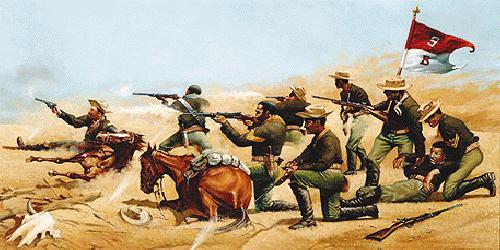
A Braver Set of Men" by Tod Haskins Fredricks
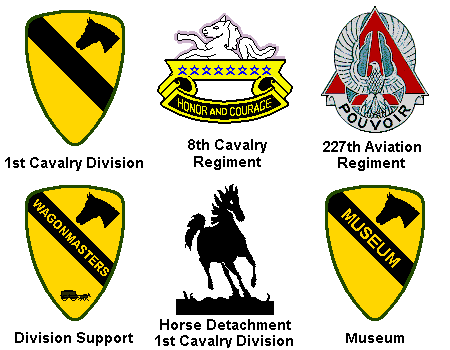
Regimental Distinctive Unit Insignia
Introduction
The 1st Cavalry Division, a major subordinate command of the US Third Mobile
Armored Corps, is a 19,000 soldier, heavy armored division stationed at Ft.
Hood, TX. As one of the two "on-call" heavy contingency force divisions of the
Army, the First Team has an on-order mission to deploy by sea, air or land to
any part of the world on a short notice. The following narratives, divided in
timeline eras of major operational missions, describes the threat environment,
tactical conditions, evolution of equipment technology and the strategic
methodology employed by one of its subordinate units, the 9th Cavalry
Regiment, to contribute to the successful missions and enhancement of the
warring organization of the 1st Cavalry Division.
Mission:
The mission of the 9th Cavalry Regiment is to deploy to a designated
contingency area of operations and conduct full spectrum operations in support
ith mission of its cognizant Brigade On order, redeploys and prepares for
future operations.
Organizational Summary:
9th and 10th Cavalry Histories
This video clip summarizes the background of the organization and history
of the 9th and 10th Cavalry Regiments. At the end of the Civil War, the ranks
of the Regular cavalry regiments were thin indeed, as were those of the other
Regular regiments. Of the 448 companies of cavalry, infantry, and artillery
authorized, 153 were not organized, and few, if any, of those in being were
at full strength. By the early summer of1866, this shortage had eased since
many of the members of the disbanded Volunteer outfits had by then enlisted as
Regulars. By that time, however, it became apparent in Washington that the
Army, even at full strength, was not large enough to perform its duties.
When Congress reorganized the peacetime regular army on 28 July, 1866, it had
taken the above situation into account. It also recognized the military merits
of black soldiers by authorizing two segregated regiments of black cavalry,
the Ninth United States Cavalry and the Tenth United States Cavalry and the
24th, 25th , 38th , 39th, 40th and 41st Infantry Regiments. Orders were given
to transfer the troops to the western war arena, where they would join the
army's fight with the Indians.
Cavalry companies accounted for 20 percent of the total number of company
sized organizations. The Regular Army's authorized strength of approximately
57,000 officers and men was then more than double what it had been at the
close of the war. The whole arrangement was remarkable because it was the
first time in the nation's history that the Regular establishment had been
increased substantially immediately after a war. Recruiting, to obtain the
increase in man power force levels, began at once. Emphasis was placed upon
securing veteran Volunteers before they left the service. The officers were
selected from both Volunteers and Regulars; each candidate was required to
have had at last two years of honorable service in the Civil War.
The new cavalry regiments, numbered 9th, and 10th, were organized under the
same tables as the 6 already in existence. A regiment consisted of 12
companies formed into 3 squadrons of 4 companies each. Besides the commanding
officer who was a colonel, the regimental staff included 7 officers, 6
enlisted men, a surgeon, and 2 assistant surgeons. Each company was authorized
4 officers, 15 noncommissioned officers, and 72 privates. A civilian
veterinarian accompanied the regiment although he was not included in the
table of organization.
On 28 July 1866, the 9th Cavalry Regiment, currently represented in the 2nd,
3rd and 4th Combat Brigades of the 1st Cavalry Division, Fort Hood, Texas was
constituted in the Regular Army. On 03 August 1866, General Phillip Sheridan,
commander of the Military Division of the Gulf, was authorized to raise one
regiment of African-American cavalry that was to be designated the 9th Cavalry
Regiment. The regiment was organized 21 September 1866, at Greenville,
Louisiana. with Col. Edward Hatch, a brevet Major General by the close of the
Civil War, commanding. The 9th Cavalry was ordered to Texas in June of 1867.
There it was charged with protecting stage and mail routes, building and
maintaining forts, and establishing law and order in a vast area full of
outlaws, Mexican revolutionaries, and raiding Comanches, Cheyennes, Kiowas and
Apaches.
The early history of 9th Cavalry Regiment was closely tied to the movement of
people and trade on the western plains and along the Mexican Border. These
routes, a result of perceived "manifest destiny", extended the domination of
the United States into the far reaches of a largely unsettled western plains
and southwestern territories. More and more wagon trains loaded with settlers,
rolling west, were being attacked by Indians. The Army, having large areas of
territory to protect, established a number of military posts at strategic
locations throughout the west.
The current capability of the 9th Cavalry Regiment has been developed in
conjunction with the long history of the 1st Cavalry Division. It is the
combination of the experienced training received by each dedicated member of
the Team and adherence to the performance level and traditions of the past.
Highlights of the many subsequent historical critical missions performed by
members of the 9th Cavalry Regiment and the honors they achieved are
summarized in the chapters that follow:
On 22 January 1921 the 1st Cavalry Division was constituted in the US Regular
Army. On 13 September 1921, with the initiation of the National Defense Act,
the 1st Cavalry Division was formally activated at Ft. Bliss, TX and Major
General Robert Lee Howze, a Texas native from Rusk County and seasoned veteran
of then Frontier Indian Wars, Spanish American War, Philippines Insurrection,
Mexican Expedition, World War I and recipient of the Medal of Honor, was
selected as its first Division Commander.
Upon formal activation, the 7th, 8th and 10th Cavalry Regiments were assigned
to the new Division. With almost a century of service behind the oldest of its
regiments and sixty five years of service for its youngest, the units that had
already ridden and fought its way into the pages of history were organized
into the newly formed divisional structure. The four regiments were now to
fight side by side. Other units initially assigned to the 1st Cavalry Division
in 1921 included the 1st and 2nd Machine Gun Squadrons, Weapons Troops, 10th
Light Tank Company, 13th Signal Troop, 15th Veterinary Company, 27th Ordnance
Company, 43rd Ambulance Company, 82nd Field Artillery Battalion (Horse) and
the 1st Cavalry Quartermaster Trains which later was redesignated as the 15th
Replacement Company.
Later, on 18 December 1922, the 5th Cavalry Regiment was assigned to the 1st
Cavalry Division, relieving the 10th Cavalry Regiment. It would not be until
03 January 1933 that the 12th Cavalry Regiment, organized in 1901, would join
the 1st Cavalry Division, relieving the 1st Cavalry Regiment.
On 15 October, 1957, the 1st Squadron, 9th Cavalry was organized using
elements of "A" Troop, 9th Cavalry Regiment that were consolidated with the
16th Reconnaissance Company (previously designated as the 302nd Mechanized
Cavalry Reconnaissance Troop, 1st Cavalry Division.) to form the 1st
Reconnaissance Squadron, 9th Cavalry Regiment. The unit formally joined the
Division in ceremonies held in Tonggu, Korea when the colors of the 24th
Infantry Division were retired and replaced by those of the 1st Cavalry
Division.
Concurrent with the 1st Cavalry Division's reorganization as a Pentomic
Division in Korea, the 4th Cavalry Regiment, the last of the old frontier
cavalry maneuvering units, joined the 1st Cavalry Division as the 2nd Battle
Group, 4th Cavalry, (an element) of the Pentomic Division
As of today, the 9th Cavalry Regiment is currently represented by the
following active Units:
The 1st Squadron, organized as an Armed Reconnaissance Squadron,
is assigned to the 4th Brigade Combat Team of the 1st Cavalry
Division, stationed at Fort Hood, Texas.
The 4th Squadron, organized as an Armed Reconnaissance Squadron,
is assigned to the 2nd Brigade Combat Team of the 1st Cavalry
Division, stationed at Fort Hood, Texas.
The 6th Squadron, organized as an Armed Reconnaissance Squadron,
is assigned to the 3rd Brigade Combat Team of the 1st Cavalry
Division, stationed at Fort Hood, Texas.
This folio of material highlights of the many subsequent historical critical
missions performed by members of the 9th Cavalry Regiment, whose actions,
operations and the many critical issues resolved over its 143 year history to
meet the changing threat and the honors they achieved are summarized in the
following sections:
If none of the data that you have found by surfing the reference unit chapter
titles and indexes measures up to your interests, you may want to deploy the
R&S (Reconnaissance and Surveillance) Scouts to search and identify keywords
or subjects within individual unit pages. Enter the descriptive keyword or
search terms(s) in the input field and "Click" on the Search button to screen the multiple DataBases of
the Cavalry OutPost and the garrisoned occupants - "The 1st Cavalry Division
and its Subordinate Units".
The search action will open the "first-team.us WebSite - R&S Scout Report",
which displays a listing of WebSite Titles and HTML Summaries that contain the
specific search term(s) of interest. To review any that best depicts a match
of your search term(s), "Click" on the WebSite Title to open a New Window.
After the WebSite is fully loaded, use the browser [EDIT/Find] Tool Button to
locate the search term within the page. After reviewing, close the New Window
to return to the listing of WebSites.
If this is your first review of the Outpost of the 1st Cavalry Division and
its Subordinate Units, you may want to record your own report on your findings
during your visit, or perhaps you may want to review the log entries of other
visitors.
To report on your findings,
"click" on the "Report-In"
Index Tab of the Troop Log.
To review entries of others,
"Click"on the "View Entries"
Index Tab of the Troop Log.
As you journey through the history of the 1st Cavalry Division and its
assigned elements, you may find it interesting enough to send a message to
your friends and extend them an invitation for the opportunity to review the
rich history of the Division. We have made it easy for you to do. All that is
required is for you to click on the Push Button below, fill in their eMail
addresses and send.
The TITLE and URL of this WebSite are automatically read, formatted
and entered into your standard eMail form.
Note - The eMail Message is processed and transmitted On-Line to the
addressee(s) via your Internet Provider.


 Introduction














 Copyright © 1996, Cavalry Outpost Publications ® and
Trooper Wm. H. Boudreau, "F" Troop, 8th Cavalry Regiment (1946 - 1947). All
rights to this body of work are reserved and are not in the public domain, or
as noted in the bibliography. Reproduction, or transfer by electronic means,
of the History of the 1st Cavalry Division, the subordinate units or any
internal element, is not permitted without prior authorization. Readers are
encouraged to link to any of the pages of this Web site, provided that proper
acknowledgment attributing to the source of the data is made. The information
or content of the material contained herein is subject to change without
notice.
Copyright © 1996, Cavalry Outpost Publications ® and
Trooper Wm. H. Boudreau, "F" Troop, 8th Cavalry Regiment (1946 - 1947). All
rights to this body of work are reserved and are not in the public domain, or
as noted in the bibliography. Reproduction, or transfer by electronic means,
of the History of the 1st Cavalry Division, the subordinate units or any
internal element, is not permitted without prior authorization. Readers are
encouraged to link to any of the pages of this Web site, provided that proper
acknowledgment attributing to the source of the data is made. The information
or content of the material contained herein is subject to change without
notice.