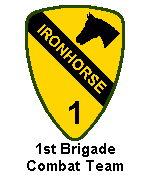
1st Brigade Combat Team
1st Cavalry Division
Heraldic Items
"IronHorse"


Heraldic Activity

 Military heraldic symbols have been used in the US military since the American
Revolution. But it was not until 1919 that the heraldry activity was
established as a separate function within the Army. This action, was in
response to a 17 June 1918 letter from President Woodrow Wilson, requesting a
higher quality of design and workmanship in new military medals. Colonel
Robert E. Wyllie, was made responsible for military heraldry. He established
general rules and regulations that governed design of heraldic items.
Military heraldic symbols have been used in the US military since the American
Revolution. But it was not until 1919 that the heraldry activity was
established as a separate function within the Army. This action, was in
response to a 17 June 1918 letter from President Woodrow Wilson, requesting a
higher quality of design and workmanship in new military medals. Colonel
Robert E. Wyllie, was made responsible for military heraldry. He established
general rules and regulations that governed design of heraldic items.
Coat of Arms
In 1920 the Army officially adopted heraldic coats of arms for units. This
originated the use of distinctive unit insignia (more commonly called unit
crests) to identify an individual soldier with his regiment. The purpose was
to foster Army tradition and esprit de corps. The first unit to wear such an
insignia was the 51st Artillery, Coast Artillery Corps which received approval
from the War Department on 18 March 1922.
QM Corps Assumes Responsibility
By 1924, heraldic responsibility was delegated to the Quartermaster General.
The Heraldic Section of the Office of the Quartermaster General was made
responsible for the research, design and development of distinctive unit
insignia, shoulder sleeve insignia (patches), flags, medals, seals, coats of
arms and other heraldic items for the Army.
The Heraldic Section painstakingly performed historical research of unit
histories to determine design and redesign of coats of arms and distinctive
unit insignia. It was also responsible for ensuring quality control of the
manufacture of the insignia that it had designed. The Heraldic Section
assisted the manufacturer in meeting its stringent specifications by
inspecting all models and dies and requiring samples of completed work. Before
final acceptance, the design and prototype were approved by the Quartermaster
General.
World War II
Under the direction of its chief, Mr. Arthur E. Du Bois, the Heraldic Section
created hundreds of new insignia and several medals to meet the requirements
of a quickly expanding of the Army in World War II. Du Bois simply stated the
reason for military insignia in a 1943 National Geographic article, "These
devices are sources of pride in oneself and in one's organization. From this
pride springs discipline; not discipline born of necessity and fear, but that
which essentially is self-discipline, the essence of respect for self, for
service, for country."
Post World War II
In 1949, the Munitions Board, acting for the Army, Navy and Air Force,
directed that the Army provide heraldic services to the military departments
and other branches of the federal government. Staffing of the Heraldic Section
and later the Institute of Heraldry, was (and still is) almost exclusively
civilian.
Institute of Heraldry is Born
On 10 August 1960, Army General Order Number 29 established the US Army
Institute of Heraldry under the control of the Quartermaster General. The
Institute of Heraldry became the only organization within the government
devoted to the science and art of military heraldry and other official
symbolism. It provides heraldic services to the Department of Defense and
other government agencies.
In 1987, the US Total Army Personnel Command became custodian of the Institute
of Heraldry. In April 1994, the Institute of Heraldry moved from Cameron
Station to Fort Belvoir, Virginia, a military installation within the
metropolitan area of Washington, DC.

Headquarters, 1st Brigade Combat Team
Heraldic Items |
|---|
|
|---|
|
Division Distinctive Unit Insignia
Distinctive Unit Insignia.
- Policy: The Distinctive Unit Insignia (DUI) of Headquarters, 1st
Brigade Combat Team, 1st Cavalry Division shall be the same design
approved and as worn by all the other non color bearing direct
subordinate units of the Division.
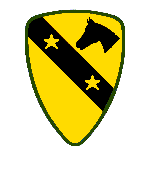
- Description: A metal and enameled device 1 inch (2.54 cm) in height
overall consisting of a gold colored Norman shield with a black
horse's head couped in sinister chief, and a black bend charged
with two five-pointed stars.
- Symbolism: The device is a miniature reproduction of the 1st
Cavalry Division's shoulder sleeve insignia with the addition of
two five-pointed stars. The Division Commander and the Division
Staff wore the distinctive insignia design from 1922 to 1934 as a
shoulder sleeve insignia.
- Background: The distinctive unit insignia was originally approved
for the 1st Cavalry Division on 25 August 1965. It was
redesignated for the 1st Air Cavalry Division on 05 August 1968.
It was redesignated for the 1st Cavalry Division (Airmobile) on
10 September 1968. The insignia was redesignated for the 1st
Cavalry Division on 24 May 1971.
|
1st Cavalry Division Shoulder Sleeve Insignia |
|---|
|
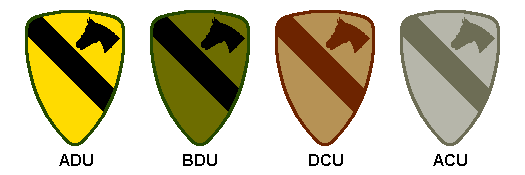 |
|---|
| 1st Cavalry Division Shoulder Sleeve Insignia Styles |
|---|
Shoulder Sleeve Insignia
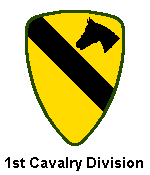
- Description: On a yellow triangular Norman shield with rounded
corners 5 1/4 inches (13.34 cm) in height overall, a black diagonal
stripe extending over the shield from upper left to lower right and in
the upper right a black horse's head cut off diagonally at the neck
all within a 1/8 inch (.32 cm) green border.
- Symbolism: The color yellow, the traditional Cavalry color, and
the horse's head refer to the Division's original Cavalry
structure. Black, symbolic of iron, alludes to the transition to
tanks and armor. The black diagonal stripe represents a sword
baldric and is a mark of military honor; it also implies movement
"up the field" and thus symbolizes aggressive élan and attack. The
one diagonal bend, as well as the one horse's head, also alludes
to the Division's numerical designation.
- Background: The shoulder sleeve insignia was originally approved
for the 1st Cavalry Division on 03 January 1921, with several
variations in colors of the bend and horse's head to reflect the
subordinate elements of the division. The current design was
authorized for wear by all subordinate elements of the Division on
11 December 1934, and previous authorization for the variations
was cancelled. The insignia was redesignated for the 1st Air
Cavalry Division on 05 August 1968. It was redesignated for 1st
Cavalry Division (Airmobile) on 10 September 1968. The insignia
was redesignated for the 1st Cavalry Division on 24 May 1971.
The United States Army Shoulder Sleeve Insignia (SSI) or shoulder
patch is a cloth heraldic device that uniquely identifies each major
US Army formation. The Shoulder Sleeve Insignia is worn on the left
upper arm, just below the shoulder seam of the uniform on all but the
Army Combat Uniform (ACU). On the Army Combat Uniform the Shoulder
Sleeve Insignia is attached to a Velcro backing and is then attached,
centered on a rectangle of Velcro on the arm.
Those soldiers who are combat veterans are authorized permanent wear
of their Shoulder Sleeve Insignia, earned during combat, on their
right shoulder. This shoulder sleeve insignia recognizes "former
wartime service" and is frequently called a "combat patch". The
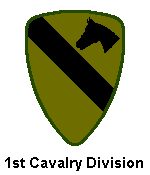
Shoulder Sleeve Insignia currently issued in four basic color
combinations:
- Full Color (SunSet Gold/Black) - Worn on the Army Dress Uniform
(ADU).
- Jungle Subdued (Green/Black) - Worn on the Battle Dress Uniform
(BDU).
- Desert Subdued (Tan/Brown) - Worn on the Desert Camouflage Uniform
(DCU).
- Subdued (Foliage Green/Gray) - Worn on the Army Combat Uniform
(ACU).
The Shoulder Sleeve Insignia (SSI) of the 1st Cavalry Division has a
history as colorful as its design, reflecting the proud heritage of the
United States Cavalry in a timeless manner.
The insignia selected for the First Team patch was designed by Colonel
and Mrs. Ben Dorcy. The Colonel was then commander of the 7th Cavalry
Regiment at Fort Bliss, Texas. Mrs. Dorcy related that the combination
of the golden sunset at Fort Bliss and the traditional colors of the
Cavalry; blue and yellow, were a great influence on the background
color and the insignia. The choice of the horse's head for the insignia
was made by the family after they observed a mounted trooper ride by
their home on a beautiful blue-black thoroughbred. Later, to improve
visibility, the color scheme was modified replacing the blue for
black, the symbolic color of iron and armor.
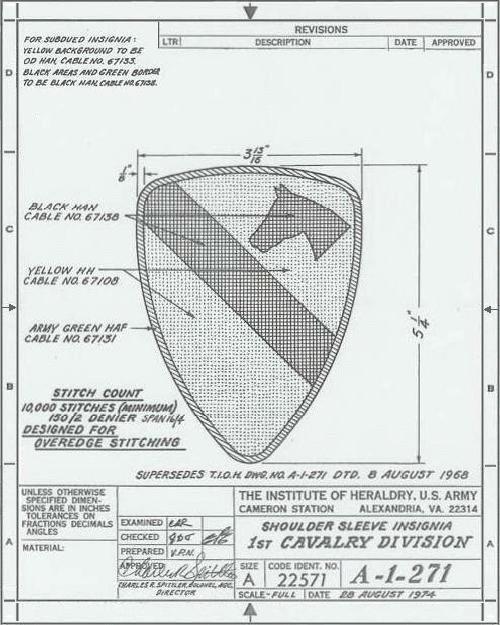
On a "sunset" yellow triangular Norman Shield with rounded corners
5 1/4 inches in height, a black diagonal stripe extends over the
shield from upper left to the lower right. In the upper right, a black
horse's head cut off diagonally at the neck, appears within 1/8 inches
of an Army Green border. The traditional Cavalry color of yellow and
the horse's head is symbolic of the original organizational structure
of the Cavalry. The color black is symbolic of iron, alluding to the
organizational transition from mounted horses to tanks and heavy
armor. The black stripe, in heraldry termed a "Sable Bend", represents
a "baldric" (a standard Army issue belt worn over the right shoulder
to the opposite hip - sometimes referred to as a "Sam Browne belt")
which retains either a scabbard which sheaths the trooper's saber or
revolver holster. |
1st Cavalry Division Combat Shoulder Sleeve Insignia |
|---|
|
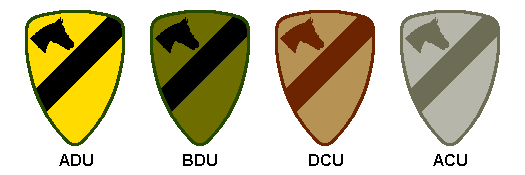 |
|---|
| 1st Cavalry Division Combat Shoulder Sleeve Insignia |
|---|
Combat Shoulder Sleeve Insignia
During the Vietnam engagements, the "sunset yellow" field of the patch
was changed to a subdued Olive Drab (OD) green/black for the Battle
Dress Uniform (BDU) in order to minimize targeting of personnel. For
operations in desert environments, the field of the patch was again
changed to a tan (Khaki) color and the emblazoned, "Sable" black
charge elements was changed to saddle brown (Spice) so that the
contrast against the Desert Camouflage Uniform (DCU) was minimized.
More recently, in the deployment to Iraq and with the introduction of
new Army Combat Uniform (ACU), field of the patch was changed to
"Foliage/Green" and the charge elements were changed to Gray.
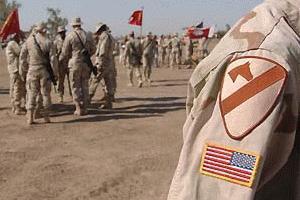 |
|---|
| 1st CD Shoulder Sleeve Combat Patch |
|---|
| |
|---|
On 04 July 2004 when all of the elements and attached units of the
1st Cavalry Division deployed in Operation IRAQI FREEDOM II were
recognized for their first 90 days of combat service in a special
ceremony, the Division broke tradition, designed and issued a new
shoulder patch to be worn on the individuals right sleeve.
The 1st Cavalry Division Combat Patch is a "mirror image" of the
Division patch in that the silhouette of the horse head and diagonal
line across the gold background was reversed so it points forward when
worn on the right arm of the uniform. It is the same concept as
utilized to display the US flag when worn on the right arm, in that
the field of stars of the flag is positioned in the upper right-hand
corner of the patch. It may look backwards, but the flag billowing
toward the back of a soldier indicates he is always advancing, never
retreating. |
1st Cavalry Division Combat Distinctive Service Identification Badge |
|---|
|
Recently, the official status of the "reversed patch" has come into
question and currently the combat patch has reverted to the original
patch design (not reversed). Meantime, those who were issued the
"reversed design", proudly wear them on their uniforms.
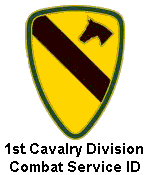 |
|---|
| "First-Team" |
|---|
Description: The new insignia design currently authorized by the
Institute of Heraldry is a gold color metal and enamel device 2 inches
(5.08 cm) in height embodying a design similar to that of the shoulder
sleeve insignia. |
1st Cavalry Division Shoulder Sleeve Insignia Design |
|---|
|
Otherwise, other than the mirrored (reversed) image for combat
operations the patch has not changed in way from the original design
and shape. Occasionally, an unauthorized supplier of the 1st Cavalry
patch makes a design that does not conform with the geometry of the
patch design and measures are taken to remove it from the market. The
design, as authorized by the Institute of Heraldry, is shown below:
 |
|---|
| 1st Cavalry Division Shoulder Sleeve Insignia Design |
|---|
|




 eMail Your WebSite Comments.

Return to 1st Cavalry Division Organization.

Copyright © 1996, Cavalry Outpost Publications ® and
Trooper Wm. H. Boudreau, "F" Troop, 8th Cavalry Regiment (1946 - 1947). All
rights to this body of work are reserved and are not in the public domain, or
as noted in the bibliography. Reproduction, or transfer by electronic means,
of the History of the 1st Cavalry Division, the subordinate units or any
internal element, is not permitted without prior authorization. Readers are
encouraged to link to any of the pages of this Web site, provided that proper
acknowledgment attributing to the source of the data is made. The information
or content of the material contained herein is subject to change without
notice.
Revised 18 Aug '11 SpellChecked